 VIPSolutions
Give step-by-step solution with explanation and final answer:Each graph in Figure 7.26 represents the graph of a potential function P(x). In each case, sketch the phase plane for the system x + f(x) = 0, where f(x) = P'(x). Identify the equilibria and discuss their stability. \ \ ~~ Xy x; X X x x (a) (b) Figure 7.26 Potential functions for Exercise 7.10. In part (b), P/(x;) = 0.
Question:
Give step-by-step solution with explanation and final answer:
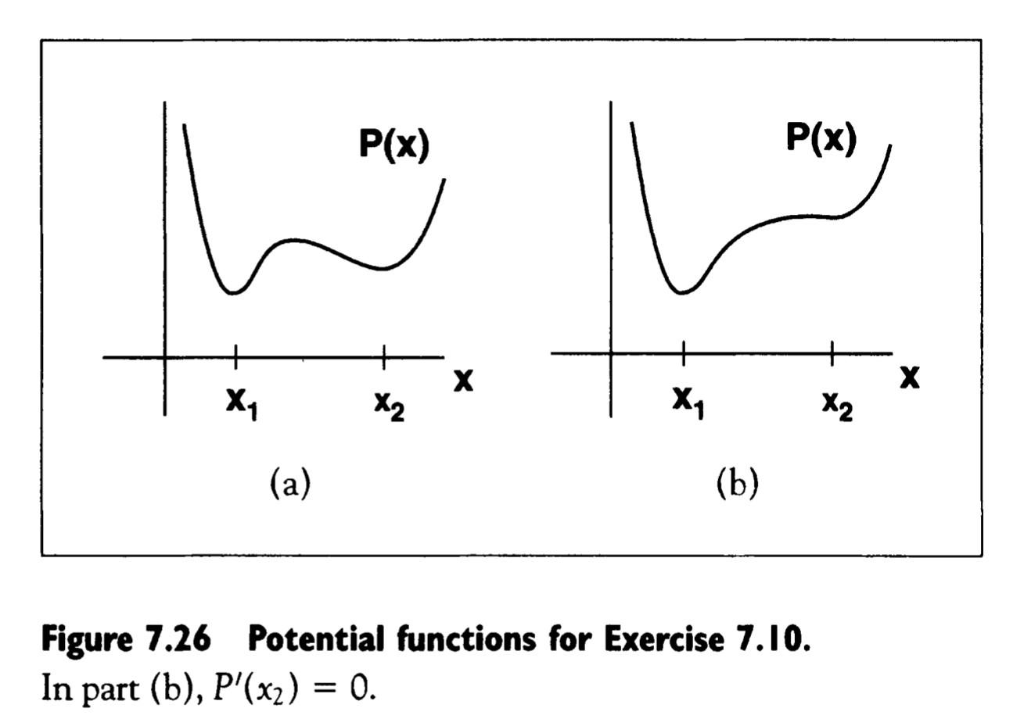 Each graph in Figure 7.26 represents the graph of a potential function P(x). In
each case, sketch the phase plane for the system x + f(x) = 0, where f(x) = P'(x).
Identify the equilibria and discuss their stability.
\ \ ~~
Xy x; X X x x
(a) (b)
Figure 7.26 Potential functions for Exercise 7.10.
In part (b), P/(x;) = 0.
This is AI generated Response.
Asked by: gvr
Created at: 2025-07-30 09:39:10
Asked by: gvr
Created at: 2025-07-30 09:39:10
Final Answer:
Rendered
Raw Text
Did you like this answer?
Let’s work through the problem step by step for both parts (a) and (b):
## **Given**
- \( \ddot{x} + f(x) = 0 \), where \( f(x) = P'(x) \).
- \( P(x) \) is the potential function (see provided graphs).
## **Phase Plane Sketching**
Let \( x_1 = x \), \( x_2 = \dot{x} \).
Then, the system becomes:
\[
\dot{x}_1 = x_2 \\
\dot{x}_2 = -f(x_1) = -P'(x_1)
\]
The phase plane is the \( (x_1, x_2) \) plane.
---
## **Step 1: Find Equilibria**
Equilibrium points occur when \( \dot{x}_1 = 0 \) and \( \dot{x}_2 = 0 \).
So, \( x_2 = 0 \) and \( P'(x_1) = 0 \).
From the graphs:
- **Equilibria:** all points where the slope of \( P(x) \) is zero (local minima, maxima, or inflection points).
---
## **Step 2: Stability Analysis**
Use the shape of \( P(x) \):
- **Local Minimum:** stable equilibrium (center)
- **Local Maximum:** unstable equilibrium (saddle)
---
## **Step 3: Analyze and Sketch Each Case**
### **(a)**
- **Graph:** \( P(x) \) has two minima (at \( x_1 \) and right of \( x_2 \)), one maximum (between \( x_1 \) and \( x_2 \)).
- **Equilibria:** At each minimum and maximum (where \( P'(x) = 0 \)).
- At \( x_1 \): local minimum → **stable**
- At \( x_2 \): local maximum → **unstable**
- Rightmost minimum: **stable**
- **Phase Plane Sketch:**
- **Around minima:** Closed orbits (energy conservation).
- **Around maxima:** Separatrix (trajectories approach and then depart from the saddle).
#### **Stability:**
- **Minima:** Centers (stable, not asymptotically because there's no friction).
- **Maxima:** Saddles (unstable).
---
### **(b)**
- **Graph:** \( P(x) \) has a minimum at \( x_1 \), an inflection at \( x_2 \) (\( P'(x_2) = 0 \) and \( P''(x_2) = 0 \)), and then increases.
- **Equilibria:** At \( x_1 \) (minimum, stable) and \( x_2 \) (inflection, neutral).
- At \( x_1 \): **stable**
- At \( x_2 \): **neutral/stability indeterminate** (higher order analysis needed).
- **Phase Plane Sketch:**
- **Around \( x_1 \):** Closed orbits.
- **Around \( x_2 \):** Behavior determined by higher derivatives. Trajectories can pass through or be repelled/attracted depending on the nonlinear terms.
#### **Stability:**
- **\( x_1 \):** Center (stable).
- **\( x_2 \):** *Typically unstable or semi-stable* (since it's a flat inflection, small perturbations may move the system away).
---
## **Summary Table**
| Point | Type | Stability (a) | Stability (b) |
|------------|------------------|---------------|---------------|
| \( x_1 \) | Local minimum | Stable | Stable |
| \( x_2 \) | Local maximum | Unstable | Inflection (neutral/unstable) |
---
## **Final Answers**
### **(a)**
- **Equilibria:** At \( x_1 \) (min), \( x_2 \) (max), and rightmost min.
- **Stability:** Minima are stable (centers), maximum is unstable (saddle).
- **Phase plane:** Closed orbits around minima, separatrix through the saddle.
### **(b)**
- **Equilibria:** At \( x_1 \) (min), \( x_2 \) (inflection).
- **Stability:** \( x_1 \) is stable (center), \( x_2 \) is typically unstable or indeterminate (needs higher order analysis).
- **Phase plane:** Closed orbits around \( x_1 \), complex behavior near \( x_2 \).
---
## **How to Sketch the Phase Plane**
- Plot \( x \) vs. \( \dot{x} \).
- Draw closed orbits around minima.
- Draw separatrices (trajectories that approach and depart the saddle) at maxima.
- At inflection, indicate possible instability or "flat" behavior.
Let me know if you want explicit sketches!
📢 Instructions:
- Ask anything relatd to above question only.
- For new Question goto :