 VIPSolutions
Give step-by-step solution with explanation and final answer:a. Use trigonometric substitution to evaluate the integral \int (\sart(x * (2) - 1))/( x)dx b. In the table of integrals, we found that \int (\sart(u » (2) -a* (2)))/(u)du =\sart(u* (2) -a~ (2)) -acos » ( - 1)((a)/(lul)) + C and in another \int (\sart(u ~(2)-a~(2))/(u)du = \sart(u* (2) -a* (2) -asec > (-1)((lu)/(2)) + C How would you reconcile these two answers? . Use either integral in part (b) to evaluate the integral \int \sart(e * (2x) - 6)dx
Question:
Give step-by-step solution with explanation and final answer: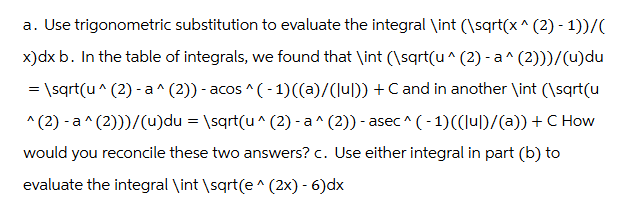 a. Use trigonometric substitution to evaluate the integral \int (\sart(x * (2) - 1))/(
x)dx b. In the table of integrals, we found that \int (\sart(u » (2) -a* (2)))/(u)du
=\sart(u* (2) -a~ (2)) -acos » ( - 1)((a)/(lul)) + C and in another \int (\sart(u
~(2)-a~(2))/(u)du = \sart(u* (2) -a* (2) -asec > (-1)((lu)/(2)) + C How
would you reconcile these two answers? . Use either integral in part (b) to
evaluate the integral \int \sart(e * (2x) - 6)dx
This is AI generated Response.
Asked by: gvr
Created at: 2025-07-30 08:46:05
Asked by: gvr
Created at: 2025-07-30 08:46:05
Final Answer:
Rendered
Raw Text
Did you like this answer?
Let's solve each part step-by-step:
---
### **a. Trigonometric substitution for \(\int \frac{\sqrt{x^2-1}}{x} dx\)**
#### **Step 1: Let \( x = \sec\theta \)**
- Then \( dx = \sec\theta\tan\theta d\theta \)
- \( x^2 - 1 = \sec^2\theta - 1 = \tan^2\theta \)
- \( \sqrt{x^2-1} = \tan\theta \)
So, substitute into the integral:
\[
\int \frac{\sqrt{x^2-1}}{x} dx = \int \frac{\tan\theta}{\sec\theta} \cdot \sec\theta\tan\theta d\theta
\]
\[
= \int \tan^2\theta d\theta
\]
#### **Step 2: Simplify \(\tan^2\theta\)**
\[
\int \tan^2\theta d\theta = \int (\sec^2\theta - 1) d\theta
= \int \sec^2\theta d\theta - \int d\theta
= \tan\theta - \theta + C
\]
#### **Step 3: Convert back to \(x\)**
Recall:
- \( x = \sec\theta \implies \theta = \arcsec(x) \)
- \( \tan\theta = \sqrt{x^2-1} \) (since \( \tan^2\theta = x^2-1 \) and \( x > 1 \))
So,
\[
\boxed{
\int \frac{\sqrt{x^2-1}}{x} dx = \sqrt{x^2-1} - \arcsec(x) + C
}
\]
---
### **b. Reconciling the Two Answers**
From the table:
- \( \int \frac{\sqrt{u^2-a^2}}{u} du = \sqrt{u^2-a^2} - \arccos\left(\frac{a}{|u|}\right) + C \)
- \( \int \frac{\sqrt{u^2-a^2}}{u} du = \sqrt{u^2-a^2} - \arcsec\left(\frac{|u|}{a}\right) + C \)
Recall the identity for \( u > 0 \) and \( u \geq a \):
\[
\arcsec\left(\frac{u}{a}\right) = \arccos\left(\frac{a}{u}\right)
\]
Thus, the two answers are equivalent; they just use different inverse trigonometric functions but express the same value.
---
### **c. Evaluate \(\int \sqrt{e^{2x}-6} dx\)**
Let’s use the formula from (b) with \( u = e^x \), \( a = \sqrt{6} \):
\[
\int \sqrt{e^{2x}-6} dx = \int \frac{\sqrt{u^2-6}}{u} du \qquad (du = e^x dx \implies dx = \frac{du}{u})
\]
But we actually have:
\[
\sqrt{e^{2x}-6} = \sqrt{(e^x)^2-6}
\]
But let's try substitution directly:
Let \( u = e^x \implies du = e^x dx \implies dx = \frac{du}{u} \)
So,
\[
\int \sqrt{e^{2x}-6} dx = \int \sqrt{u^2-6} \cdot \frac{du}{u}
= \int \frac{\sqrt{u^2-6}}{u} du
\]
Now use the result from part (b) with \( a = \sqrt{6} \):
\[
\int \frac{\sqrt{u^2-6}}{u} du = \sqrt{u^2-6} - \arcsec\left(\frac{u}{\sqrt{6}}\right) + C
\]
Substitute back \( u = e^x \):
\[
\boxed{
\int \sqrt{e^{2x}-6} dx = \sqrt{e^{2x}-6} - \arcsec\left(\frac{e^x}{\sqrt{6}}\right) + C
}
\]
---
## **Summary of Answers**
1. **(a)** \( \int \frac{\sqrt{x^2-1}}{x} dx = \sqrt{x^2-1} - \arcsec(x) + C \)
2. **(b)** The answers are equivalent because \( \arcsec(u/a) = \arccos(a/u) \) for \( u > 0 \).
3. **(c)** \( \int \sqrt{e^{2x}-6} dx = \sqrt{e^{2x}-6} - \arcsec\left(\frac{e^x}{\sqrt{6}}\right) + C \)
Question:
i need step by step detailed calculations of each part along with the final answer
This is AI generated Response.
Asked by: gvr
Created at: 2025-07-30 08:47:22
Asked by: gvr
Created at: 2025-07-30 08:47:22
Final Answer:
Rendered
Raw Text
Did you like this answer?
Let's carefully work through each part of the problem step-by-step, providing detailed explanations and calculations.
---
## **Part (a): Use trigonometric substitution to evaluate \(\displaystyle \int \frac{\sqrt{x^2 - 1}}{x} \, dx\)**
### **Step 1: Recognize the form and choose substitution**
The integrand involves \(\sqrt{x^2 - 1}\), which suggests a substitution involving secant, because:
\[
x = \sec \theta \quad \Rightarrow \quad \sqrt{x^2 - 1} = \sqrt{\sec^2 \theta - 1} = \sqrt{\tan^2 \theta} = |\tan \theta|
\]
Assuming \(x > 1\), then \(\theta \in [0, \pi/2)\), and \(\tan \theta \ge 0\).
---
### **Step 2: Set substitution**
\[
x = \sec \theta \quad \Rightarrow \quad dx = \sec \theta \tan \theta \, d\theta
\]
\[
\sqrt{x^2 - 1} = \tan \theta
\]
Rewrite the integral:
\[
\int \frac{\sqrt{x^2 - 1}}{x} \, dx = \int \frac{\tan \theta}{\sec \theta} \cdot \sec \theta \tan \theta \, d\theta
\]
Simplify numerator and denominator:
\[
\frac{\tan \theta}{\sec \theta} \times \sec \theta \tan \theta = \tan \theta \times \tan \theta = \tan^2 \theta
\]
So, the integral reduces to:
\[
\boxed{
\int \tan^2 \theta \, d\theta
}
\]
---
### **Step 3: Integrate \(\tan^2 \theta\)**
Recall the identity:
\[
\tan^2 \theta = \sec^2 \theta - 1
\]
Thus,
\[
\int \tan^2 \theta \, d\theta = \int (\sec^2 \theta - 1) \, d\theta = \int \sec^2 \theta \, d\theta - \int 1 \, d\theta
\]
We know:
\[
\int \sec^2 \theta \, d\theta = \tan \theta + C
\]
and
\[
\int 1 \, d\theta = \theta + C
\]
Therefore,
\[
\int \tan^2 \theta \, d\theta = \tan \theta - \theta + C
\]
---
### **Step 4: Back-substitute to \(x\)**
Recall:
\[
x = \sec \theta \quad \Rightarrow \quad \theta = \arcsec x
\]
\[
\tan \theta = \sqrt{x^2 - 1}
\]
So, the integral becomes:
\[
\boxed{
\int \frac{\sqrt{x^2 - 1}}{x} \, dx = \sqrt{x^2 - 1} - \arcsec x + C
}
\]
---
## **Part (b): Reconciling the two integral expressions**
Given in the problem:
\[
\int \frac{\sqrt{u^2 - a^2}}{u} \, du = \sqrt{u^2 - a^2} - \arccos \left( \frac{a}{u} \right) + C
\]
and
\[
\int \frac{\sqrt{u^2 - a^2}}{u} \, du = \sqrt{u^2 - a^2} - \arcsec \left( \frac{u}{a} \right) + C
\]
### **How to reconcile this?**
Recall the relationship between \(\arccos\) and \(\arcsec\):
\[
\arcsec y = \arccos \left( \frac{1}{y} \right) \quad \text{for } y \ge 1
\]
Similarly,
\[
\arccos \left( \frac{a}{u} \right) = \arccos \left( \frac{1}{\frac{u}{a}} \right) = \arcsec \left( \frac{u}{a} \right)
\]
**Conclusion:**
\[
\boxed{
\arccos \left( \frac{a}{u} \right) = \arcsec \left( \frac{u}{a} \right)
}
\]
Thus, both expressions are equivalent, differing only by the use of \(\arccos\) versus \(\arcsec\). They are just different inverse trigonometric functions representing the same angle.
---
## **Part (c): Use either integral to evaluate \(\displaystyle \int \sqrt{e^{2x} - 6} \, dx \)**
### **Step 1: Substitution**
Let:
\[
u = e^x \quad \Rightarrow \quad du = e^x dx = u \, dx \quad \Rightarrow \quad dx = \frac{du}{u}
\]
Express the integral in terms of \(u\):
\[
\int \sqrt{u^2 - 6} \, dx = \int \sqrt{u^2 - 6} \times \frac{du}{u} = \int \frac{\sqrt{u^2 - 6}}{u} \, du
\]
### **Step 2: Apply the formula from part (b)**
From part (b), with \( a = \sqrt{6} \):
\[
\int \frac{\sqrt{u^2 - a^2}}{u} \, du = \sqrt{u^2 - a^2} - \arcsec \left( \frac{u}{a} \right) + C
\]
Substitute \(a = \sqrt{6}\):
\[
\int \frac{\sqrt{u^2 - 6}}{u} \, du = \sqrt{u^2 - 6} - \arcsec \left( \frac{u}{\sqrt{6}} \right) + C
\]
### **Step 3: Back-substitute \(u = e^x\)**
\[
\boxed{
\int \sqrt{e^{2x} - 6} \, dx = \sqrt{e^{2x} - 6} - \arcsec \left( \frac{e^x}{\sqrt{6}} \right) + C
}
\]
---
## **Final answers:**
### **(a)**
\[
\boxed{
\int \frac{\sqrt{x^2 - 1}}{x} \, dx = \sqrt{x^2 - 1} - \arcsec x + C
}
\]
### **(b)**
The two integral expressions are equivalent because:
\[
\arccos \left( \frac{a}{u} \right) = \arcsec \left( \frac{u}{a} \right)
\]
They differ only by the choice of inverse trig function, but represent the same angle.
### **(c)**
\[
\boxed{
\int \sqrt{e^{2x} - 6} \, dx = \sqrt{e^{2x} - 6} - \arcsec \left( \frac{e^x}{\sqrt{6}} \right) + C
}
\]
---
**Hope this detailed step-by-step explanation helps clarify each part!**
📢 Instructions:
- Ask anything relatd to above question only.
- For new Question goto :