This is AI generated Response.
Asked by: gvr
Created at: 2025-07-30 07:20:17
Final Answer:
RenderedRaw Text
Did you like this answer?
Let's solve part (b) **step by step**:
### **Given**
We want to minimize the error function:
\[
E(m, b) = \sum_{i=1}^n (y_i - mx_i - b)^2
\]
with respect to \(m\) and \(b\).
We need to find the critical points, i.e., where:
\[
\frac{\partial E}{\partial m} = 0 \quad \text{and} \quad \frac{\partial E}{\partial b} = 0
\]
---
## **Step 1: Compute Partial Derivatives**
### **Partial with respect to \(m\):**
\[
\frac{\partial E}{\partial m} = \frac{\partial}{\partial m} \sum_{i=1}^n (y_i - mx_i - b)^2
\]
Using the chain rule:
\[
= \sum_{i=1}^n 2(y_i - mx_i - b)(-x_i)
\]
\[
= -2 \sum_{i=1}^n x_i (y_i - mx_i - b)
\]
Set this to zero:
\[
-2 \sum_{i=1}^n x_i (y_i - mx_i - b) = 0
\]
\[
\sum_{i=1}^n x_i (y_i - mx_i - b) = 0
\]
---
### **Partial with respect to \(b\):**
\[
\frac{\partial E}{\partial b} = \frac{\partial}{\partial b} \sum_{i=1}^n (y_i - mx_i - b)^2
\]
Using the chain rule:
\[
= \sum_{i=1}^n 2(y_i - mx_i - b)(-1)
\]
\[
= -2 \sum_{i=1}^n (y_i - mx_i - b)
\]
Set this to zero:
\[
-2 \sum_{i=1}^n (y_i - mx_i - b) = 0
\]
\[
\sum_{i=1}^n (y_i - mx_i - b) = 0
\]
---
## **Step 2: Expand and Rearrange Equations**
### **From \(\frac{\partial E}{\partial m} = 0\):**
\[
\sum_{i=1}^n x_i y_i - m \sum_{i=1}^n x_i^2 - b \sum_{i=1}^n x_i = 0
\]
\[
m \sum_{i=1}^n x_i^2 + b \sum_{i=1}^n x_i = \sum_{i=1}^n x_i y_i \tag{1}
\]
---
### **From \(\frac{\partial E}{\partial b} = 0\):**
\[
\sum_{i=1}^n y_i - m \sum_{i=1}^n x_i - b \sum_{i=1}^n 1 = 0
\]
But \(\sum_{i=1}^n 1 = n\):
\[
m \sum_{i=1}^n x_i + b n = \sum_{i=1}^n y_i \tag{2}
\]
---
## **Final System of Equations (as required):**
\[
\boxed{
\begin{aligned}
& m \left(\sum_{i=1}^n x_i^2\right) + b \left( \sum_{i=1}^n x_i \right) = \sum_{i=1}^n x_i y_i \\
& m \left(\sum_{i=1}^n x_i \right) + b n = \sum_{i=1}^n y_i
\end{aligned}
}
\]
---
### **Explanation**
- These are two linear equations in the two unknowns, \(m\) and \(b\). They can be solved using algebra (substitution, elimination, or matrix methods).
- The solution to this system gives the slope and intercept of the **best-fit line** (in the least squares sense).
### **Final Answer**
\[
\boxed{
\begin{aligned}
& m \left(\sum_{i=1}^n x_i^2\right) + b \left( \sum_{i=1}^n x_i \right) = \sum_{i=1}^n x_i y_i \\
& m \left(\sum_{i=1}^n x_i \right) + b n = \sum_{i=1}^n y_i
\end{aligned}
}
\]
These are the normal equations for least squares linear regression.
VIPSolutions focuses on clear, step‑by‑step explanations so you can learn quickly. Whether you need an AI‑generated walkthrough or a short hint to get unstuck, each solution is organized for fast reading and easy review later.
Search similar questions, compare approaches, and bookmark the best answers for revision. Our goal is simple: quick, reliable study help that feels natural—not noisy.
 VIPSolutions
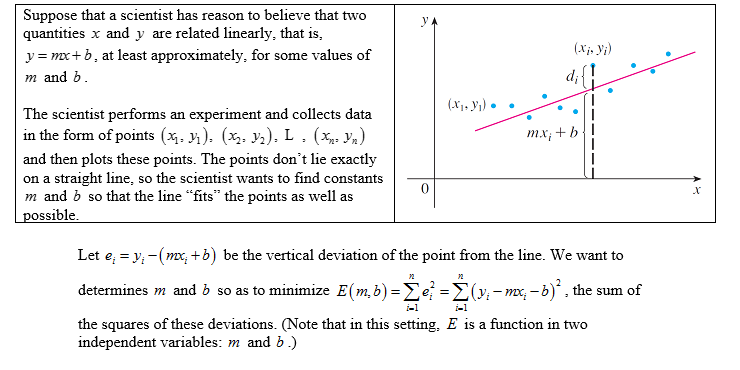
 Suppose that a scientist has reason to believe that two y
quantities x and y are related linearly, that is,
y=noc+ b, at least approximately, for some values of We.
m and b afl
The scientist performs an experiment and collects data tne © ul
in the form of points (x. 34). (x. 32). L + (x. 3) mi +b
and then plots these points. The points don't lie exactly I
ona straight line, so the scientist wants to find constants | —;
m and b so that the line “fits” the points as well as x
possible
Let ¢, =, ~ (mmx, +5) be the vertical deviation of the point from the line. We want to
determines m1 and b so as to minimize E(m,5)=Y.¢} = (v,~mx,~b)’ , the sum of
=
the squares of these deviations. (Note that in this setting, E is a function in two
independent variables: m and 5.)
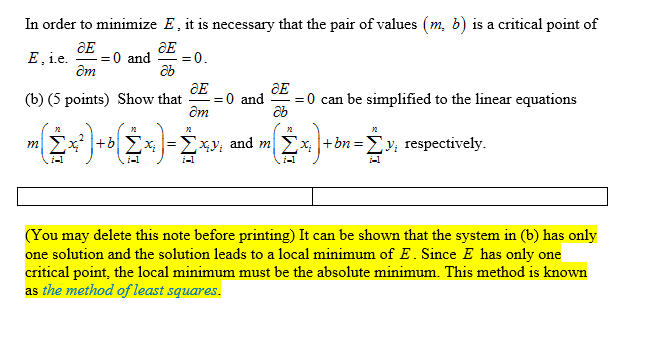
In order to minimize E, it is necessary that the pair of values (m, b) is a critical point of
Eie Eooams Loo
EX @
aE aE
(6) 5 points) Show that = =0 and = =0 can be simplified o the liar equations
m
wl Et)oo{ Bn) Eo and nF feon=5 respectively.
= T= = =