VIPSolutions logo ✨ VIPSolutions

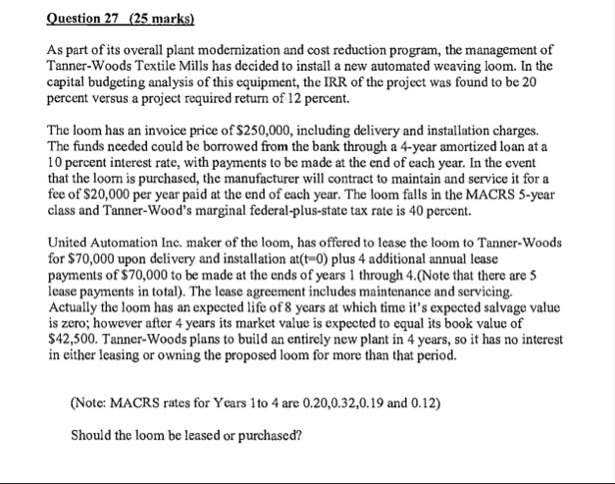
Give step-by-step solution with explanation and final answer:Question 27_(25 marks) As part of ts overall plant modemization and cost reduction program, the management of Tanner-Woods Textile Mills has decided to install a new automated weaving loom. In the capital budgeting analysis of this equipment, the IRR of the project was found to be 20 percent versus a project required return of 12 percent. ‘The loom has an invoice price of $250,000, including delivery and installation charges. ‘The funds needed could be borrowed from the bank through a 4-year amortized loan at a 10 percent interest rate, with payments to be made at the end of each year. In the event that the loom is purchased, the manufacturer will contract to maintain and service it for a fee of $20,000 per year paid at the end of each year. The loom falls in the MACRS S-year class and Tanner-Wood's marginal federal-plus-state tax rate is 40 percent. United Automation Inc. maker of the loom, has offered to lease the loom to Tanner-Woods for $70,000 upon delivery and installation ax(t=0) plus 4 additional annual lease ‘payments of $70,000 to be made at the ends of years 1 through 4. (Note that there are § lease payments in total). The lease agreement includes maintenance and servicing. Actually the loom has an expected life of 8 years at which time it's expected salvage value is zero; however after 4 years its market value is expected to equal its book value of $42,500. Tanner-Woods plans to build an entirely new plant in 4 years, so it has no interest in either leasing or owning the proposed loom for more than that period. (Note: MACRS rates for Years 110 4 arc 0.20,0.32,0.19 and 0.12) Should the loom be leased or purchased?

Question:

Give step-by-step solution with explanation and final answer:Uploaded ImageQuestion 27_(25 marks) As part of ts overall plant modemization and cost reduction program, the management of Tanner-Woods Textile Mills has decided to install a new automated weaving loom. In the capital budgeting analysis of this equipment, the IRR of the project was found to be 20 percent versus a project required return of 12 percent. ‘The loom has an invoice price of $250,000, including delivery and installation charges. ‘The funds needed could be borrowed from the bank through a 4-year amortized loan at a 10 percent interest rate, with payments to be made at the end of each year. In the event that the loom is purchased, the manufacturer will contract to maintain and service it for a fee of $20,000 per year paid at the end of each year. The loom falls in the MACRS S-year class and Tanner-Wood's marginal federal-plus-state tax rate is 40 percent. United Automation Inc. maker of the loom, has offered to lease the loom to Tanner-Woods for $70,000 upon delivery and installation ax(t=0) plus 4 additional annual lease ‘payments of $70,000 to be made at the ends of years 1 through 4. (Note that there are § lease payments in total). The lease agreement includes maintenance and servicing. Actually the loom has an expected life of 8 years at which time it's expected salvage value is zero; however after 4 years its market value is expected to equal its book value of $42,500. Tanner-Woods plans to build an entirely new plant in 4 years, so it has no interest in either leasing or owning the proposed loom for more than that period. (Note: MACRS rates for Years 110 4 arc 0.20,0.32,0.19 and 0.12) Should the loom be leased or purchased?
This is AI generated Response.
Asked by: gvr
Created at: 2025-07-30 07:16:57

Final Answer:

Rendered Raw Text
Did you like this answer?
Let's break this down step-by-step: ## **Step 1: Summarize Key Data** - **Purchase price:** $250,000 (includes delivery/installation) - **Loan:** 4 years, 10% interest, fully amortized - **Maintenance:** $20,000/year (end of each year) - **MACRS (5-year):** 0.20, 0.32, 0.19, 0.12 for Years 1-4 - **Tax rate:** 40% - **Salvage value after 4 years:** $42,500 - **Lease:** $70,000 upfront + $70,000/year for 4 years (5 payments total, includes maintenance) - **Timeframe:** 4 years (Tanner-Woods will not use the loom more than 4 years) ## **Step 2: Compute Annual Loan Payments** - **Loan Amount:** $250,000 - **Interest Rate:** 10% - **Years:** 4 The formula for the annual payment (A) on an amortizing loan: \[ A = \frac{P \cdot r}{1 - (1 + r)^{-n}} \] Where \(P = \$250,000\), \(r = 0.10\), \(n = 4\) \[ A = \frac{250,000 \times 0.10}{1 - (1.10)^{-4}} \] \[ (1.10)^{-4} = 0.6830 \] \[ 1 - 0.6830 = 0.3170 \] \[ A = \frac{25,000}{0.3170} = \$78,857 \] ## **Step 3: Calculate Cash Flows for Purchase Option** ### **Year 0:** - Outflow: $250,000 (purchase) ### **Years 1-4:** - Loan payment: $78,857/year (includes principal & interest) - Maintenance: $20,000/year - Tax shield on depreciation & interest ### **Depreciation via MACRS:** - Year 1: $250,000 × 0.20 = $50,000 - Year 2: $250,000 × 0.32 = $80,000 - Year 3: $250,000 × 0.19 = $47,500 - Year 4: $250,000 × 0.12 = $30,000 ### **Interest Portion of Loan Payments:** We need to calculate interest for each year (declines as principal is repaid). Let's calculate outstanding principal and interest for each year: #### **Amortization Schedule** - Year 0: $250,000 - Year 1: Interest = $250,000 × 10% = $25,000; Principal repaid = $78,857 - $25,000 = $53,857; Remaining principal: $250,000 - $53,857 = $196,143 - Year 2: Interest = $196,143 × 10% = $19,614; Principal repaid = $78,857 - $19,614 = $59,243; Remaining principal: $196,143 - $59,243 = $136,900 - Year 3: Interest = $136,900 × 10% = $13,690; Principal repaid = $78,857 - $13,690 = $65,167; Remaining principal: $136,900 - $65,167 = $71,733 - Year 4: Interest = $71,733 × 10% = $7,173; Principal repaid = $78,857 - $7,173 = $71,684; Remaining principal: $71,733 - $71,684 = $49 ### **Tax Shields:** - Depreciation tax shield: Depreciation × tax rate - Interest tax shield: Interest × tax rate - Maintenance tax shield: Maintenance × tax rate ### **After-Tax Cash Flows (Years 1-4):** #### *Year 1:* - Loan payment: $78,857 (outflow) - Maintenance: $20,000 (outflow) - Depreciation: $50,000 - Interest: $25,000 - Tax shield = (Depreciation + Interest + Maintenance) × 40% = ($50,000 + $25,000 + $20,000) × 0.4 = $95,000 × 0.4 = $38,000 Net outflow = $78,857 + $20,000 - $38,000 = $60,857 #### *Year 2:* - Loan payment: $78,857 - Maintenance: $20,000 - Depreciation: $80,000 - Interest: $19,614 - Tax shield = ($80,000 + $19,614 + $20,000) × 0.4 = $119,614 × 0.4 = $47,846 Net outflow = $78,857 + $20,000 - $47,846 = $51,011 #### *Year 3:* - Loan payment: $78,857 - Maintenance: $20,000 - Depreciation: $47,500 - Interest: $13,690 - Tax shield = ($47,500 + $13,690 + $20,000) × 0.4 = $81,190 × 0.4 = $32,476 Net outflow = $78,857 + $20,000 - $32,476 = $66,381 #### *Year 4:* - Loan payment: $78,857 - Maintenance: $20,000 - Depreciation: $30,000 - Interest: $7,173 - Tax shield = ($30,000 + $7,173 + $20,000) × 0.4 = $57,173 × 0.4 = $22,869 Net outflow = $78,857 + $20,000 - $22,869 = $75,988 #### *Salvage Value:* - After-tax salvage value = $42,500 - [($42,500 - Book value) × 0.4] - Book value after 4 years = $250,000 - (sum of depreciation) = $250,000 - ($50,000 + $80,000 + $47,500 + $30,000) = $42,500 - Gain = $42,500 - $42,500 = $0 → No tax on gain - After-tax salvage = $42,500 (inflow in Year 4) ## **Step 4: Calculate Cash Flows for Lease Option** - Lease payment: $70,000 at t=0, and $70,000 at end of each year for 4 years - Maintenance included - Tax shield: Lease payment × tax rate ### **Years 0-4:** Each year (including Year 0): Lease payment $70,000 Tax shield: $70,000 × 0.4 = $28,000 Net outflow each year = $70,000 - $28,000 = $42,000 per year (Years 1-4) Year 0: $70,000 (no tax shield in Year 0) ## **Step 5: Find Present Value of Cash Flows (at 12% required return)** ### **Purchase Option:** - Year 0: $250,000 (outflow) - Year 1: $60,857 - Year 2: $51,011 - Year 3: $66,381 - Year 4: $75,988 - $42,500 (salvage) = $33,488 PV = $250,000 + $60,857/(1.12)^1 + $51,011/(1.12)^2 + $66,381/(1.12)^3 + $33,488/(1.12)^4 Let's calculate each term: - Year 1: $60,857 / 1.12 = $54,340 - Year 2: $51,011 / (1.12)^2 = $51,011 / 1.2544 = $40,685 - Year 3: $66,381 / (1.12)^3 = $66,381 / 1.4049 = $47,286 - Year 4: $33,488 / (1.12)^4 = $33,488 / 1.5735 = $21,292 Total PV = $250,000 + $54,340 + $40,685 + $47,286 + $21,292 = **$413,603** ### **Lease Option:** - Year 0: $70,000 (outflow) - Years 1-4: $42,000 per year PV = $70,000 + $42,000/(1.12)^1 + $42,000/(1.12)^2 + $42,000/(1.12)^3 + $42,000/(1.12)^4 - Year 1: $42,000 / 1.12 = $37,500 - Year 2: $42,000 / 1.2544 = $33,486 - Year 3: $42,000 / 1.4049 = $29,900 - Year 4: $42,000 / 1.5735 = $26,705 Total PV = $70,000 + $37,500 + $33,486 + $29,900 + $26,705 = **$197,591** --- ## **Step 6: Decision & Conclusion** - **Present Value of Cost of Purchase:** $413,603 - **Present Value of Cost of Lease:** $197,591 ### **Final Answer:** > **Tanner-Woods should lease the loom, as the present value of the lease option ($197,591) is significantly less than the present value of the purchase option ($413,603).** --- **Let me know if you need the calculations shown in Excel or further clarifications!**

📢 Instructions:

  • Ask anything relatd to above question only.
  • For new Question goto :

Study Help, Fast Answers

VIPSolutions focuses on clear, step‑by‑step explanations so you can learn quickly. Whether you need an AI‑generated walkthrough or a short hint to get unstuck, each solution is organized for fast reading and easy review later.

Search similar questions, compare approaches, and bookmark the best answers for revision. Our goal is simple: quick, reliable study help that feels natural—not noisy.