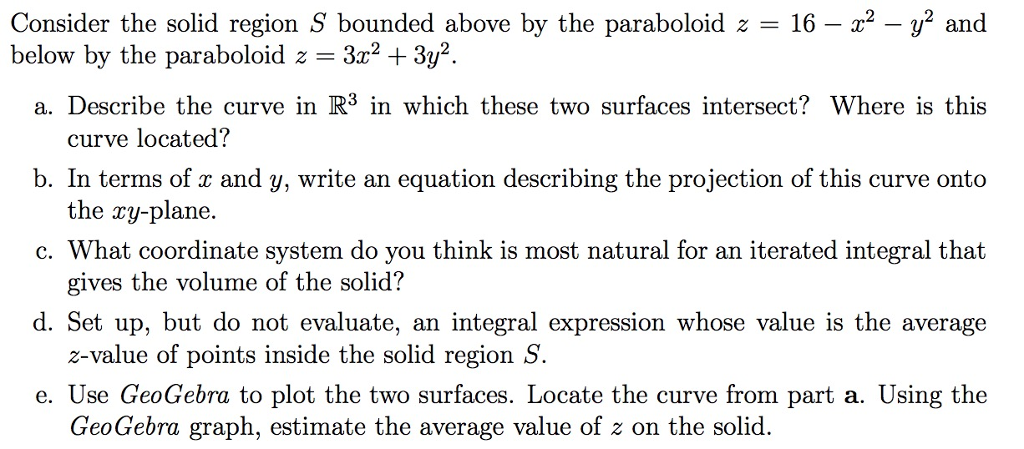
Give step-by-step solution with explanation and final answer:Consider the solid region S bounded above by the paraboloid z = 16 — 22 — y? and
below by the paraboloid z = 3z2 + 3y2.
a. Describe the curve in R® in which these two surfaces intersect? Where is this
curve located?
b. In terms of z and y, write an equation describing the projection of this curve onto
the zy-plane.
c. What coordinate system do you think is most natural for an iterated integral that
gives the volume of the solid?
d. Set up, but do not evaluate, an integral expression whose value is the average
z-value of points inside the solid region S.
e. Use GeoGebra to plot the two surfaces. Locate the curve from part a. Using the
GeoGebra graph, estimate the average value of z on the solid.
Question:
Give step-by-step solution with explanation and final answer:Consider the solid region S bounded above by the paraboloid z = 16 — 22 — y? and
below by the paraboloid z = 3z2 + 3y2.
a. Describe the curve in R® in which these two surfaces intersect? Where is this
curve located?
b. In terms of z and y, write an equation describing the projection of this curve onto
the zy-plane.
c. What coordinate system do you think is most natural for an iterated integral that
gives the volume of the solid?
d. Set up, but do not evaluate, an integral expression whose value is the average
z-value of points inside the solid region S.
e. Use GeoGebra to plot the two surfaces. Locate the curve from part a. Using the
GeoGebra graph, estimate the average value of z on the solid.
This is AI generated Response.
Asked by: gvr
Created at: 2025-07-29 21:55:50
Final Answer:
RenderedRaw Text
Did you like this answer?
Let's solve the problem step by step:
---
### **a. Describe the curve in \(\mathbb{R}^3\) in which these two surfaces intersect. Where is this curve located?**
The surfaces intersect where
\[
z = 16 - x^2 - y^2 = 3x^2 + 3y^2
\]
Setting the two expressions for \(z\) equal:
\[
16 - x^2 - y^2 = 3x^2 + 3y^2
\implies 16 = 4x^2 + 4y^2
\implies x^2 + y^2 = 4
\]
The intersection is when \(x^2 + y^2 = 4\).
Plug back into either equation to get \(z\):
Using \(z = 3x^2 + 3y^2\):
\[
z = 3(x^2 + y^2) = 3 \times 4 = 12
\]
**So the curve is the circle \(x^2 + y^2 = 4\) at height \(z = 12\) in \(\mathbb{R}^3\).**
---
### **b. In terms of \(x\) and \(y\), write an equation describing the projection of this curve onto the \(xy\)-plane.**
The projection onto the \(xy\)-plane ignores the \(z\)-coordinate, so:
\[
x^2 + y^2 = 4
\]
This is a circle of radius 2 centered at the origin.
---
### **c. What coordinate system do you think is most natural for an iterated integral that gives the volume of the solid?**
Since the boundary is a circle (\(x^2 + y^2 = 4\)), **polar coordinates** are the most natural.
---
### **d. Set up, but do not evaluate, an integral expression whose value is the average \(z\)-value of points inside the solid region \(S\).**
The average value of \(z\) over the solid is:
\[
\text{Average } z = \frac{1}{\text{Volume}} \int\int\int_S z \, dV
\]
For this solid, the region in the \(xy\)-plane is the disk \(x^2 + y^2 \leq 4\), and for each \((x, y)\), \(z\) goes from \(z_\text{lower} = 3x^2 + 3y^2\) to \(z_\text{upper} = 16 - x^2 - y^2\).
In **polar coordinates** (\(x = r\cos\theta, y = r\sin\theta\)), the setup:
- \(0 \leq r \leq 2\)
- \(0 \leq \theta \leq 2\pi\)
- \(z\) goes from \(3r^2\) to \(16 - r^2\)
**Volume:**
\[
V = \int_0^{2\pi} \int_0^2 \left[ (16 - r^2) - (3r^2) \right] r\, dr\, d\theta
= \int_0^{2\pi} \int_0^2 (16 - 4r^2) r\, dr\, d\theta
\]
**Average z:**
\[
\text{Average } z = \frac{1}{V} \int_0^{2\pi} \int_0^2 \int_{z=3r^2}^{z=16 - r^2} z\, dz \, r\, dr\, d\theta
\]
---
### **e. Use GeoGebra to plot the two surfaces. Locate the curve from part a. Using the GeoGebra graph, estimate the average value of \(z\) on the solid.**
- In GeoGebra, input:
- \(z_1 = 16 - x^2 - y^2\)
- \(z_2 = 3x^2 + 3y^2\)
- The intersection curve is the circle \(x^2 + y^2 = 4\) at \(z = 12\).
- The solid lies between these two surfaces above the disk \(x^2 + y^2 \leq 4\).
**Estimate:**
Since the top surface ranges from \(z = 16\) at the center (\(r=0\)) down to \(z = 12\) at \(r=2\), and the bottom surface goes from \(z = 0\) at the center up to \(z = 12\) at \(r=2\), the average \(z\) will be somewhat above the halfway point between the two surfaces at each \((x, y)\).
By inspection (or geometric intuition), the average \(z\) should be **slightly above \(z=8\)**, possibly in the range **\(z = 9\) to \(10\)**.
---
### **Summary of Final Answers**
**a.** The intersection curve is \(x^2 + y^2 = 4\), \(z=12\) in \(\mathbb{R}^3\).
**b.** The projection is \(x^2 + y^2 = 4\).
**c.** Polar coordinates.
**d.**
\[
\text{Average } z = \frac{1}{V} \int_0^{2\pi} \int_0^2 \int_{z=3r^2}^{z=16 - r^2} z\, dz\, r\, dr\, d\theta
\]
where \(V = \int_0^{2\pi} \int_0^2 (16 - 4r^2) r\, dr\, d\theta\).
**e.** From the graph, estimate average \(z \approx 9\) to \(10\). (Use GeoGebra to refine this estimate.)
VIPSolutions focuses on clear, step‑by‑step explanations so you can learn quickly. Whether you need an AI‑generated walkthrough or a short hint to get unstuck, each solution is organized for fast reading and easy review later.
Search similar questions, compare approaches, and bookmark the best answers for revision. Our goal is simple: quick, reliable study help that feels natural—not noisy.
 VIPSolutions
 Consider the solid region S bounded above by the paraboloid z = 16 — 22 — y? and
below by the paraboloid z = 3z2 + 3y2.
a. Describe the curve in R® in which these two surfaces intersect? Where is this
curve located?
b. In terms of z and y, write an equation describing the projection of this curve onto
the zy-plane.
c. What coordinate system do you think is most natural for an iterated integral that
gives the volume of the solid?
d. Set up, but do not evaluate, an integral expression whose value is the average
z-value of points inside the solid region S.
e. Use GeoGebra to plot the two surfaces. Locate the curve from part a. Using the
GeoGebra graph, estimate the average value of z on the solid.