 VIPSolutions
Give step-by-step solution with explanation and final answer:Explain Now ne, patient €esPoN Si bili orion © ORBITS) por Into | the contracted cumounst oc | Physiaon a greesitiaceert for a specific. service. for example, 1£ aprovicler | Charges $175 The contract amotint 1s 845, and ‘he patient owes a $25 copayment How would His be. (J cod culated? Rrovide \joor example.(show Jo And also destribe the. Outcome, What Napeens fo Hae. Qifference \n monies if +h slovider Sarge $250 ond Contract omsunt 1s $135, [Wino \noppens to the $15 Oitference © Can “he Patient bbe billed 2 Why or Why not;
Question:
Give step-by-step solution with explanation and final answer: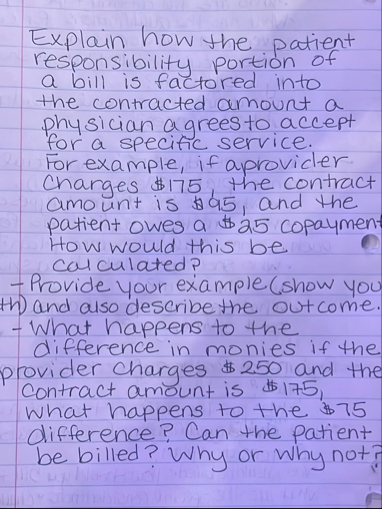 Explain Now ne, patient
€esPoN Si bili orion ©
ORBITS) por Into
| the contracted cumounst oc
| Physiaon a greesitiaceert
for a specific. service.
for example, 1£ aprovicler
| Charges $175 The contract
amotint 1s 845, and ‘he
patient owes a $25 copayment
How would His be. (J
cod culated?
Rrovide \joor example.(show Jo
And also destribe the. Outcome,
What Napeens fo Hae.
Qifference \n monies if +h
slovider Sarge $250 ond
Contract omsunt 1s $135,
[Wino \noppens to the $15
Oitference © Can “he Patient
bbe billed 2 Why or Why not;
This is AI generated Response.
Asked by: gvr
Created at: 2025-07-29 17:22:54
Asked by: gvr
Created at: 2025-07-29 17:22:54
Final Answer:
Rendered
Raw Text
Did you like this answer?
Let's break down the questions step by step:
---
### 1. **Explain how the patient responsibility portion of a bill is factored into the contracted amount a physician agrees to accept for a specific service.**
**Explanation:**
- The **contracted amount** is the maximum amount a provider agrees to accept from the insurance company (and the patient) for a covered service.
- The **patient responsibility** is the part of the contracted amount that the patient must pay, such as copayments, coinsurance, or deductibles.
- The insurance pays the rest of the contracted amount **after** the patient pays their share.
---
### 2. **Example: If a provider charges $175, the contract amount is $145, and the patient owes a $25 copayment, how would this be calculated?**
#### **Step-by-step Solution:**
- **Provider's Charge:** $175 (how much the provider wants to charge)
- **Contracted Amount:** $145 (what the insurance and provider agreed upon)
- **Patient Copayment:** $25
**Calculation:**
- The insurance company and patient together will pay a total of the contracted amount, **not** the provider's full charge.
- The patient pays the **copayment**: $25.
- The insurance pays the rest: $145 (contracted amount) - $25 (copayment) = **$120**.
**Outcome:**
- **Provider receives:** $145 total ($25 from the patient, $120 from insurance)
- **The $30 difference** ($175 - $145) is a "write-off." The provider cannot bill the patient for this amount because they agreed to accept only the contracted amount.
---
### 3. **What happens to the difference in monies if the provider charges $250 and the contract amount is $175? What happens to the $75 difference? Can the patient be billed? Why or why not?**
#### **Step-by-step Solution:**
- **Provider's Charge:** $250
- **Contracted Amount:** $175
**Calculation:**
- The provider can **only collect** up to the contracted amount ($175).
- The insurance company and patient will split the $175 according to the patient’s copayment, coinsurance, or deductible requirements.
- The **$75 difference** ($250 - $175) is a "write-off" for the provider.
**Can the patient be billed for the $75?**
- **No,** the patient cannot be billed for the $75 difference. This is called "balance billing," and it is **not allowed** when the provider is in-network and has agreed to the insurance's contracted rate. The provider must write off this amount.
---
## **Summary Table**
| | Provider Charge | Contracted Amount | Patient Pays | Insurance Pays | Write-off | Can Patient Be Billed for Write-off? |
|-----------|----------------|-------------------|--------------|---------------|-----------|--------------------------------------|
| Example 1 | $175 | $145 | $25 | $120 | $30 | No |
| Example 2 | $250 | $175 | Varies* | Varies* | $75 | No |
*Varies depending on copay/coinsurance.
---
### **Final Answers:**
1. **Patient responsibility is factored into the contracted amount. The patient pays part (copay/coinsurance), insurance pays the rest up to the contracted amount.**
2. **For $175 charge, $145 contracted, $25 copay:**
- Patient pays $25, insurance pays $120, provider writes off $30.
3. **For $250 charge, $175 contracted:**
- Provider writes off $75; patient cannot be billed for this amount. This ensures the patient only pays their share of the contracted amount, not the provider’s original charge.
📢 Instructions:
- Ask anything relatd to above question only.
- For new Question goto :