This is AI generated Response.
Asked by: Kota Swarupa Rani
Created at: 2025-07-29 17:12:19
Final Answer:
RenderedRaw Text
Did you like this answer?
Let's solve **each model** (Figures 2.35–2.38) step-by-step:
---
## **Figure 2.35: Vertical Oscillation with Two Springs**
### **(a) Newton’s Second Law**
**Free Body Diagram:**
- Upward force by upper spring: \( kx \)
- Downward force by lower spring: \( kx \)
- Weight: \( mg \)
**Equation of Motion:**
At equilibrium, \( mg = 2k x_0 \) (where \( x_0 \) is static deflection).
Let \( x(t) \) be displacement from equilibrium.
By Newton’s law:
\[
m \frac{d^2x}{dt^2} = -k x(t) - k x(t) = -2k x(t)
\]
\[
\boxed{m \ddot{x} + 2k x = 0}
\]
**Linear/Nonlinear:** Linear
**Natural Frequency:**
\[
\omega_n = \sqrt{\frac{2k}{m}}
\]
---
### **(b) Energy Method**
Total energy \( E = \) Kinetic + Potential:
\[
E = \frac{1}{2}m \dot{x}^2 + \frac{1}{2}(2k)x^2
\]
Set \( \frac{dE}{dt} = 0 \Rightarrow m \ddot{x} + 2k x = 0 \)
---
## **Figure 2.36: Horizontal Oscillation on Frictionless Surface**
### **(a) Newton’s Second Law**
**Free Body Diagram:**
- Rightward force by spring: \( -k x \)
Equation:
\[
m \frac{d^2x}{dt^2} = -k x
\]
\[
\boxed{m \ddot{x} + k x = 0}
\]
**Linear/Nonlinear:** Linear (for small \( x \)), but nonlinear if impact with wall.
**Natural Frequency:**
\[
\omega_n = \sqrt{\frac{k}{m}}
\]
---
### **(b) Energy Method**
\[
E = \frac{1}{2}m \dot{x}^2 + \frac{1}{2}k x^2
\]
Again, \( \frac{dE}{dt} = 0 \Rightarrow m \ddot{x} + k x = 0 \)
---
## **Figure 2.37: Simple Pendulum**
### **(a) Newton’s Second Law**
**Free Body Diagram:**
- Tangential force: \( -mg \sin \theta \)
\[
m l \frac{d^2 \theta}{dt^2} = -mg \sin \theta
\]
\[
\boxed{l \ddot{\theta} + g \sin \theta = 0}
\]
**Linear/Nonlinear:** Nonlinear. For small \( \theta \), \( \sin\theta \approx \theta \):
\[
l \ddot{\theta} + g \theta = 0
\]
**Natural Frequency:**
\[
\omega_n = \sqrt{\frac{g}{l}}
\]
---
### **(b) Energy Method**
\[
E = \frac{1}{2} m l^2 \dot{\theta}^2 + m g l (1 - \cos \theta)
\]
For small \( \theta \), \( 1-\cos\theta \approx \frac{1}{2}\theta^2 \)
---
## **Figure 2.38: Torsional Oscillator**
### **(a) Newton’s Second Law**
**Free Body Diagram:**
- Restoring torque: \( -K \theta \)
- Moment of inertia: \( I \)
\[
I \frac{d^2\theta}{dt^2} = -K \theta
\]
\[
\boxed{I \ddot{\theta} + K \theta = 0}
\]
**Linear/Nonlinear:** Linear
**Natural Frequency:**
\[
\omega_n = \sqrt{\frac{K}{I}}
\]
---
### **(b) Energy Method**
\[
E = \frac{1}{2} I \dot{\theta}^2 + \frac{1}{2} K \theta^2
\]
---
## **Summary Table**
| Figure | Equation of Motion | Linear? | Natural Frequency |
|--------|-----------------------------------|------------|----------------------------|
| 2.35 | \( m\ddot{x} + 2k x = 0 \) | Linear | \( \sqrt{\frac{2k}{m}} \) |
| 2.36 | \( m\ddot{x} + k x = 0 \) | Linear* | \( \sqrt{\frac{k}{m}} \) |
| 2.37 | \( l\ddot{\theta} + g \sin\theta = 0 \) | Nonlinear | \( \sqrt{\frac{g}{l}} \) (small \(\theta\)) |
| 2.38 | \( I\ddot{\theta} + K \theta = 0 \) | Linear | \( \sqrt{\frac{K}{I}} \) |
(*linear until impact*)
---
**Let me know if you need free-body diagrams or further clarification on any part!**
Question:
Yes
This is AI generated Response.
Asked by: Kota Swarupa Rani
Created at: 2025-07-29 17:14:27
Final Answer:
RenderedRaw Text
Did you like this answer?
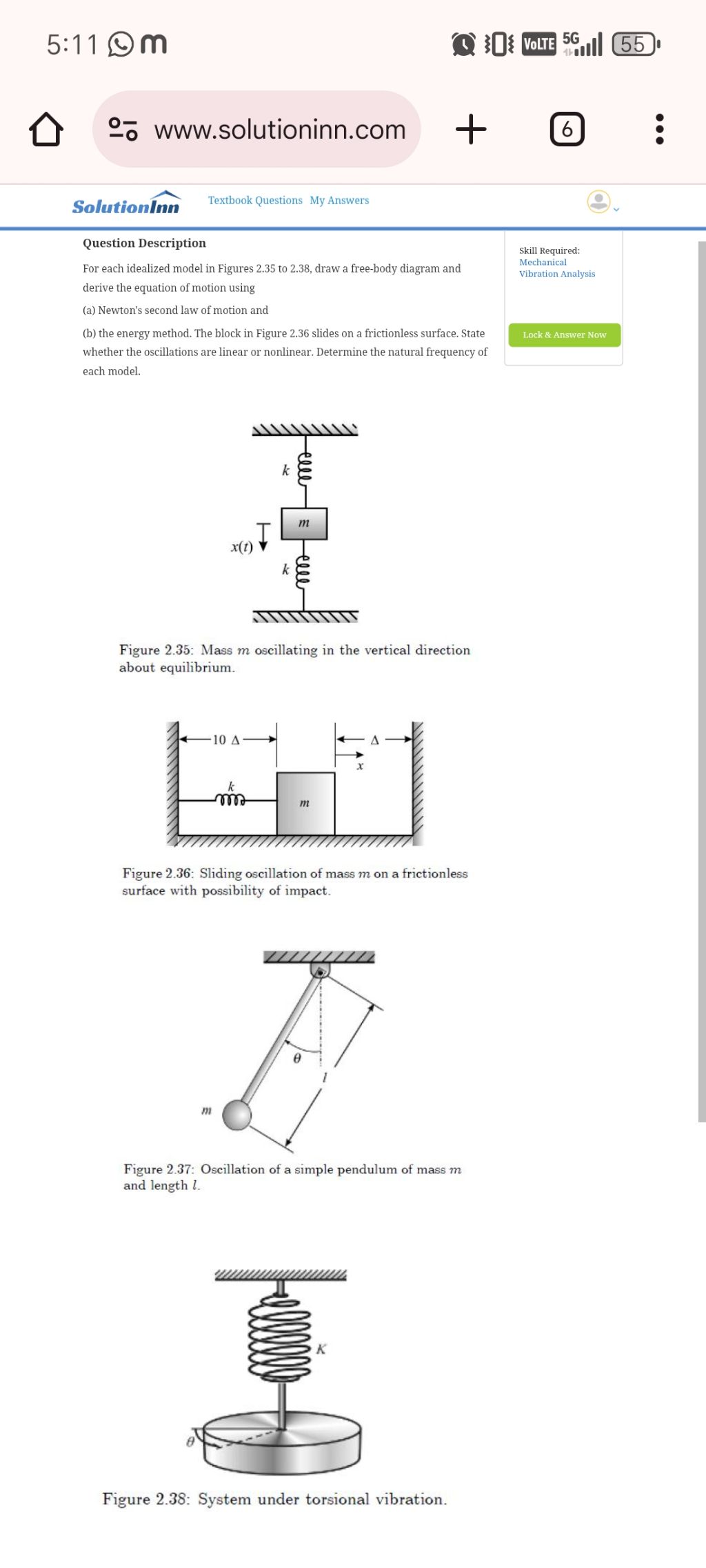
Let's analyze each model step-by-step, drawing free-body diagrams, deriving equations of motion using Newton's second law, and applying the energy method. We'll also determine if the oscillations are linear or nonlinear and find the natural frequencies.
---
### **Figure 2.35: Vertical Oscillation of a Mass \( m \) with Two Springs**
#### **(a) Free-Body Diagram:**
- The mass \( m \) is attached to two springs, one on top and one below, both with spring constant \( k \).
- When displaced downward by \( x \), the springs stretch, exerting restoring forces upward: \( kx \) from each spring.
- The weight acts downward: \( mg \).
**Diagram:**
```
Spring (top) Mass Spring (bottom)
| m |
| | |
--- | ---
(k) | (k)
```
---
#### **(a) Equation of Motion via Newton's Second Law:**
- **Assumption:** \( x(t) \) is the displacement from equilibrium.
- **At equilibrium:** The springs balance the weight:
\[
2k x_0 = mg \Rightarrow x_0 = \frac{mg}{2k}
\]
- **Displacement from equilibrium:** \( x(t) \). Total restoring force:
\[
F_{restoring} = -2k x(t)
\]
- **Newton's law:**
\[
m \frac{d^2x}{dt^2} = -2k x
\]
**Equation:**
\[
\boxed{
m \ddot{x} + 2k x = 0
}
\]
---
#### **(b) Energy Method:**
- **Total energy:** Kinetic + Potential
\[
E = \frac{1}{2} m \dot{x}^2 + \frac{1}{2} (2k) x^2
\]
- **Equation of motion** from energy conservation:
\[
\frac{dE}{dt} = 0 \Rightarrow m \ddot{x} + 2k x = 0
\]
---
#### **Linear or Nonlinear?**
- The restoring force is proportional to \( x \), so **linear oscillations**.
#### **Natural Frequency:**
\[
\boxed{
\omega_n = \sqrt{\frac{2k}{m}}
}
\]
---
### **Figure 2.36: Horizontal Sliding Oscillation of Mass \( m \) on a Frictionless Surface**
#### **(a) Free-Body Diagram:**
- The mass \( m \) slides on a frictionless surface.
- When displaced by \( x \), the spring exerts a restoring force \( -k x \).
**Diagram:**
```
Mass (m) --- Spring --- Wall
```
---
#### **(a) Equation of Motion via Newton's Second Law:**
\[
m \ddot{x} = -k x
\]
**Equation:**
\[
\boxed{
m \ddot{x} + k x = 0
}
\]
#### **(b) Energy Method:**
\[
E = \frac{1}{2} m \dot{x}^2 + \frac{1}{2} k x^2
\]
---
#### **Linear or Nonlinear?**
- For small \( x \), **linear oscillations**.
- Impact with the wall (if relevant) introduces **nonlinearity** when oscillations are large.
#### **Natural Frequency:**
\[
\boxed{
\omega_n = \sqrt{\frac{k}{m}}
}
\]
---
### **Figure 2.37: Simple Pendulum of Length \( l \) and Mass \( m \)**
#### **(a) Free-Body Diagram:**
- Tangential component of gravity provides restoring torque:
\[
\text{Restoring torque} = -mg l \sin \theta
\]
- Moment of inertia for small oscillations:
\[
I = m l^2
\]
**Equation of motion:**
\[
I \ddot{\theta} = -mg l \sin \theta
\]
\[
m l^2 \ddot{\theta} + mg l \sin \theta = 0
\]
Simplify:
\[
l \ddot{\theta} + g \sin \theta = 0
\]
---
#### **(a) Equation of Motion:**
\[
\boxed{
l \ddot{\theta} + g \sin \theta = 0
}
\]
**Linear or Nonlinear?**
- **Nonlinear** in general.
- **Linearized** for small angles (\( \sin \theta \approx \theta \)):
\[
l \ddot{\theta} + g \theta = 0
\]
**Natural frequency (small oscillations):**
\[
\boxed{
\omega_n = \sqrt{\frac{g}{l}}
}
\]
---
#### **(b) Energy Method:**
\[
E = \frac{1}{2} m l^2 \dot{\theta}^2 + m g l (1 - \cos \theta)
\]
---
### **Figure 2.38: System Under Torsional Vibration**
#### **(a) Free-Body Diagram:**
- Torsional restoring torque: \( -K \theta \)
- Moment of inertia: \( I \)
**Equation:**
\[
I \ddot{\theta} + K \theta = 0
\]
---
#### **(a) Equation of Motion:**
\[
\boxed{
I \ddot{\theta} + K \theta = 0
}
\]
---
#### **(b) Energy Method:**
\[
E = \frac{1}{2} I \dot{\theta}^2 + \frac{1}{2} K \theta^2
\]
---
### **Summary of Results:**
| Model | Equation of Motion | Oscillation Type | Natural Frequency \( \omega_n \) |
|---------|----------------------|-------------------|------------------------------|
| **Figure 2.35** | \( m \ddot{x} + 2k x = 0 \) | Linear | \( \sqrt{\frac{2k}{m}} \) |
| **Figure 2.36** | \( m \ddot{x} + k x = 0 \) | Linear (small oscillations) | \( \sqrt{\frac{k}{m}} \) |
| **Figure 2.37** | \( l \ddot{\theta} + g \sin \theta = 0 \) | Nonlinear | \( \sqrt{\frac{g}{l}} \) (small \( \theta \)) |
| **Figure 2.38** | \( I \ddot{\theta} + K \theta = 0 \) | Linear | \( \sqrt{\frac{K}{I}} \) |
---
**Note:** For large amplitude oscillations in the pendulum, the motion is nonlinear, and the simple harmonic approximation no longer holds exactly, but the above linearized frequency gives an approximate natural frequency.
---
If you'd like, I can help you draw the free-body diagrams or clarify any specific step further!
VIPSolutions focuses on clear, step‑by‑step explanations so you can learn quickly. Whether you need an AI‑generated walkthrough or a short hint to get unstuck, each solution is organized for fast reading and easy review later.
Search similar questions, compare approaches, and bookmark the best answers for revision. Our goal is simple: quick, reliable study help that feels natural—not noisy.
 VIPSolutions
 = - 5G
5:110m © 30¢ OB Sul GB
o— SI °
-0 www.solutioninn.com S
Solution, ry Textbook Questions My Answers (®)
Question Description Skill Required:
For each idealized model in Figures 2.35 to 2.38, draw a free-body diagram and a a
derive the equation of motion using
(@) Newton's second law of motion and
(b) the energy method. The block in Figure 2.36 slides on a frictionless surface. State ==
whether the oscillations are linear or nonlinear. Determine the natural frequency of
each model.
\
k
(1) 1
k
P
Figure 2.35: Mass m oscillating in the vertical direction
about equilibrium
10 A = — A
x
k
Figure 2.36: Sliding oscillation of mass m on a frictionless
surface with possibility of impact
ol
F§
m /
Figure 2.37: Oscillation of a simple pendulum of mass m
and length 1
Pp
-—
—
Ce
-——
—
‘cal —
Figure 2.38: System under torsional vibration.