 VIPSolutions
Give step-by-step solution with explanation and final answer:: Gueston 8 (12 marks) 3 gl: find parametric equtkens gf the fine that passes : thou re point P= (1, 0,-) and 6 parliel LT lio te vedor n=, J 52. Find ramen equotons Of the ing that passes tvagn te pons ho (Lo, and B= CLAD 1 to Tind dhe parametric aatuns for the (ne of a gps faces —S%ty a Ts -2 and E E RAr—23Y a se ips som : — 8 Ee nic i oe - Ee —— EE ke = Ee - — -— eS 2 ppd Bb
Question:
Give step-by-step solution with explanation and final answer: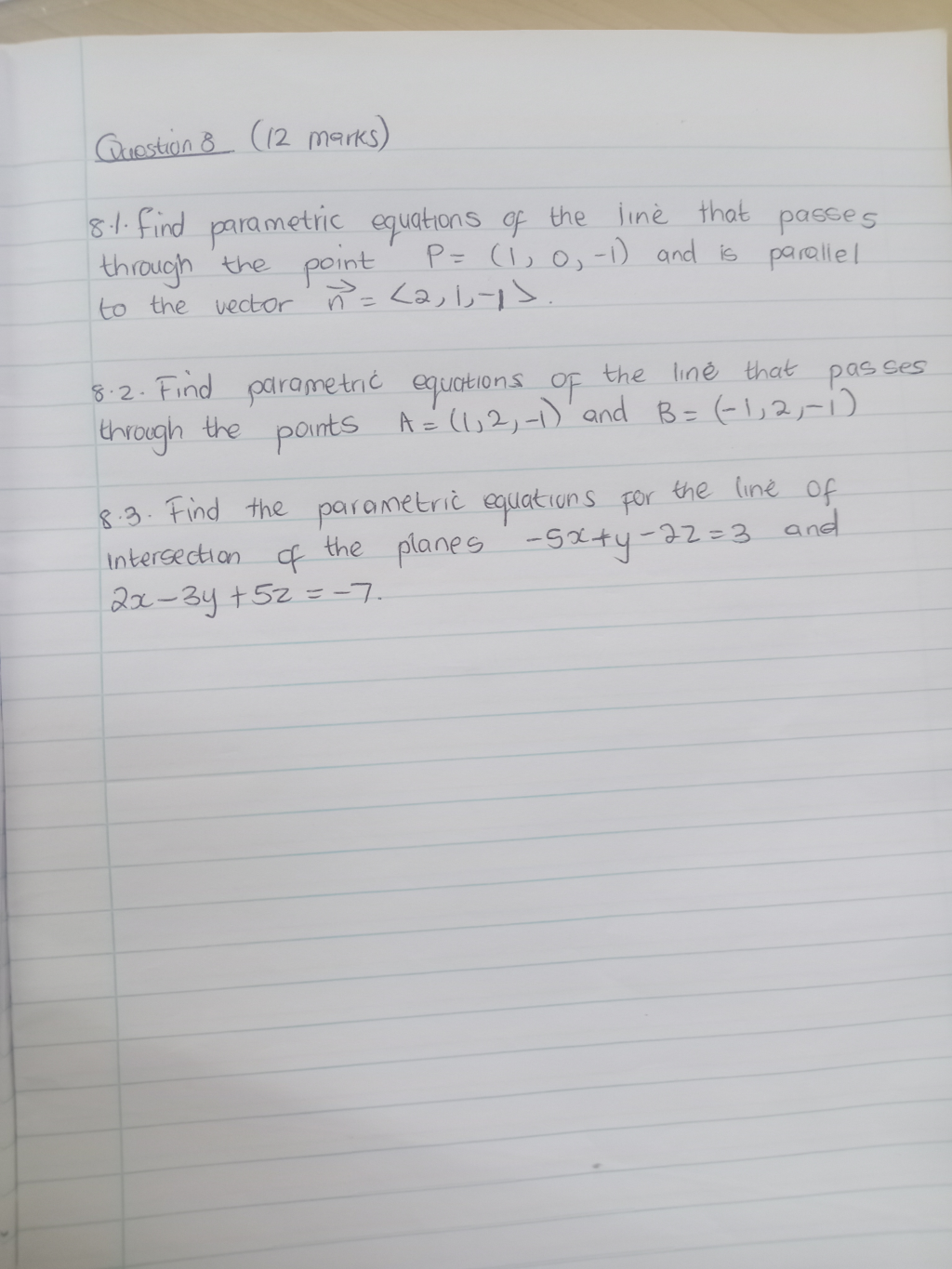 : Gueston 8 (12 marks)
3 gl: find parametric equtkens gf the fine that passes
: thou re point P= (1, 0,-) and 6 parliel
LT lio te vedor n=,
J 52. Find ramen equotons Of the ing that passes
tvagn te pons ho (Lo, and B= CLAD
1 to Tind dhe parametric aatuns for the (ne of
a gps faces —S%ty a Ts -2 and E
E RAr—23Y a se ips som :
— 8 Ee nic i oe
- Ee ——
EE ke = Ee - —
-— eS 2 ppd Bb
This is AI generated Response.
Asked by: gvr
Created at: 2025-07-29 14:38:59
Asked by: gvr
Created at: 2025-07-29 14:38:59
Final Answer:
Rendered
Raw Text
Did you like this answer?
Let's solve each part step by step:
---
### **8.1: Parametric equation of the line through** \( P = (1, 0, -1) \) **parallel to** \( \vec{n} = \langle 2, 1, -1 \rangle \)
**Step 1: General Form**
The parametric equation of a line passing through point \( P_0(x_0, y_0, z_0) \) and parallel to vector \( \vec{d} = \langle a, b, c \rangle \) is:
\[
\begin{align*}
x &= x_0 + at \\
y &= y_0 + bt \\
z &= z_0 + ct
\end{align*}
\]
**Step 2: Substitute the values**
\[
\begin{align*}
x &= 1 + 2t \\
y &= 0 + 1t = t \\
z &= -1 - t
\end{align*}
\]
**Final Answer (8.1):**
\[
\boxed{
\begin{align*}
x &= 1 + 2t \\
y &= t \\
z &= -1 - t
\end{align*}
}
\]
where \( t \in \mathbb{R} \).
---
### **8.2: Line through points \( A = (1, 2, -1) \) and \( B = (-1, 2, -1) \)**
**Step 1: Direction vector**
\[
\vec{AB} = B - A = (-1 - 1, 2 - 2, -1 - (-1)) = (-2, 0, 0)
\]
**Step 2: Parametric Form**
Using point \( A \) and direction vector \( \vec{d} = (-2, 0, 0) \):
\[
\begin{align*}
x &= 1 - 2t \\
y &= 2 \\
z &= -1
\end{align*}
\]
**Final Answer (8.2):**
\[
\boxed{
\begin{align*}
x &= 1 - 2t \\
y &= 2 \\
z &= -1
\end{align*}
}
\]
where \( t \in \mathbb{R} \).
---
### **8.3: Intersection of Planes**
Planes:
1. \( -5x + y - 2z = 3 \)
2. \( 2x - 3y + 5z = -7 \)
**Step 1: Direction vector of intersection**
The direction vector is the cross product of normals:
- Normal to plane 1: \( \vec{n_1} = (-5, 1, -2) \)
- Normal to plane 2: \( \vec{n_2} = (2, -3, 5) \)
\[
\vec{d} = \vec{n_1} \times \vec{n_2}
\]
Calculate:
\[
\begin{align*}
\vec{d}_x &= (1)(5) - (-2)(-3) = 5 - 6 = -1 \\
\vec{d}_y &= -[(-5)(5) - (-2)(2)] = -[-25 + 4] = -[-21] = 21 \\
\vec{d}_z &= (-5)(-3) - (1)(2) = 15 - 2 = 13 \\
\end{align*}
\]
So \( \vec{d} = \langle -1, 21, 13 \rangle \).
**Step 2: Find a point on the line**
Let \( z = 0 \):
- Plane 1: \( -5x + y = 3 \)
- Plane 2: \( 2x - 3y = -7 \)
Solve these simultaneously:
Multiply plane 1 by 3:
- \( -15x + 3y = 9 \)
Add to plane 2:
- \( 2x - 3y = -7 \)
- \( -15x + 3y = 9 \)
Add both:
\[
(2x - 3y) + (-15x + 3y) = -7 + 9 \implies -13x = 2 \implies x = -\frac{2}{13}
\]
Substitute \( x \) into plane 1:
\[
-5x + y = 3 \implies -5(-\frac{2}{13}) + y = 3 \implies \frac{10}{13} + y = 3 \implies y = 3 - \frac{10}{13} = \frac{29}{13}
\]
So, when \( z = 0 \), \( x = -\frac{2}{13} \), \( y = \frac{29}{13} \).
So point \( P = \left(-\frac{2}{13}, \frac{29}{13}, 0\right) \).
**Step 3: Parametric Equations**
\[
\begin{align*}
x &= -\frac{2}{13} - t \\
y &= \frac{29}{13} + 21t \\
z &= 0 + 13t
\end{align*}
\]
**Final Answer (8.3):**
\[
\boxed{
\begin{align*}
x &= -\frac{2}{13} - t \\
y &= \frac{29}{13} + 21t \\
z &= 13t
\end{align*}
}
\]
where \( t \in \mathbb{R} \).
---
**Let me know if you need any further explanation or details!**
📢 Instructions:
- Ask anything relatd to above question only.
- For new Question goto :