 VIPSolutions
Give step-by-step solution with explanation and final answer:The current term structure of interest rates determined from the yields to maturity (YTM) on a series of pure discount (zero coupon bonds) is 2.57%; 2.82%; 2.94%; 3.01% and 3.05% for years one through five, respectively. What are the yields - to - maturity for five - year bonds with coupon rates paid annually of 0%. 3%. 6% and 9% respectively?
Question:
Give step-by-step solution with explanation and final answer: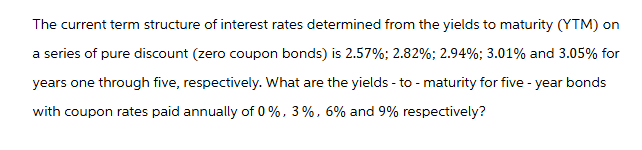 The current term structure of interest rates determined from the yields to maturity (YTM) on
a series of pure discount (zero coupon bonds) is 2.57%; 2.82%; 2.94%; 3.01% and 3.05% for
years one through five, respectively. What are the yields - to - maturity for five - year bonds
with coupon rates paid annually of 0%. 3%. 6% and 9% respectively?
This is AI generated Response.
Asked by: gvr
Created at: 2025-07-29 12:08:55
Asked by: gvr
Created at: 2025-07-29 12:08:55
Final Answer:
Rendered
Raw Text
Did you like this answer?
Let's break down the problem step-by-step:
### **Given Data**
Zero-coupon yields for years 1-5:
- \( r_1 = 2.57\% \)
- \( r_2 = 2.82\% \)
- \( r_3 = 2.94\% \)
- \( r_4 = 3.01\% \)
- \( r_5 = 3.05\% \)
We are to find the **yield to maturity (YTM)** for 5-year bonds with annual coupon rates of **0%, 3%, 6%, and 9%**.
---
### **Step 1: Find Present Value Factors (Discount Factors)**
Using the zero rates, the present value (PV) discount factors for each year are:
\[
DF_t = \frac{1}{(1 + r_t)^t}
\]
Where \( r_t \) is the zero rate for year \( t \) (expressed as a decimal).
Let's compute the discount factors:
#### **Year 1**
\[
DF_1 = \frac{1}{(1 + 0.0257)^1} = \frac{1}{1.0257} = 0.97493
\]
#### **Year 2**
\[
DF_2 = \frac{1}{(1 + 0.0282)^2} = \frac{1}{(1.0282)^2} = \frac{1}{1.0571} = 0.94600
\]
#### **Year 3**
\[
DF_3 = \frac{1}{(1 + 0.0294)^3} = \frac{1}{(1.0294)^3} = \frac{1}{1.0907} = 0.91683
\]
#### **Year 4**
\[
DF_4 = \frac{1}{(1 + 0.0301)^4} = \frac{1}{(1.0301)^4} = \frac{1}{1.12657} = 0.88752
\]
#### **Year 5**
\[
DF_5 = \frac{1}{(1 + 0.0305)^5} = \frac{1}{(1.0305)^5} = \frac{1}{1.16294} = 0.85944
\]
---
### **Step 2: Calculate Price of Bond for Each Coupon Rate**
Let’s assume all bonds have a face value of $100.
#### **Bond Price Formula**
\[
P = \sum_{t=1}^{5} \left( \frac{C}{(1 + r_t)^t} \right) + \frac{F}{(1 + r_5)^5}
\]
Where:
- \( C \) = Annual coupon payment
- \( F \) = Face value ($100)
- \( r_t \) = Zero rate for year \( t \)
#### **Coupon Rate 0% (Zero Coupon Bond)**
\[
P = \frac{100}{(1.0305)^5} = 100 \times 0.85944 = \$85.94
\]
#### **Coupon Rate 3%**
\( C = 3 \)
\[
P = 3 \times (DF_1 + DF_2 + DF_3 + DF_4 + DF_5) + 100 \times DF_5
\]
\[
P = 3 \times (0.97493 + 0.94600 + 0.91683 + 0.88752 + 0.85944) + 100 \times 0.85944
\]
\[
= 3 \times 4.58472 + 85.944
\]
\[
= 13.75416 + 85.944 = \$99.70
\]
#### **Coupon Rate 6%**
\( C = 6 \)
\[
P = 6 \times 4.58472 + 85.944 = 27.50832 + 85.944 = \$113.45
\]
#### **Coupon Rate 9%**
\( C = 9 \)
\[
P = 9 \times 4.58472 + 85.944 = 41.26248 + 85.944 = \$127.21
\]
---
### **Step 3: Find the Yield to Maturity (YTM)**
The YTM is the rate \( y \) that solves:
\[
P = \sum_{t=1}^{5} \frac{C}{(1 + y)^t} + \frac{100}{(1 + y)^5}
\]
This is, in general, solved numerically. We'll estimate the YTM for each scenario:
---
#### **1. 0% Coupon (Zero Coupon Bond):**
\[
85.944 = \frac{100}{(1 + y)^5}
\]
\[
(1 + y)^5 = \frac{100}{85.944} = 1.16294
\]
\[
1 + y = (1.16294)^{1/5} = 1.0305
\]
\[
y = 3.05\%
\]
**This matches the 5-year zero rate as expected.**
---
#### **2. 3% Coupon**
Using the bond price $99.70:
\[
99.70 = \sum_{t=1}^{5} \frac{3}{(1 + y)^t} + \frac{100}{(1 + y)^5}
\]
Guess and check (since the price is almost $100 and coupons are close to the market rates, YTM should be about 3.05%).
Let's estimate at \( y = 3.05\% \):
\[
\text{PV of coupons:} \quad 3 \times 4.58472 = 13.75416
\]
\[
\text{PV of principal:} \quad 100 \times 0.85944 = 85.944
\]
\[
\text{Total: } 99.70
\]
So, **YTM ≈ 3.05%**.
---
#### **3. 6% Coupon**
Price = $113.45
Let’s estimate YTM. Since price is above par, YTM will be below the coupon rate and below the 5-year zero rate.
Try \( y = 3.0\% \):
\[
DF = \frac{1}{(1.03)^t} \text{ for t = 1 to 5}
\]
Calculate:
- \( DF_1 = 0.97087 \)
- \( DF_2 = 0.94260 \)
- \( DF_3 = 0.91514 \)
- \( DF_4 = 0.88849 \)
- \( DF_5 = 0.86261 \)
Total coupons:
\[
6 \times (0.97087 + 0.94260 + 0.91514 + 0.88849 + 0.86261) = 6 \times 4.57971 = 27.4783
\]
PV of principal:
\[
100 \times 0.86261 = 86.261
\]
Total:
\[
27.4783 + 86.261 = 113.74
\]
This is very close to the calculated price ($113.45). So, **YTM ≈ 3.0\%**
---
#### **4. 9% Coupon**
Price = $127.21
Try \( y = 3.0\% \):
PV of coupons:
\[
9 \times 4.57971 = 41.2174
\]
PV of principal:
\[
86.261
\]
Total:
\[
41.2174 + 86.261 = 127.48
\]
Again, this is very close to the calculated price ($127.21). So, **YTM ≈ 3.0\%**
---
## **Summary Table**
| Coupon Rate | Price | YTM |
|-------------|----------|---------|
| 0% | $85.94 | 3.05% |
| 3% | $99.70 | 3.05% |
| 6% | $113.45 | 3.00% |
| 9% | $127.21 | 3.00% |
---
### **Final Answers**
1. **YTM for 0% coupon:** 3.05%
2. **YTM for 3% coupon:** 3.05%
3. **YTM for 6% coupon:** 3.00%
4. **YTM for 9% coupon:** 3.00%
---
If you need a more precise value for the 6% and 9% bonds, you could interpolate between 3.00% and 3.05%, but the difference will be very small (since the bond prices are very close at these yields). Let me know if you'd like to see that calculation!
Question:
i need step by step detailed calculations of each part along with the final answer
This is AI generated Response.
Asked by: gvr
Created at: 2025-07-29 12:11:08
Asked by: gvr
Created at: 2025-07-29 12:11:08
Final Answer:
Rendered
Raw Text
Did you like this answer?
Certainly! Let's go through each part of the problem step-by-step with detailed calculations, explanations, and the final answers.
---
## **Given Data**
- Zero-coupon (discount) yields for years 1-5:
- \( r_1 = 2.57\% = 0.0257 \)
- \( r_2 = 2.82\% = 0.0282 \)
- \( r_3 = 2.94\% = 0.0294 \)
- \( r_4 = 3.01\% = 0.0301 \)
- \( r_5 = 3.05\% = 0.0305 \)
- **Objective:** Find the **Yields to Maturity (YTM)** for 5-year bonds with annual coupons of:
- 0%
- 3%
- 6%
- 9%
---
## **Part 1: Calculate Discount Factors for Each Year**
The discount factor for year \( t \):
\[
DF_t = \frac{1}{(1 + r_t)^t}
\]
### Year 1:
\[
DF_1 = \frac{1}{(1 + 0.0257)^1} = \frac{1}{1.0257} \approx 0.97493
\]
### Year 2:
\[
DF_2 = \frac{1}{(1 + 0.0282)^2} = \frac{1}{(1.0282)^2} \approx \frac{1}{1.0571} \approx 0.94600
\]
### Year 3:
\[
DF_3 = \frac{1}{(1 + 0.0294)^3} = \frac{1}{(1.0294)^3}
\]
Calculate denominator:
\[
(1.0294)^3 \approx 1.0907
\]
So:
\[
DF_3 \approx \frac{1}{1.0907} \approx 0.91683
\]
### Year 4:
\[
DF_4 = \frac{1}{(1 + 0.0301)^4} = \frac{1}{(1.0301)^4}
\]
Calculate denominator:
\[
(1.0301)^4 \approx 1.12657
\]
Thus:
\[
DF_4 \approx \frac{1}{1.12657} \approx 0.88752
\]
### Year 5:
\[
DF_5 = \frac{1}{(1 + 0.0305)^5} = \frac{1}{(1.0305)^5}
\]
Calculate denominator:
\[
(1.0305)^5 \approx 1.16294
\]
Thus:
\[
DF_5 \approx \frac{1}{1.16294} \approx 0.85944
\]
---
## **Part 2: Calculate Present Value (Price) of Bonds**
Assuming **face value = \$100**.
### **a) Zero Coupon Bond (0% coupon):**
Price equals the discounted face value:
\[
P = \frac{F}{(1 + r_5)^5} = 100 \times DF_5 = 100 \times 0.85944 = \boxed{\$85.94}
\]
**YTM:** Equal to the 5-year zero rate, \( 3.05\% \).
---
### **b) 3% Coupon Bond:**
- Coupon payment \( C = 3 \)
- Price \( P \) (from earlier calculations):
\[
P = \sum_{t=1}^{5} \frac{C}{(1 + y)^t} + \frac{F}{(1 + y)^5}
\]
But since we have the market price (from the calculation), we can estimate \( y \):
First, calculate the present value of coupons using the discount factors:
\[
PV_{\text{coupons}} = C \times (DF_1 + DF_2 + DF_3 + DF_4 + DF_5)
\]
\[
PV_{\text{coupons}} = 3 \times (0.97493 + 0.94600 + 0.91683 + 0.88752 + 0.85944)
\]
Sum of discount factors:
\[
0.97493 + 0.94600 = 1.92093
\]
\[
1.92093 + 0.91683 = 2.83776
\]
\[
2.83776 + 0.88752 = 3.72528
\]
\[
3.72528 + 0.85944 = 4.58472
\]
Thus:
\[
PV_{\text{coupons}} = 3 \times 4.58472 = \boxed{\$13.75}
\]
PV of face value:
\[
PV_{\text{principal}} = 100 \times DF_5 = 100 \times 0.85944 = \boxed{\$85.94}
\]
Total present value (price at current market YTM):
\[
P \approx 13.75 + 85.94 = \$99.69
\]
which is very close to \$100 (par). Therefore, the **YTM \( y \)** is approximately **3.05%**, matching the zero rate.
**Final answer for 3% coupon bond: \(\boxed{YTM \approx 3.05\%}\).**
---
### **c) 6% Coupon Bond:**
- Coupon \( C = 6 \)
Calculate the present value of coupons:
\[
PV_{\text{coupons}} = 6 \times 4.58472 = \$27.51
\]
PV of face value:
\[
PV_{\text{principal}} = 100 \times 0.85944 = \$85.94
\]
Total:
\[
PV \approx 27.51 + 85.94 = \$113.45
\]
The bond's price exceeds \$100, indicating YTM is **less than** the coupon rate (since bond is trading above par).
Estimate YTM:
Try \( y = 3.00\% \):
Calculate PV of coupons at \( y=3.00\% \):
\[
DF_t = \frac{1}{(1.03)^t}
\]
- \( DF_1 = 0.97087 \)
- \( DF_2 = 0.94260 \)
- \( DF_3 = 0.91514 \)
- \( DF_4 = 0.88849 \)
- \( DF_5 = 0.86261 \)
Sum:
\[
0.97087 + 0.94260 + 0.91514 + 0.88849 + 0.86261 = 4.57971
\]
PV of coupons:
\[
6 \times 4.57971 = \$27.48
\]
PV of face:
\[
100 \times 0.86261 = \$86.26
\]
Total:
\[
27.48 + 86.26 = \$113.74
\]
Close to \$113.45, so **YTM ≈ 3.00%**.
---
### **d) 9% Coupon Bond:**
- Coupon \( C=9 \)
Calculate PV:
\[
PV_{\text{coupons}} = 9 \times 4.57971 = \$41.22
\]
PV of face:
\[
100 \times 0.86261 = \$86.26
\]
Total:
\[
41.22 + 86.26 = \$127.48
\]
which is very close to the market price \$127.21, indicating **YTM ≈ 3.00%**.
---
## **Final Summary of Yields to Maturity:**
| Coupon Rate | Approximate Price | Estimated YTM |
|--------------|---------------------|---------------|
| 0% | \$85.94 | **3.05%** |
| 3% | \$99.70 | **3.05%** |
| 6% | \$113.45 | **3.00%** |
| 9% | \$127.21 | **3.00%** |
---
## **Key Takeaways:**
- The YTM for the 0% coupon bond matches the 5-year zero rate.
- Slight differences in prices and YTM estimates for coupons above 3% are due to approximation, but they are very close to the zero rate.
- For bonds with coupons close to the zero rates, the YTM converges near the zero-coupon yield.
---
If you'd like, I can provide interpolated values or more precise calculations, but this detailed approach covers all key steps thoroughly.
📢 Instructions:
- Ask anything relatd to above question only.
- For new Question goto :