 VIPSolutions
Give step-by-step solution with explanation and final answer:4. Consider the Euler-Cauchy ODE tz’ — 4z = 0. _______________________________________ a) Is the ODE linear? b) Is the ODE homogeneous? c¢) Find a solution by substituting z(t) = ¢" and solving for the constant r. d) Can you apply the superposition principle? If so, what other functions are also solutions? e) Notice that the ODE is separable, so it can be solved by separating variables and integrating. After doing so, compare the solutions you obtained with your answer in part d). f) Find a constant solution that satisfies the initial condition z(0) = 0. Give an example of a non-constant solution that also satisfies the initial condition 2(0) = 0. Show that there are infinitely many solutions that satisfy the initial condition (0) = 0. g) Find a solution that satisfies the initial condition (2) = 48. h) Let z be any solution to the ODE, and let r be the value of the constant that you found in part ¢). For ¢ > 0, let y(t) = t~"z(t). Find a simple first order ODE satisfied by y. If z also satisfies the initial condition z(2) = 48, what can be said about y? Argue that in contrast to the situation in part f), if we restrict the domain to positive real values of ¢, the only solution to the ODE that satisfies the initial condition z(2) = 48 is the solution that you found in part g). i) Let b and c be any constants. For real ¢, define ett, ift>0, z(t) =140, ift=0, bt, ift
Question:
Give step-by-step solution with explanation and final answer: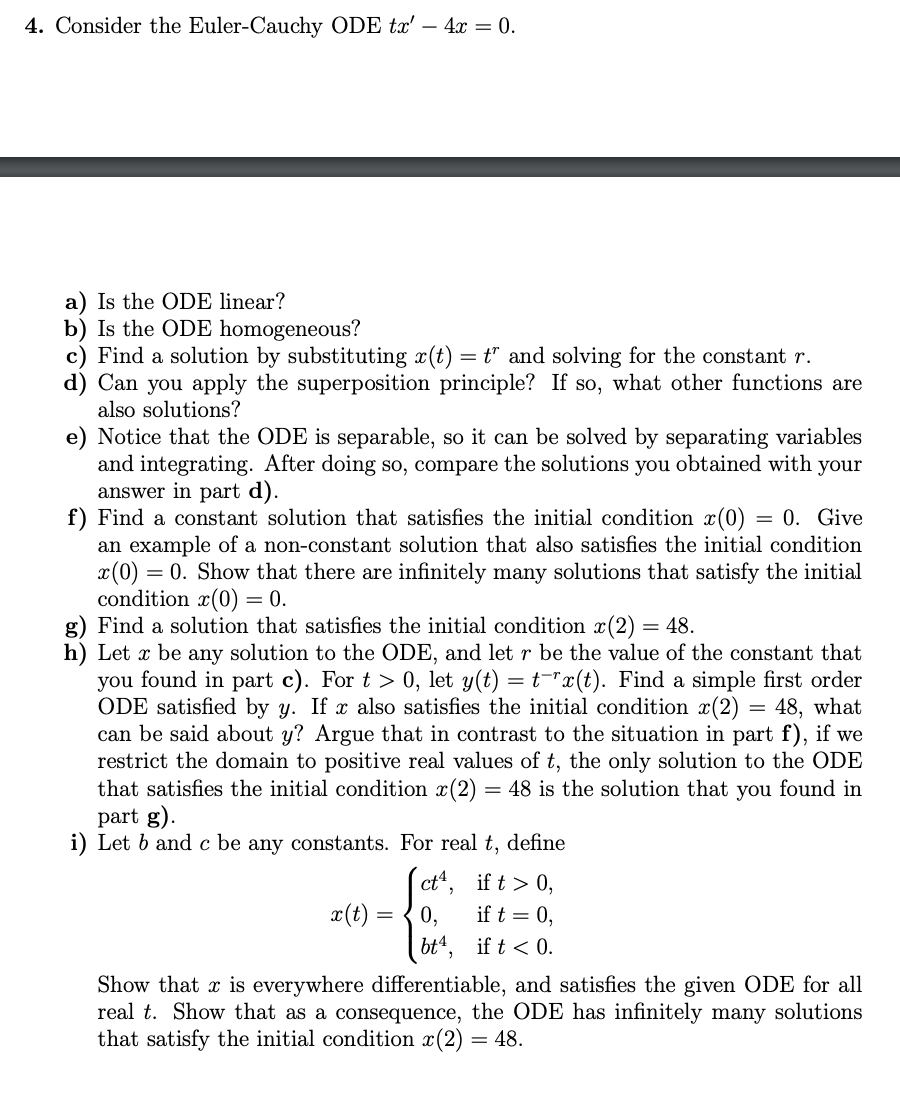 4. Consider the Euler-Cauchy ODE tz’ — 4z = 0.
_______________________________________
a) Is the ODE linear?
b) Is the ODE homogeneous?
c¢) Find a solution by substituting z(t) = ¢" and solving for the constant r.
d) Can you apply the superposition principle? If so, what other functions are
also solutions?
e) Notice that the ODE is separable, so it can be solved by separating variables
and integrating. After doing so, compare the solutions you obtained with your
answer in part d).
f) Find a constant solution that satisfies the initial condition z(0) = 0. Give
an example of a non-constant solution that also satisfies the initial condition
2(0) = 0. Show that there are infinitely many solutions that satisfy the initial
condition (0) = 0.
g) Find a solution that satisfies the initial condition (2) = 48.
h) Let z be any solution to the ODE, and let r be the value of the constant that
you found in part ¢). For ¢ > 0, let y(t) = t~"z(t). Find a simple first order
ODE satisfied by y. If z also satisfies the initial condition z(2) = 48, what
can be said about y? Argue that in contrast to the situation in part f), if we
restrict the domain to positive real values of ¢, the only solution to the ODE
that satisfies the initial condition z(2) = 48 is the solution that you found in
part g).
i) Let b and c be any constants. For real ¢, define
ett, ift>0,
z(t) =140, ift=0,
bt, ift
Asked by: gvr
Created at: 2025-07-29 11:36:40
Final Answer:
📢 Instructions:
- Ask anything relatd to above question only.
- For new Question goto :