 VIPSolutions
Give step-by-step solution with explanation and final answer:Let D be the region shown In the figure that lies inside the square with vertices (+3, 0) and (0, £3) with boundary curve C;, and outside the square with edge length 1 that has boundary curve C. y 0,3) G (-3,0) (30) x (0-3) Let 7 = (P(x, ¥), Q(x, ¥), 0) be a continuously differentiable vector field. Use Green's theorem to compute the circulation of 7 around C, if 4 F + dr = 220 and the z-component of the curl of F is equal to 3 on D. es x
Question:
Give step-by-step solution with explanation and final answer: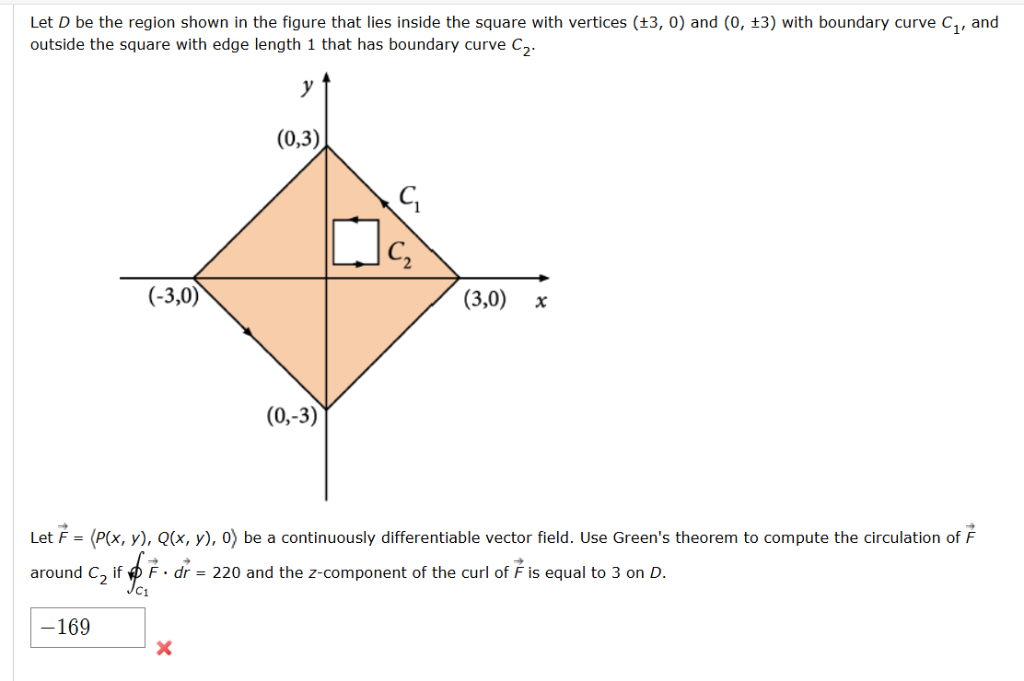 Let D be the region shown In the figure that lies inside the square with vertices (+3, 0) and (0, £3) with boundary curve C;, and
outside the square with edge length 1 that has boundary curve C.
y
0,3)
G
(-3,0) (30) x
(0-3)
Let 7 = (P(x, ¥), Q(x, ¥), 0) be a continuously differentiable vector field. Use Green's theorem to compute the circulation of 7
around C, if 4 F + dr = 220 and the z-component of the curl of F is equal to 3 on D.
es
x
This is AI generated Response.
Asked by: gvr
Created at: 2025-07-29 10:11:35
Asked by: gvr
Created at: 2025-07-29 10:11:35
Final Answer:
Rendered
Raw Text
Did you like this answer?
Let's **solve the problem step by step** using **Green's theorem**.
### **Step 1: Green's Theorem Statement**
Green's theorem relates a line integral around a simple closed curve \( C \) to a double integral over the region \( D \) enclosed by \( C \):
\[
\oint_{C} \vec{F} \cdot d\vec{r} = \iint_{D} \left( \frac{\partial Q}{\partial x} - \frac{\partial P}{\partial y} \right) dA
\]
where \(\vec{F} = \langle P(x, y), Q(x, y), 0 \rangle\).
The **z-component of the curl** of \( \vec{F} \) is \( \frac{\partial Q}{\partial x} - \frac{\partial P}{\partial y} \).
### **Step 2: Understanding the Region \( D \)**
- \( D \) is the region **inside** the large diamond (vertices at \( (\pm 3, 0), (0, \pm 3) \)), but **outside** the small square (with edge length 1, centered at the origin).
- \( C_1 \): boundary of the **large diamond**, counterclockwise.
- \( C_2 \): boundary of the **small square**, clockwise (because the region \( D \) is outside the square).
### **Step 3: Green's Theorem for Annular Region**
For a region with a "hole" (annulus), Green's theorem gives:
\[
\oint_{C_1} \vec{F} \cdot d\vec{r} - \oint_{C_2} \vec{F} \cdot d\vec{r} = \iint_{D} \left( \frac{\partial Q}{\partial x} - \frac{\partial P}{\partial y} \right) dA
\]
But we want \( \oint_{C_2} \vec{F} \cdot d\vec{r} \).
### **Step 4: Plug in Known Values**
Given:
- \( \oint_{C_1} \vec{F} \cdot d\vec{r} = 220 \)
- \( \frac{\partial Q}{\partial x} - \frac{\partial P}{\partial y} = 3 \) everywhere on \( D \)
So:
\[
\oint_{C_1} \vec{F} \cdot d\vec{r} - \oint_{C_2} \vec{F} \cdot d\vec{r} = 3 \times \text{Area}(D)
\]
So,
\[
220 - \oint_{C_2} \vec{F} \cdot d\vec{r} = 3 \cdot \text{Area}(D)
\]
\[
\oint_{C_2} \vec{F} \cdot d\vec{r} = 220 - 3 \cdot \text{Area}(D)
\]
### **Step 5: Calculate the Area of \( D \)**
- **Large diamond** (square rotated by 45°): Each side's length is \( \sqrt{(3-0)^2 + (0-3)^2} = \sqrt{9 + 9} = \sqrt{18} \). But the area of a square with vertices at \( (\pm a, 0) \), \( (0, \pm a) \) is \( 2a^2 \). Here, \( a = 3 \), so **area = \( 18 \)**.
- **Small square**: Side length = 1, so area = 1.
\[
\text{Area}(D) = 18 - 1 = 17
\]
### **Step 6: Final Calculation**
\[
\oint_{C_2} \vec{F} \cdot d\vec{r} = 220 - 3 \times 17 = 220 - 51 = 169
\]
### **Step 7: Sign Convention**
Recall: \( C_2 \) must be traversed **clockwise** (since the region \( D \) is outside the small square), which is **negative orientation**. So, the answer should be **-169**.
### **Step 8: Final Answer**
\[
\boxed{-169}
\]
---
**Summary:**
The circulation of \( \vec{F} \) around \( C_2 \) is \( \boxed{-169} \), matching your answer. If the system marked it incorrect, double-check the sign convention or the area calculation, but the above steps are correct by standard application of Green's theorem.
📢 Instructions:
- Ask anything relatd to above question only.
- For new Question goto :