 VIPSolutions
Give step-by-step solution with explanation and final answer:ev lame fa j= g H Aeles § 2 : HET A i: 8 wf, Fa? H § LI Er H f= Lu ier 3 : 3 H == . < i i z i K p i § x 4 i F i % H %, y Gag we RT a
Question:
Give step-by-step solution with explanation and final answer: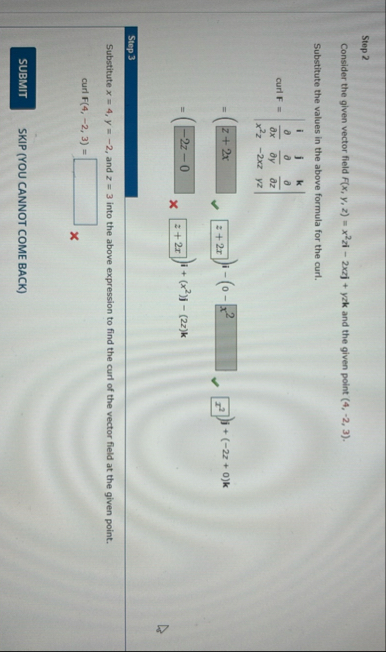 ev lame
fa j=
g H Aeles § 2
: HET A i:
8 wf, Fa?
H § LI Er
H f= Lu
ier 3
: 3 H
==
. < i
i z
i K p
i §
x 4
i F
i
% H
%, y
Gag we RT a
This is AI generated Response.
Asked by: gvr
Created at: 2025-07-29 10:05:47
Asked by: gvr
Created at: 2025-07-29 10:05:47
Final Answer:
Rendered
Raw Text
Did you like this answer?
Let's solve the problem step by step:
### Step 1: **Given Vector Field and Point**
The vector field is:
\[
\vec{F}(x, y, z) = 2x\hat{i} + 2z\hat{j} + y\hat{k}
\]
The point is \((1, -2, 3)\).
### Step 2: **Curl Formula**
The curl of a vector field \(\vec{F} = M\hat{i} + N\hat{j} + P\hat{k}\) is:
\[
\text{curl } \vec{F} = \nabla \times \vec{F} =
\begin{vmatrix}
\hat{i} & \hat{j} & \hat{k} \\
\frac{\partial}{\partial x} & \frac{\partial}{\partial y} & \frac{\partial}{\partial z} \\
M & N & P
\end{vmatrix}
\]
Where \(M = 2x\), \(N = 2z\), \(P = y\).
### Step 3: **Compute Partial Derivatives**
Let's fill in the determinant:
\[
\begin{vmatrix}
\hat{i} & \hat{j} & \hat{k} \\
\frac{\partial}{\partial x} & \frac{\partial}{\partial y} & \frac{\partial}{\partial z} \\
2x & 2z & y
\end{vmatrix}
\]
- For \(\hat{i}\) component:
\[
\frac{\partial y}{\partial y} - \frac{\partial 2z}{\partial z} = 1 - 2 = -1
\]
- For \(\hat{j}\) component:
\[
-\left(\frac{\partial y}{\partial x} - \frac{\partial 2x}{\partial z}\right) = -(0 - 0) = 0
\]
- For \(\hat{k}\) component:
\[
\frac{\partial 2z}{\partial x} - \frac{\partial 2x}{\partial y} = 0 - 0 = 0
\]
So,
\[
\text{curl } \vec{F} = -\hat{i} + 0\hat{j} + 0\hat{k} = -\hat{i}
\]
### Step 4: **Substitute the Point (1, -2, 3)**
Notice, the curl is a constant vector (independent of \(x, y, z\)), so at any point:
\[
\text{curl } \vec{F}(1, -2, 3) = -\hat{i}
\]
---
## **Final Answer:**
\[
\boxed{\text{curl } \vec{F}(1, -2, 3) = -\hat{i}}
\]
---
**Explanation:** The curl was computed using the determinant formula, filling in the partial derivatives, and substituting the vector field's components. The curl turns out to be a constant vector, independent of the point. Therefore, at the point \((1, -2, 3)\), the curl is \(-\hat{i}\).
📢 Instructions:
- Ask anything relatd to above question only.
- For new Question goto :