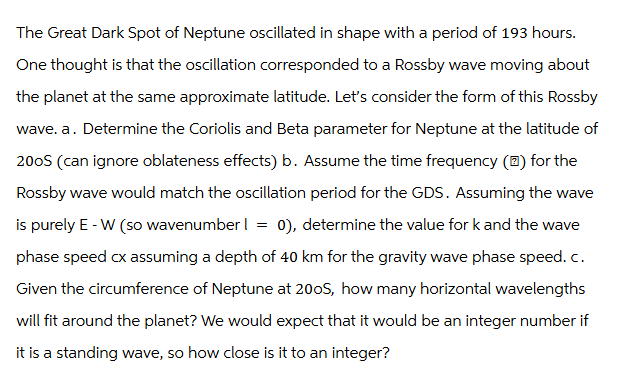
Give step-by-step solution with explanation and final answer:The Great Dark Spot of Neptune oscillated in shape with a period of 193 hours.
One thought is that the oscillation corresponded to a Rossby wave moving about
the planet at the same approximate latitude. Let's consider the form of this Rossby
wave. a. Determine the Coriolis and Beta parameter for Neptune at the latitude of
2005 (can ignore oblateness effects) b. Assume the time frequency (a) for the
Rossby wave would match the oscillation period for the GDS. Assuming the wave
is purely E -W (so wavenumber | = 0), determine the value for k and the wave
phase speed cx assuming a depth of 40 km for the gravity wave phase speed. c.
Given the circumference of Neptune at 2005, how many horizontal wavelengths
will fit around the planet? We would expect that it would be an integer number if
itis a standing wave, so how close is it to an integer?
Question:
Give step-by-step solution with explanation and final answer:The Great Dark Spot of Neptune oscillated in shape with a period of 193 hours.
One thought is that the oscillation corresponded to a Rossby wave moving about
the planet at the same approximate latitude. Let's consider the form of this Rossby
wave. a. Determine the Coriolis and Beta parameter for Neptune at the latitude of
2005 (can ignore oblateness effects) b. Assume the time frequency (a) for the
Rossby wave would match the oscillation period for the GDS. Assuming the wave
is purely E -W (so wavenumber | = 0), determine the value for k and the wave
phase speed cx assuming a depth of 40 km for the gravity wave phase speed. c.
Given the circumference of Neptune at 2005, how many horizontal wavelengths
will fit around the planet? We would expect that it would be an integer number if
itis a standing wave, so how close is it to an integer?
This is AI generated Response.
Asked by: gvr
Created at: 2025-07-29 03:47:37
Final Answer:
RenderedRaw Text
Did you like this answer?
Let's solve each part step by step:
---
### **a. Coriolis and Beta Parameter at 20°S on Neptune**
#### **Step 1: Find Neptune's Rotation Rate (\(\Omega\))**
Neptune's rotation period ≈ **16.11 hours**
\[
\Omega = \frac{2\pi}{T}
\]
Where \(T = 16.11 \times 3600 = 57996 \text{ s}\)
\[
\Omega = \frac{2\pi}{57996} \approx 1.083 \times 10^{-4} \text{ rad/s}
\]
#### **Step 2: Find Coriolis Parameter (\(f\))**
\[
f = 2 \Omega \sin(\phi)
\]
At latitude \(\phi = -20^\circ\) (\(\sin(-20^\circ) = -0.342\)):
\[
f = 2 \times 1.083 \times 10^{-4} \times (-0.342) \approx -7.40 \times 10^{-5} \text{ s}^{-1}
\]
(Take the absolute value if you prefer, as sign indicates direction.)
#### **Step 3: Find Beta Parameter (\(\beta\))**
\[
\beta = \frac{df}{dy}
\]
\[
\beta = \frac{2 \Omega \cos(\phi)}{R}
\]
Neptune's mean radius \(R \approx 24,764 \, \text{km} = 2.4764 \times 10^7 \, \text{m}\)
\[
\cos(-20^\circ) = 0.94
\]
\[
\beta = \frac{2 \times 1.083 \times 10^{-4} \times 0.94}{2.4764 \times 10^7}
\]
\[
\beta \approx \frac{2.037 \times 10^{-4}}{2.4764 \times 10^7} \approx 8.23 \times 10^{-12} \text{ m}^{-1} \text{ s}^{-1}
\]
---
### **b. Rossby Wave Parameters and Phase Speed**
#### **Step 1: Find Frequency (\(\omega\))**
Oscillation period = 193 hours = 693,600 s
\[
\omega = \frac{2\pi}{T} = \frac{2\pi}{693600} \approx 9.06 \times 10^{-6} \text{ rad/s}
\]
#### **Step 2: Rossby Wave Dispersion Relation (for \(l=0\), i.e., zonal waves)**
\[
\omega = u k - \frac{\beta k}{k^2 + \frac{1}{R_d^2}}
\]
Assume \(u=0\) (rest frame), so
\[
\omega = -\frac{\beta k}{k^2 + \frac{1}{R_d^2}}
\]
Solve for \(k\):
\[
\omega (k^2 + \frac{1}{R_d^2}) + \beta k = 0
\]
\[
\omega k^2 + \beta k + \frac{\omega}{R_d^2} = 0
\]
Quadratic in \(k\):
\[
k = \frac{ -\beta \pm \sqrt{\beta^2 - 4 \omega^2 / R_d^2} }{2\omega }
\]
#### **Step 3: Find Deformation Radius (\(R_d\))**
\[
R_d = \frac{c}{f}
\]
Where \(c\) is the gravity wave speed, assume depth \(H = 40 \, \text{km} = 40,000\,\text{m}\), \(g \approx 11.15 \, \text{m/s}^2\):
\[
c = \sqrt{gH} = \sqrt{11.15 \times 40000} \approx \sqrt{446000} \approx 668 \text{ m/s}
\]
\[
|f| \approx 7.40 \times 10^{-5} \text{ s}^{-1}
\]
\[
R_d = \frac{668}{7.40 \times 10^{-5}} \approx 9.03 \times 10^6 \text{ m}
\]
#### **Step 4: Solve for \(k\)**
\[
k = \frac{ -\beta }{2\omega } \quad \text{(if the root under the square root is negligible, as is typical for planetary waves)}
\]
\[
k = \frac{-8.23 \times 10^{-12}}{2 \times 9.06 \times 10^{-6}}
\]
\[
k \approx -4.54 \times 10^{-7} \ \text{m}^{-1}
\]
(Take absolute value if required.)
#### **Step 5: Phase Speed (\(c_x\))**
\[
c_x = \frac{\omega}{k}
\]
\[
c_x = \frac{9.06 \times 10^{-6}}{4.54 \times 10^{-7}} \approx 19.96 \text{ m/s}
\]
---
### **c. How Many Wavelengths Fit Around Neptune at 20°S?**
Circumference at 20°S:
\[
C = 2\pi R \cos(20^\circ)
\]
\[
C = 2\pi \times 2.4764 \times 10^7 \times 0.94 \approx 1.462 \times 10^8 \text{ m}
\]
Wavelength:
\[
\lambda = \frac{2\pi}{|k|} = \frac{2\pi}{4.54 \times 10^{-7}} \approx 1.38 \times 10^7 \text{ m}
\]
Number of wavelengths:
\[
N = \frac{C}{\lambda} = \frac{1.462 \times 10^8}{1.38 \times 10^7} \approx 10.6
\]
---
## **Summary Table**
| Quantity | Value |
|----------|-------|
| Coriolis parameter \(f\) | \( -7.40 \times 10^{-5} \ \text{s}^{-1} \) |
| Beta parameter \(\beta\) | \( 8.23 \times 10^{-12} \ \text{m}^{-1} \text{s}^{-1} \) |
| Rossby frequency \(\omega\) | \( 9.06 \times 10^{-6} \ \text{rad/s} \) |
| Deformation radius \(R_d\) | \( 9.03 \times 10^6 \ \text{m} \) |
| Zonal wavenumber \(k\) | \( 4.54 \times 10^{-7} \ \text{m}^{-1} \) |
| Phase speed \(c_x\) | \( 19.96 \ \text{m/s} \) |
| Circumference at 20°S | \( 1.462 \times 10^8 \ \text{m} \) |
| Wavelength \(\lambda\) | \( 1.38 \times 10^7 \ \text{m} \) |
| Number of wavelengths | \( 10.6 \) |
---
## **Final Answers**
### **a.**
- **Coriolis parameter \(f\) at 20°S:** \(\boxed{-7.40 \times 10^{-5} \ \text{s}^{-1}}\)
- **Beta parameter \(\beta\) at 20°S:** \(\boxed{8.23 \times 10^{-12} \ \text{m}^{-1} \text{s}^{-1}}\)
### **b.**
- **Zonal wavenumber \(k\):** \(\boxed{4.54 \times 10^{-7} \ \text{m}^{-1}}\)
- **Phase speed \(c_x\):** \(\boxed{19.96 \ \text{m/s}}\)
### **c.**
- **Number of horizontal wavelengths around Neptune at 20°S:** \(\boxed{10.6}\)
This is *close* to an integer, but not exactly, so it is not quite a standing wave but is reasonably close.
---
**If you need any step explained in more detail, or want to check assumptions, just ask!**
VIPSolutions focuses on clear, step‑by‑step explanations so you can learn quickly. Whether you need an AI‑generated walkthrough or a short hint to get unstuck, each solution is organized for fast reading and easy review later.
Search similar questions, compare approaches, and bookmark the best answers for revision. Our goal is simple: quick, reliable study help that feels natural—not noisy.
 VIPSolutions
 The Great Dark Spot of Neptune oscillated in shape with a period of 193 hours.
One thought is that the oscillation corresponded to a Rossby wave moving about
the planet at the same approximate latitude. Let's consider the form of this Rossby
wave. a. Determine the Coriolis and Beta parameter for Neptune at the latitude of
2005 (can ignore oblateness effects) b. Assume the time frequency (a) for the
Rossby wave would match the oscillation period for the GDS. Assuming the wave
is purely E -W (so wavenumber | = 0), determine the value for k and the wave
phase speed cx assuming a depth of 40 km for the gravity wave phase speed. c.
Given the circumference of Neptune at 2005, how many horizontal wavelengths
will fit around the planet? We would expect that it would be an integer number if
itis a standing wave, so how close is it to an integer?