VIPSolutions logo ✨ VIPSolutions

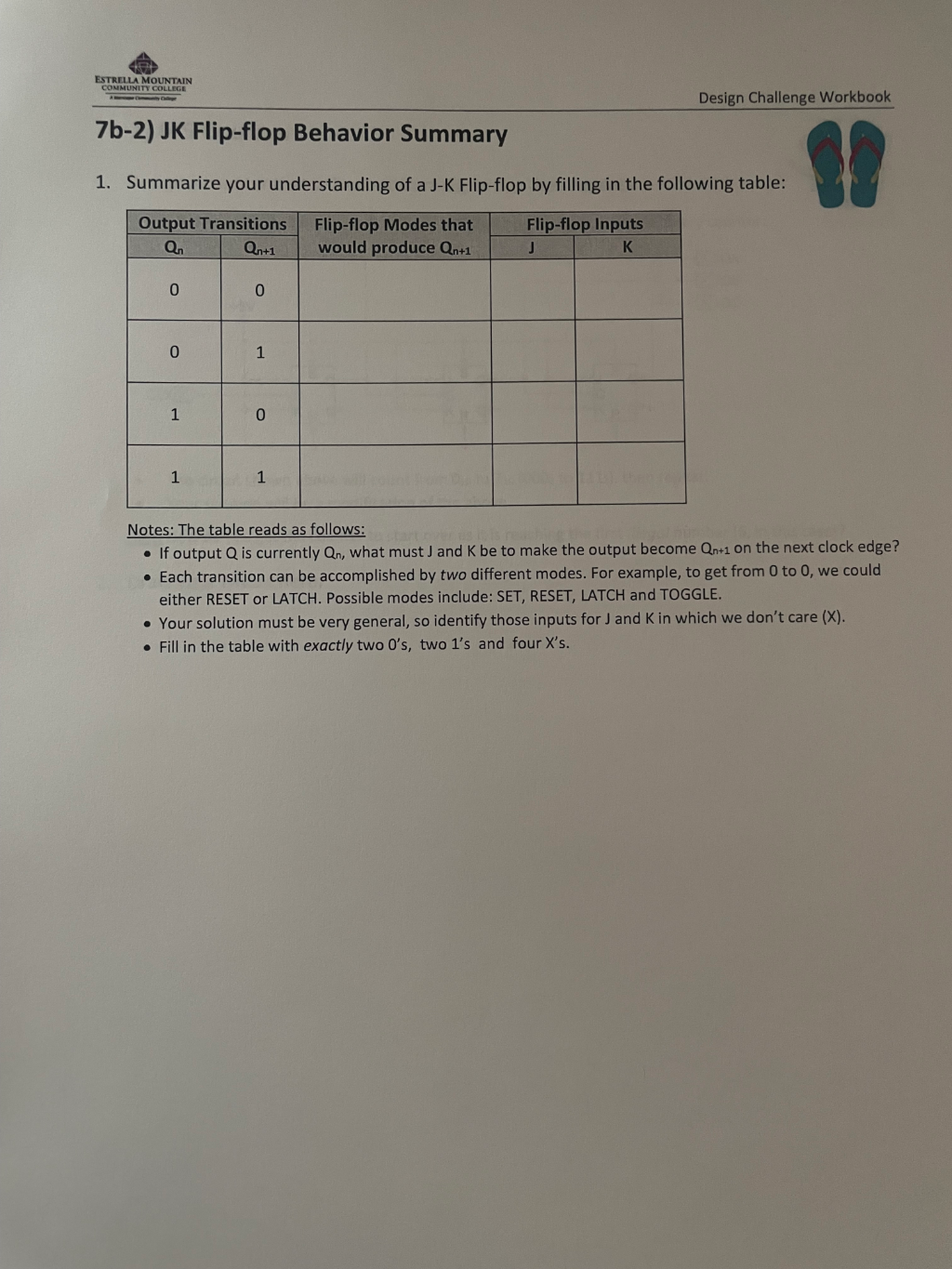
Give step-by-step solution with explanation and final answer:= _—— Design Challenge Workbook 7b-2) JK Flip-flop Behavior Summary 1. Summarize your understanding of a J-K Flip-flop by filling in the following table: Output Transitions | Flip-flop Modes that. Flip-flop Inputs [Qu [ Qu | wouldproduce@us [© J [ "Kk | Notes: The table reads as follows: « If output Q is currently Q-, what must J and K be to make the output become Qns1 on the next clock edge? Each transition can be accomplished by two different modes. For example, to get from 0 to 0, we could either RESET or LATCH. Possible modes include: SET, RESET, LATCH and TOGGLE. « Your solution must be very general, so identify those inputs for J and K in which we don’t care (X). « Fill in the table with exactly two 0's, two 1's and four X's.

Question:

Give step-by-step solution with explanation and final answer:Uploaded Image= _—— Design Challenge Workbook 7b-2) JK Flip-flop Behavior Summary 1. Summarize your understanding of a J-K Flip-flop by filling in the following table: Output Transitions | Flip-flop Modes that. Flip-flop Inputs [Qu [ Qu | wouldproduce@us [© J [ "Kk | Notes: The table reads as follows: « If output Q is currently Q-, what must J and K be to make the output become Qns1 on the next clock edge? Each transition can be accomplished by two different modes. For example, to get from 0 to 0, we could either RESET or LATCH. Possible modes include: SET, RESET, LATCH and TOGGLE. « Your solution must be very general, so identify those inputs for J and K in which we don’t care (X). « Fill in the table with exactly two 0's, two 1's and four X's.
This is AI generated Response.
Asked by: gvr
Created at: 2025-07-29 03:34:06

Final Answer:

Rendered Raw Text
Did you like this answer?
Let's solve the table step-by-step for the **JK Flip-Flop**. ### **JK Flip-Flop Basics** - **J = 0, K = 0:** **No change** (Latch/Memory) - **J = 0, K = 1:** **Reset** (Output goes to 0) - **J = 1, K = 0:** **Set** (Output goes to 1) - **J = 1, K = 1:** **Toggle** (Output switches to opposite state) ### **Step-by-Step Solution** Let's analyze each row of the table. --- #### **Row 1: Qₙ = 0, Qₙ₊₁ = 0** - We want the output to remain 0. - This can happen either by: 1. **Latch/Memory**: No change (J=0, K=0) 2. **Reset**: (J=0, K=1) - So, possible inputs: - J = 0, K = X (K can be either 0 or 1) - J = X, K = 0 (J can be either 0 or 1) - But since J must be 0 for both cases, and K can vary, the correct entry is: - **J = 0, K = X** --- #### **Row 2: Qₙ = 0, Qₙ₊₁ = 1** - We want the output to go from 0 to 1. - This can happen by: 1. **Set**: (J=1, K=0) 2. **Toggle**: (J=1, K=1) - So, possible inputs: - J = 1, K = X - **J = 1, K = X** --- #### **Row 3: Qₙ = 1, Qₙ₊₁ = 0** - We want the output to go from 1 to 0. - This can happen by: 1. **Reset**: (J=0, K=1) 2. **Toggle**: (J=1, K=1) - So, possible inputs: - J = X, K = 1 - **J = X, K = 1** --- #### **Row 4: Qₙ = 1, Qₙ₊₁ = 1** - We want the output to remain 1. - This can happen by: 1. **Latch/Memory**: No change (J=0, K=0) 2. **Set**: (J=1, K=0) - So, possible inputs: - J = X, K = 0 - **J = X, K = 0** --- ### **Summary Table** Let’s fill the table: | Qₙ | Qₙ₊₁ | Flip-flop Modes that would produce Qₙ₊₁ | J | K | |----|-------|-----------------------------------------|----|----| | 0 | 0 | Latch/Reset | 0 | X | | 0 | 1 | Set/Toggle | 1 | X | | 1 | 0 | Reset/Toggle | X | 1 | | 1 | 1 | Latch/Set | X | 0 | --- #### **Check requirements:** - 2 zeros (J or K): ✔️ - 2 ones (J or K): ✔️ - 4 X's: ✔️ --- ### **Final Answer** | Qₙ | Qₙ₊₁ | Flip-flop Modes that would produce Qₙ₊₁ | J | K | |----|-------|-----------------------------------------|----|----| | 0 | 0 | Latch/Reset | 0 | X | | 0 | 1 | Set/Toggle | 1 | X | | 1 | 0 | Reset/Toggle | X | 1 | | 1 | 1 | Latch/Set | X | 0 | Let me know if you need the table in a different format or more explanation!

📢 Instructions:

  • Ask anything relatd to above question only.
  • For new Question goto :

Study Help, Fast Answers

VIPSolutions focuses on clear, step‑by‑step explanations so you can learn quickly. Whether you need an AI‑generated walkthrough or a short hint to get unstuck, each solution is organized for fast reading and easy review later.

Search similar questions, compare approaches, and bookmark the best answers for revision. Our goal is simple: quick, reliable study help that feels natural—not noisy.