 VIPSolutions
Give step-by-step solution with explanation and final answer:(1 point) Consider the initial value problem 0 if0
Question:
Give step-by-step solution with explanation and final answer: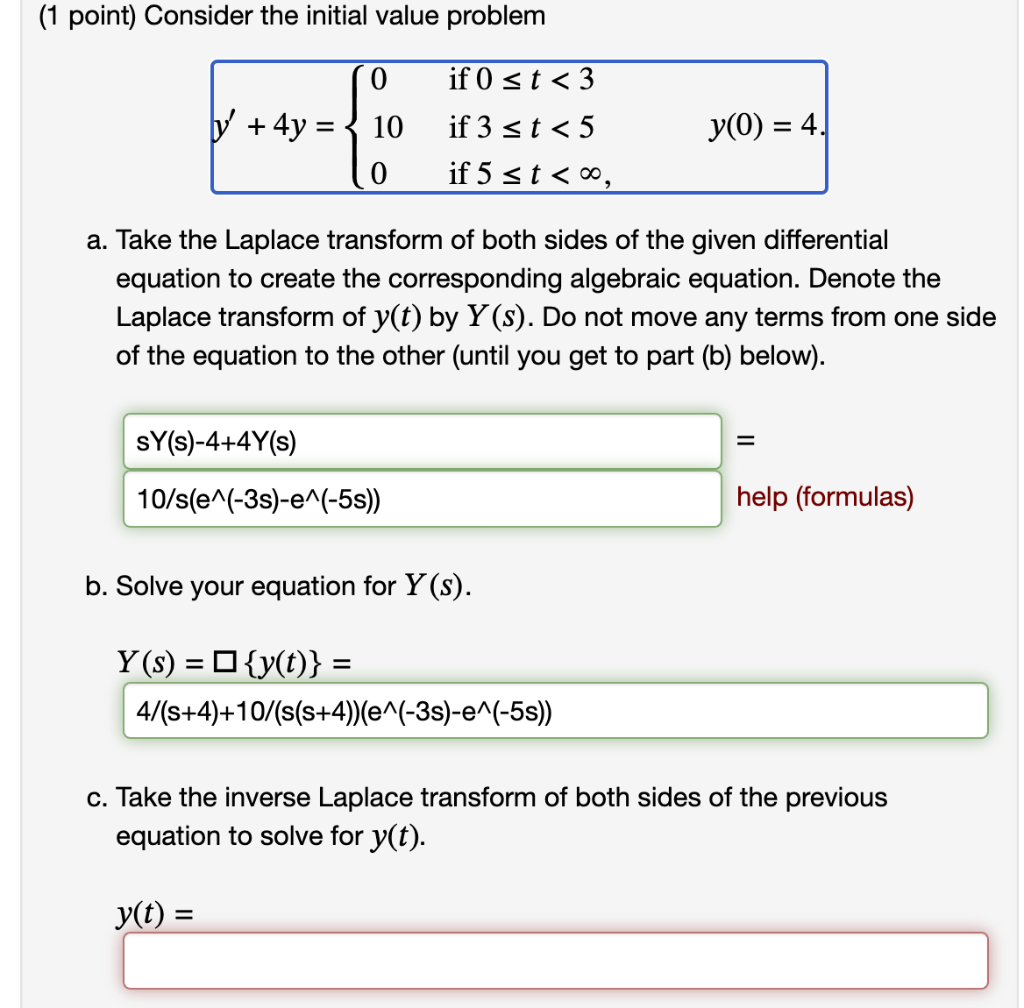 (1 point) Consider the initial value problem
0 if0
This is AI generated Response.
Asked by: gvr
Created at: 2025-07-28 22:42:23
Asked by: gvr
Created at: 2025-07-28 22:42:23
Final Answer:
Rendered
Raw Text
Did you like this answer?
Let's solve part (c) step by step based on the previous answers:
Given:
\[
Y(s) = \frac{4}{s+4} + \frac{10}{(s+4)}\left(\frac{e^{-3s} - e^{-5s}}{s}\right)
\]
### Step 1: Inverse Laplace of Each Term
#### 1. First term: \( \frac{4}{s+4} \)
The inverse Laplace transform is:
\[
\mathcal{L}^{-1}\left\{\frac{4}{s+4}\right\} = 4e^{-4t}
\]
#### 2. Second term: \( \frac{10}{(s+4)} \cdot \frac{e^{-3s} - e^{-5s}}{s} \)
This can be written as:
\[
10 \left( \frac{e^{-3s}}{(s+4)s} - \frac{e^{-5s}}{(s+4)s} \right)
\]
Recall:
\[
\mathcal{L}^{-1}\left\{\frac{e^{-as}}{s} F(s)\right\} = u_a(t)f(t-a)
\]
where \( u_a(t) \) is the unit step function.
\[
\mathcal{L}^{-1}\left\{\frac{1}{s(s+4)}\right\} = \int_0^t e^{-4\tau} d\tau = \frac{1}{4}(1-e^{-4t})
\]
So,
\[
\mathcal{L}^{-1}\left\{\frac{1}{s(s+4)}\right\} = \frac{1}{4}(1-e^{-4t})
\]
Using the shifting property for Laplace transforms:
- For \( e^{-as} \) multiply by \( u_a(t) \) and shift \( t \to t-a \).
So,
\[
\mathcal{L}^{-1}\left\{\frac{e^{-as}}{s(s+4)}\right\} = u_a(t) \cdot \frac{1}{4}(1-e^{-4(t-a)})
\]
### Step 2: Combine Terms
Thus,
\[
y(t) = 4e^{-4t} + 10\left[ u_3(t)\cdot \frac{1}{4}(1-e^{-4(t-3)}) - u_5(t)\cdot \frac{1}{4}(1-e^{-4(t-5)}) \right]
\]
\[
y(t) = 4e^{-4t} + \frac{10}{4}\left[ u_3(t)(1-e^{-4(t-3)}) - u_5(t)(1-e^{-4(t-5)}) \right]
\]
\[
y(t) = 4e^{-4t} + \frac{5}{2}\left[ u_3(t)(1-e^{-4(t-3)}) - u_5(t)(1-e^{-4(t-5)}) \right]
\]
---
### **Final Answer**
\[
\boxed{
y(t) = 4e^{-4t} + \frac{5}{2} \left[ u_3(t)(1 - e^{-4(t-3)}) - u_5(t)(1 - e^{-4(t-5)}) \right]
}
\]
where \( u_a(t) \) is the unit step function.
---
**This is your step-by-step solution and the final answer for \( y(t) \).**
📢 Instructions:
- Ask anything relatd to above question only.
- For new Question goto :