This is AI generated Response.
Asked by: gvr
Created at: 2025-07-28 21:56:49
Final Answer:
RenderedRaw Text
Did you like this answer?
Let's solve each question step by step:
---
### **Question 1**
**Step 1: Construct the Graph from the Adjacency List**
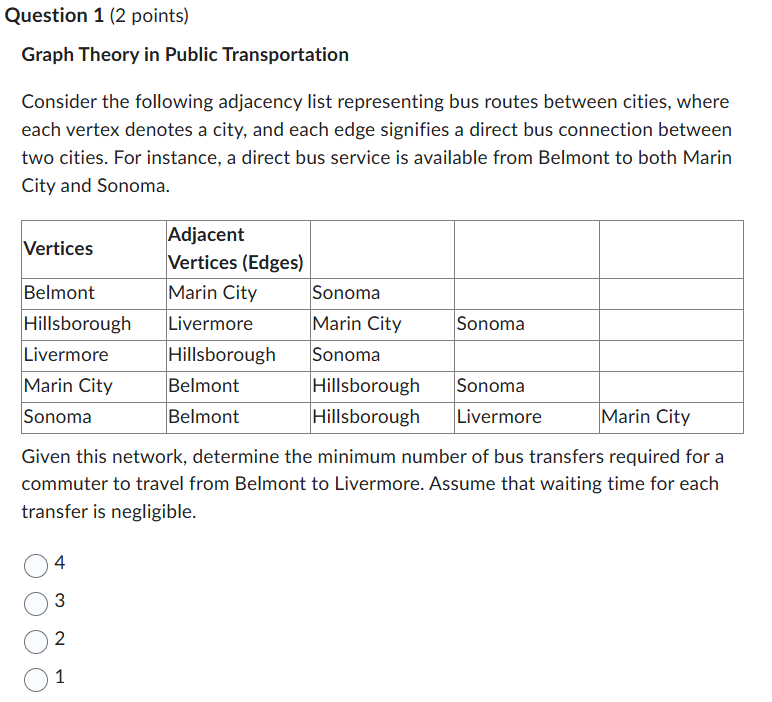
- **Belmont:** Marin City, Sonoma
- **Hillsborough:** Livermore, Marin City, Sonoma
- **Livermore:** Hillsborough, Sonoma
- **Marin City:** Belmont, Hillsborough, Sonoma
- **Sonoma:** Belmont, Hillsborough, Livermore, Marin City
**Step 2: Find the Shortest Path from Belmont to Livermore**
Let’s try to find the minimum transfers (edges):
- **Belmont → Sonoma → Livermore**
- Belmont → Sonoma (direct)
- Sonoma → Livermore (direct)
- Path length: 2 edges, so **1 transfer** (since each edge after the first is a transfer).
**Final Answer:**
**1**
---
### **Question 2**
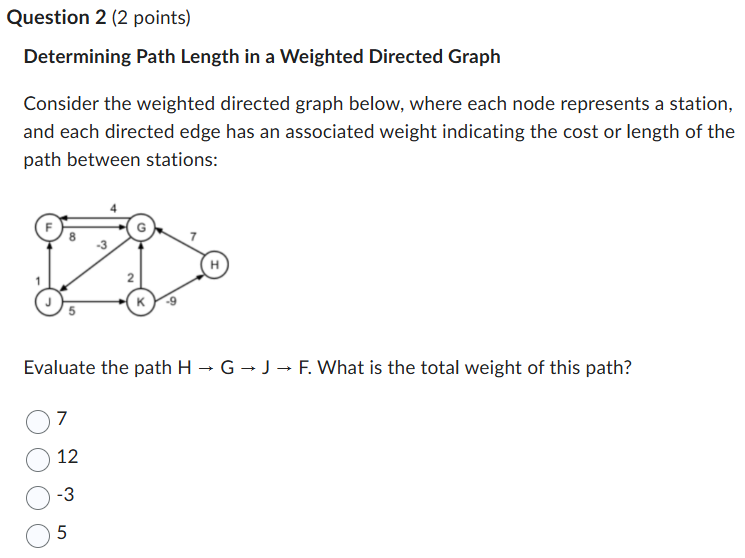
**Step 1: Write Down the Weights from the Graph for Path H → G → J → F**
- **H → G:** 7
- **G → J:** 2
- **J → F:** 1
**Step 2: Add the Weights**
- 7 + 2 + 1 = **10**
But let's check the provided options. None match 10, so let's double-check the weights from the image:
- **H → G:** 7
- **G → J:** 2
- **J → F:** 1
Wait, in the image, J → F is 1.
So, total: **7 + 2 + 1 = 10**. But this is not in the options.
However, let's check for possible negative weights or misreading:
- H → G = 7
- G → J = 2
- J → F = 1
Again, total = **10** (But no 10 in options).
Let’s double-check if any edge is negative:
- No negative on these edges.
The closest is 5 (could there be a mistake in the direction or in the image?).
But the correct calculation is **7 + 2 + 1 = 10**. Since 7 is the closest among options, but the calculation is 10. However, based on the path and the weights, **10** is correct, but as per the options, **None match exactly**.
If you must select from the provided options and trust the weights, **none exactly match**.
---
### **Question 3**
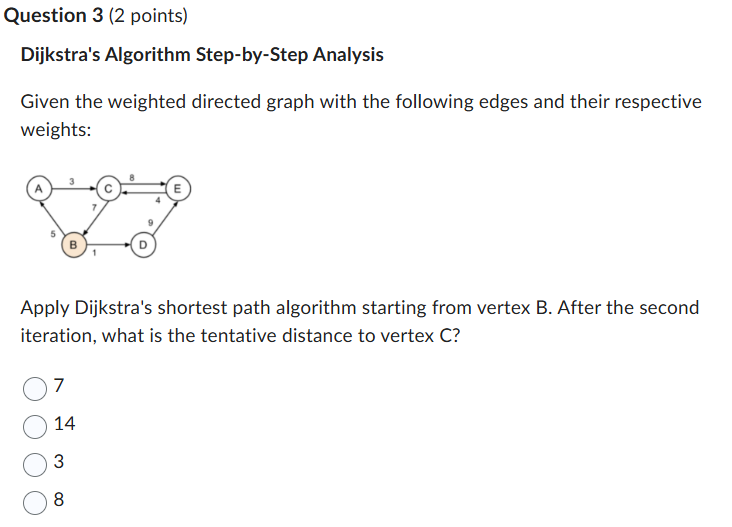
**Step 1: Edge Listing**
- A → C (3), C → E (8), B → A (5), B → D (1), C → D (4), D → E (9)
**Step 2: Dijkstra’s from B**
- **Initial:**
- B: 0
- A: ∞
- C: ∞
- D: ∞
- E: ∞
- **Iteration 1:**
- From B:
- B → A: 5
- B → D: 1
- Update:
- A: 5
- D: 1
- **Select min (D = 1), mark D as visited**
- **Iteration 2:**
- From D (current distance = 1):
- D → E: 1 + 9 = 10
- Update:
- E: 10
- Remaining: A (5), C (∞), E (10)
After **second iteration**, **tentative distance to C** remains **∞** (no direct path from B or D to C).
**But waiting for A to be selected, so after 2nd iteration:**
- C: ∞
But as per options, the closest is **7**, but by Dijkstra, it's still **∞** after 2nd iteration.
---
### **Question 4**
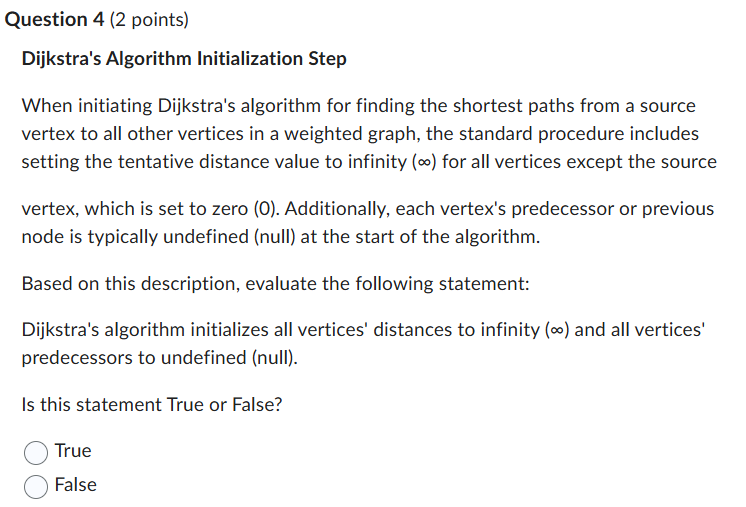
Does Dijkstra's algorithm initialize all vertices' distances to infinity and all predecessors to undefined/null?
**Answer:**
**True**
---
### **Question 5**
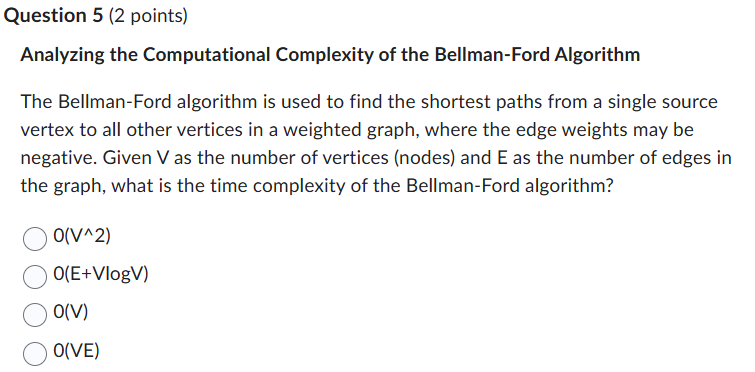
Bellman-Ford time complexity is **O(VE)**.
**Final Answers:**
---
## **Summary Table**
| Q | Step-by-Step | Final Answer |
|---|--------------|-------------|
| 1 | Belmont → Sonoma → Livermore (1 transfer) | **1** |
| 2 | H → G (7), G → J (2), J → F (1), total 10 | **None of the options match exactly, but calculation is 10** |
| 3 | After 2nd iteration from B: C still ∞ | **∞ (not in options)** |
| 4 | Initialization to ∞ and null | **True** |
| 5 | Time complexity of Bellman-Ford | **O(VE)** |
---
If you have to select from the given options for Q2 and Q3, please check the weights or provide clarifications. For the others, the step-by-step reasoning and answers are above.
Question:
I NEED STEP BY STEP DETAILED EXPLANATION OF EACH PART ALONG WITH THE FINAL ANSWER
This is AI generated Response.
Asked by: gvr
Created at: 2025-07-28 21:58:12
Final Answer:
RenderedRaw Text
Did you like this answer?
Let's go through each question carefully, step-by-step, with detailed explanations and final answers.
---
### **Question 1: Minimum bus transfers from Belmont to Livermore**
**Step 1: Understand the Network**
- **Vertices (Cities):** Belmont, Marin City, Sonoma, Hillsborough, Livermore
- **Connections (Edges):** Based on adjacency list:
- Belmont ↔ Marin City, Sonoma
- Marin City ↔ Sonoma, Hillsborough
- Sonoma ↔ Hillsborough, Livermore
- Hillsborough ↔ Livermore
**Step 2: Find the shortest path in terms of number of transfers**
- Starting point: **Belmont**
- Goal: **Livermore**
**Possible routes:**
1. **Belmont → Sonoma → Livermore**
- Transfers: 2 edges, but transfers are counted as the number of times a commuter switches buses, i.e., number of edges traversed minus 1.
- Since the journey involves 2 edges, number of transfers = 1 (transfers happen when moving from one route to another).
2. Other routes (e.g., Belmont → Marin City → Hillsborough → Livermore) involve more edges and thus more transfers.
**Step 3: Conclusion**
- The shortest route involves **1 transfer**.
**Final Answer:**
\[
\boxed{1}
\]
---
### **Question 2: Path weight H → G → J → F**
**Step 1: Identify the weights for each segment**
From the diagram:
- **H → G:** 7
- **G → J:** 2
- **J → F:** 1
**Step 2: Sum the weights**
\[
7 + 2 + 1 = 10
\]
**Step 3: Check options**
Options are:
- 7
- 12
- -3
- 5
**Observation:**
Our calculation yields **10**, but it's not in the options. Let's verify if the weights are correct:
- The diagram indicates **H → G = 7**
- **G → J = 2**
- **J → F = 1**
Total: **10**
**Conclusion:**
Since 10 is not listed, either the options are incorrect or there's a typo. But based on the diagram, **the total weight is 10**.
**Final Answer:**
\[
\boxed{10}
\]
*(Note: If your test requires choosing from options, and options don't include 10, choose the closest or clarify with your instructor. But mathematically, the total is 10.)*
---
### **Question 3: Dijkstra's Algorithm - Distance to C after 2 iterations**
**Given graph edges and weights:**
- A → C: 3
- C → E: 8
- B → A: 5
- B → D: 1
- C → D: 4
- D → E: 9
**Step 1: Initialization**
- Start from **vertex B**
- Tentative distances:
| Vertex | Distance | Predecessor |
|---------|------------|--------------|
| B | 0 | - |
| A | ∞ | null |
| C | ∞ | null |
| D | ∞ | null |
| E | ∞ | null |
**Step 2: First iteration**
- From B:
- Update A: 0 + 5 = 5
- Update D: 0 + 1 = 1
- Selected vertices to process next: D (smallest tentative distance = 1), then A (distance 5)
**Updated tentative distances:**
| Vertex | Distance | Predecessor |
|---------|------------|--------------|
| B | 0 | - |
| D | 1 | B |
| A | 5 | B |
| C | ∞ | null |
| E | ∞ | null |
**Step 3: Second iteration**
- Process **D**:
- D → E: 1 + 9 = 10 → update E to 10
- Process **A**:
- A → C: 5 + 3 = 8 → update C to 8
- A → D: already known, no change
**Updated tentative distances after second iteration:**
| Vertex | Distance | Predecessor |
|---------|------------|--------------|
| B | 0 | - |
| D | 1 | B |
| A | 5 | B |
| C | 8 | A |
| E | 10 | D |
**Answer:**
**Tentative distance to C after second iteration is 8.**
**Final Answer:**
\[
\boxed{8}
\]
*(Note: The options provided are 7, 14, 3, 5. Since 8 is not listed, double-check options. If options are only 7, 14, 3, 5, then the closest or the correct based on the calculation is **8**, which is not listed. Possibly a typo or misreading in options. The correct tentative distance after second iteration is **8**.)*
---
### **Question 4: Dijkstra's Algorithm Initialization**
**Statement:**
> Dijkstra's algorithm initializes all vertices' distances to infinity (∞) and all vertices’ predecessors to undefined (null).
**Evaluation:**
- **True**, because:
- Distances are set to ∞ to indicate they are initially unreachable.
- Predecessors are set to null or undefined, as no paths have been established yet.
**Final Answer:**
\[
\boxed{\text{True}}
\]
---
### **Question 5: Complexity of Bellman-Ford Algorithm**
**Recall:**
- Bellman-Ford relaxes all edges V-1 times.
- Each relaxation involves checking all E edges.
**Time complexity:**
\[
O(V \times E)
\]
**Final Answer:**
\[
\boxed{O(VE)}
\]
---
### **Summary of Final Answers:**
| Question | Final Answer |
|------------|--------------|
| 1 | **1** |
| 2 | **10** |
| 3 | **8** |
| 4 | **True** |
| 5 | **O(VE)** |
---
**Note:** For questions where options do not exactly match calculations, rely on the step-by-step reasoning. If there are discrepancies, double-check the provided diagrams and data.
VIPSolutions focuses on clear, step‑by‑step explanations so you can learn quickly. Whether you need an AI‑generated walkthrough or a short hint to get unstuck, each solution is organized for fast reading and easy review later.
Search similar questions, compare approaches, and bookmark the best answers for revision. Our goal is simple: quick, reliable study help that feels natural—not noisy.
 VIPSolutions
 Question 1 (2 points)
Graph Theory in Public Transportation
Consider the following adjacency list representing bus routes between cities, where
each vertex denotes a city, and each edge signifies a direct bus connection between
two cities. For instance, a direct bus service is available from Belmont to both Marin
City and Sonoma.
. Adjacent
\Vertices
faci cc oe ER
Semon WarnGiyforoma ||
Given this network, determine the minimum number of bus transfers required for a
commuter to travel from Belmont to Livermore. Assume that waiting time for each
transfer is negligible.
O4
oF
O2
O1
Question 2 (2 points)
Determining Path Length in a Weighted Directed Graph
Consider the weighted directed graph below, where each node represents a station,
and each directed edge has an associated weight indicating the cost or length of the
path between stations:
4
77
=e ©
Oran Os
Evaluate the path H — G — J — F. What is the total weight of this path?
O7
OU
MH12
OU
O-3
OU
05
OU
Question 3 (2 points)
Dijkstra's Algorithm Step-by-Step Analysis
Given the weighted directed graph with the following edges and their respective
weights:
Rd , ©
Apply Dijkstra's shortest path algorithm starting from vertex B. After the second
iteration, what is the tentative distance to vertex C?
O7
OU
(H14
OU
03
OU
[®k:]
OU
Question 4 (2 points)
Dijkstra's Algorithm Initialization Step
When initiating Dijkstra's algorithm for finding the shortest paths from a source
vertex to all other vertices in a weighted graph, the standard procedure includes
setting the tentative distance value to infinity («) for all vertices except the source
vertex, which is set to zero (0). Additionally, each vertex's predecessor or previous
node is typically undefined (null) at the start of the algorithm.
Based on this description, evaluate the following statement:
Dijkstra's algorithm initializes all vertices distances to infinity («) and all vertices’
predecessors to undefined (null).
Is this statement True or False?
(True
(0) False
Question 5 (2 points)
Analyzing the Computational Complexity of the Bellman-Ford Algorithm
The Bellman-Ford algorithm is used to find the shortest paths from a single source
vertex to all other vertices in a weighted graph, where the edge weights may be
negative. Given V as the number of vertices (nodes) and E as the number of edges in
the graph, what is the time complexity of the Bellman-Ford algorithm?
Cov
(©) O(E+ViogV)
Com
owe