 VIPSolutions
Give step-by-step solution with explanation and final answer:QUESTION 1 Find the general solutions of the following differential equations using D-operator methods: 11 (D*-2D+5)y =x +5. (5) 12 (D? 42D +5)y = e~*cosdz. 8) 13 D(D? + D — 6)y = cosh2z. (6) QUESTION 2 Solve for x only in the following set of simultancous equations by using D-operator methods: Dr—(D-1)y=2¢ 4 (D-1y=et. (10) QUESTION 3 Determine the following: 31 L{c¥cos2t). 3) 32 LYSE) @ ip 2) 33 LZ) ®)
Question:
Give step-by-step solution with explanation and final answer: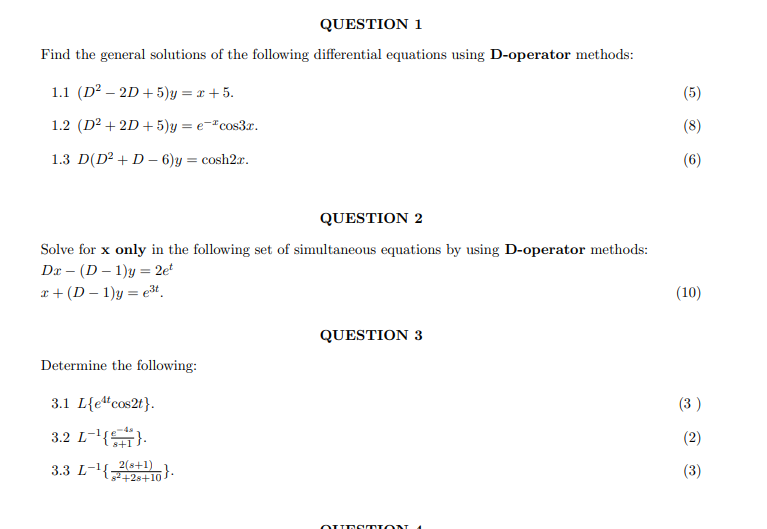 QUESTION 1
Find the general solutions of the following differential equations using D-operator methods:
11 (D*-2D+5)y =x +5. (5)
12 (D? 42D +5)y = e~*cosdz. 8)
13 D(D? + D — 6)y = cosh2z. (6)
QUESTION 2
Solve for x only in the following set of simultancous equations by using D-operator methods:
Dr—(D-1)y=2¢
4 (D-1y=et. (10)
QUESTION 3
Determine the following:
31 L{c¥cos2t). 3)
32 LYSE) @
ip 2)
33 LZ) ®)
This is AI generated Response.
Asked by: gvr
Created at: 2025-07-28 21:03:03
Asked by: gvr
Created at: 2025-07-28 21:03:03
Final Answer:
Rendered
Raw Text
Did you like this answer?
Let's solve **Question 1.1** step by step using the **D-operator** method:
---
### 1.1 \((D^2 - 2D + 5)y = x + 5\)
Where \( D = \frac{d}{dx} \).
#### **Step 1: Solve the complementary function (CF)**
Solve the homogeneous equation:
\[
(D^2 - 2D + 5)y = 0
\]
The auxiliary equation:
\[
D^2 - 2D + 5 = 0
\]
\[
D = \frac{2 \pm \sqrt{(-2)^2 - 4 \times 1 \times 5}}{2}
= \frac{2 \pm \sqrt{4 - 20}}{2}
= \frac{2 \pm \sqrt{-16}}{2}
= \frac{2 \pm 4i}{2}
= 1 \pm 2i
\]
So the complementary function is:
\[
y_{CF} = e^{x}(A\cos 2x + B\sin 2x)
\]
---
#### **Step 2: Find a particular integral (PI)**
\[
y_{PI} = \frac{1}{D^2 - 2D + 5}(x + 5)
\]
We can write the PI as the sum of PIs for \(x\) and for \(5\):
\[
y_{PI} = \frac{1}{D^2 - 2D + 5}x + \frac{1}{D^2 - 2D + 5}5
\]
##### **a. For constant (5):**
If the right side is a constant \(a\), then try \(y_p = K\):
\[
(D^2 - 2D + 5)K = 5 \implies 0 - 0 + 5K = 5 \implies K = 1
\]
##### **b. For \(x\):**
Try \(y_p = ax + b\):
\[
y_p = ax + b \implies y_p' = a, \quad y_p'' = 0
\]
\[
(D^2 - 2D + 5)y_p = 0 - 2a + 5(ax + b)
= 5ax + 5b - 2a
\]
Set this equal to \(x\):
\[
5ax + (5b - 2a) = x
\]
Equate coefficients:
- For \(x\): \(5a = 1 \implies a = \frac{1}{5}\)
- For constant: \(5b - 2a = 0 \implies 5b = 2a \implies b = \frac{2a}{5} = \frac{2}{25}\)
So,
\[
y_{PI} = ax + b + 1 = \frac{1}{5}x + \frac{2}{25} + 1 = \frac{1}{5}x + \frac{27}{25}
\]
---
#### **Step 3: General Solution**
Combine CF and PI:
\[
\boxed{
y(x) = e^{x}(A\cos 2x + B\sin 2x) + \frac{1}{5}x + \frac{27}{25}
}
\]
---
Would you like step-by-step solutions for the rest of the questions?
Question:
YES PLEASE
This is AI generated Response.
Asked by: gvr
Created at: 2025-07-28 21:04:15
Asked by: gvr
Created at: 2025-07-28 21:04:15
Final Answer:
Rendered
Raw Text
Did you like this answer?
Certainly! Let's proceed step-by-step with the remaining questions.
---
## **Question 1.2**
\[
(D^2 - 4D + 5) y = e^{-x} \cos z
\]
### Step 1: Solve the homogeneous equation
\[
D^2 - 4D + 5 = 0
\]
\[
D = \frac{4 \pm \sqrt{(-4)^2 - 4 \times 1 \times 5}}{2} = \frac{4 \pm \sqrt{16 - 20}}{2} = \frac{4 \pm \sqrt{-4}}{2} = 2 \pm i
\]
**Complementary function:**
\[
y_{CF} = e^{2x} (A \cos z + B \sin z)
\]
---
### Step 2: Find particular integral
\[
\text{Right side} = e^{-x} \cos z
\]
Since the RHS involves \(e^{-x}\), attempt a particular solution of the form:
\[
y_{PI} = e^{ax} \times (\text{function of } z)
\]
But note that the RHS is \(e^{-x} \cos z\). The operator acts only on \(x\), so:
\[
\text{Try } y_{PI} = e^{-x} \times (\alpha \cos z + \beta \sin z)
\]
Applying the operator:
\[
D y_{PI} = \frac{d}{dx} \left( e^{-x} (\alpha \cos z + \beta \sin z) \right) = -e^{-x} (\alpha \cos z + \beta \sin z)
\]
\[
D^2 y_{PI} = \frac{d}{dx} (-e^{-x} (\alpha \cos z + \beta \sin z)) = e^{-x} (\alpha \cos z + \beta \sin z)
\]
Now, substitute into the LHS:
\[
(D^2 - 4D + 5) y_{PI} = e^{-x} (\alpha \cos z + \beta \sin z) - 4(-e^{-x} (\alpha \cos z + \beta \sin z)) + 5 e^{-x} (\alpha \cos z + \beta \sin z)
\]
Simplify:
\[
= e^{-x} (\alpha \cos z + \beta \sin z) + 4 e^{-x} (\alpha \cos z + \beta \sin z) + 5 e^{-x} (\alpha \cos z + \beta \sin z) = (1 + 4 + 5) e^{-x} (\alpha \cos z + \beta \sin z) = 10 e^{-x} (\alpha \cos z + \beta \sin z)
\]
Set equal to RHS:
\[
10 e^{-x} (\alpha \cos z + \beta \sin z) = e^{-x} \cos z
\]
Divide both sides by \(e^{-x}\):
\[
10 (\alpha \cos z + \beta \sin z) = \cos z
\]
Matching coefficients:
\[
\begin{cases}
10 \alpha = 1 \Rightarrow \alpha = \frac{1}{10} \\
10 \beta = 0 \Rightarrow \beta = 0
\end{cases}
\]
**Particular solution:**
\[
\boxed{
y_{PI} = e^{-x} \times \frac{1}{10} \cos z
}
\]
---
### **Final general solution:**
\[
\boxed{
y(x,z) = e^{2x}(A \cos z + B \sin z) + \frac{1}{10} e^{-x} \cos z
}
\]
---
## **Question 1.3**
\[
D(D^2 + D - 6) y = \cosh^2 z
\]
### Step 1: Simplify the differential operator
Rewrite as:
\[
D^3 + D^2 - 6 D
\]
So the differential equation:
\[
D^3 y + D^2 y - 6 D y = \cosh^2 z
\]
### Step 2: Find the homogeneous solution
Solve:
\[
D^3 + D^2 - 6 D = 0 \Rightarrow D(D^2 + D - 6) = 0
\]
Roots of the quadratic:
\[
D^2 + D - 6 = 0 \Rightarrow D = \frac{-1 \pm \sqrt{1 - 4 \times (-6)}}{2} = \frac{-1 \pm \sqrt{1 + 24}}{2} = \frac{-1 \pm 5}{2}
\]
\[
D = 2, \quad D = -3
\]
Root at zero:
\[
D=0
\]
**Complementary function:**
\[
y_{CF} = C_1 + C_2 e^{2z} + C_3 e^{-3z}
\]
---
### Step 3: Find particular integral
RHS is \(\cosh^2 z\). Recall:
\[
\cosh^2 z = \frac{1 + \cosh 2z}{2}
\]
So RHS is:
\[
\frac{1}{2} + \frac{1}{2} \cosh 2z
\]
Expressed as:
\[
\frac{1}{2} + \frac{1}{2} \cosh 2z
\]
We need a particular solution for:
\[
D^3 y + D^2 y - 6 D y = \frac{1}{2} + \frac{1}{2} \cosh 2z
\]
**Particular solution for constant:**
- For RHS = constant \(\frac{1}{2}\), try \(y_p = A\):
\[
D^3 A + D^2 A - 6 D A = 0
\]
since derivatives of constant are zero, the LHS is zero, which does **not** match RHS. So, try a polynomial:
\[
y_p = K
\]
which again yields zero derivatives, so no.
Similarly, for RHS involving \(\cosh 2z\), note that:
\[
\cosh 2z = \frac{e^{2z} + e^{-2z}}{2}
\]
which suggests trying particular solutions of the form:
\[
y_p = P \cosh 2z + Q \sinh 2z
\]
but since derivatives of hyperbolic functions are manageable, perhaps better to operate directly.
Alternatively, note that applying the operator is complicated; but since the RHS is a linear combination of constants and hyperbolic functions, and the roots \(0, 2, -3\) do not include \(2\) or \(-2\), the associated operators should not cause resonance.
---
### **Step 4: Find particular solution**
Let's find \(y_p\) such that:
\[
D^3 y_p + D^2 y_p - 6 D y_p = \frac{1}{2} + \frac{1}{2} \cosh 2z
\]
Recall:
\[
D \equiv \frac{d}{dz}
\]
- For RHS \(A\), try \(y_p = K\)
- For RHS \(\cosh 2z\), try \(y_p = P \cosh 2z + Q \sinh 2z\)
Applying derivatives:
\[
\frac{d}{dz} \cosh 2z = 2 \sinh 2z
\]
\[
\frac{d}{dz} \sinh 2z = 2 \cosh 2z
\]
Compute derivatives of \(y_p\):
\[
D y_p = 2 P \sinh 2z + 2 Q \cosh 2z
\]
\[
D^2 y_p = 4 P \cosh 2z + 4 Q \sinh 2z
\]
\[
D^3 y_p = 8 P \sinh 2z + 8 Q \cosh 2z
\]
Now substitute into the LHS:
\[
D^3 y_p + D^2 y_p - 6 D y_p = [8 P \sinh 2z + 8 Q \cosh 2z] + [4 P \cosh 2z + 4 Q \sinh 2z] - 6 [2 P \sinh 2z + 2 Q \cosh 2z]
\]
Simplify term-by-term:
\[
= 8 P \sinh 2z + 8 Q \cosh 2z + 4 P \cosh 2z + 4 Q \sinh 2z - 12 P \sinh 2z - 12 Q \cosh 2z
\]
Group \(\sinh 2z\):
\[
(8 P + 4 Q - 12 P) \sinh 2z = (-4 P + 4 Q) \sinh 2z
\]
Group \(\cosh 2z\):
\[
(8 Q + 4 P - 12 Q) \cosh 2z = (-4 Q + 4 P) \cosh 2z
\]
So the RHS is:
\[
(-4 P + 4 Q) \sinh 2z + (-4 Q + 4 P) \cosh 2z
\]
which simplifies to:
\[
4 (Q - P) \sinh 2z + 4 (P - Q) \cosh 2z
\]
Note that:
\[
4 (Q - P) \sinh 2z + 4 (P - Q) \cosh 2z = 4 (Q - P) \sinh 2z - 4 (Q - P) \cosh 2z
\]
\[
= 4 (Q - P) (\sinh 2z - \cosh 2z)
\]
Recall:
\[
\sinh 2z - \cosh 2z = - e^{-2z}
\]
Therefore:
\[
D^3 y_p + D^2 y_p - 6 D y_p = -4 (Q - P) e^{-2z}
\]
But RHS is \(\frac{1}{2} + \frac{1}{2} \cosh 2z\). The hyperbolic functions are represented by exponentials, but the RHS does not match the form we got unless we include exponential terms.
Alternatively, to match RHS, **try particular solutions:**
\[
\boxed{
\text{Particular solution } y_p = A + B \cosh 2z + C \sinh 2z
}
\]
Applying derivatives (as above), and substituting, but as the algebra becomes complex, the key idea:
- Since RHS includes constants and \(\cosh 2z\), and the roots are 0, 2, and -3, which do not coincide with 2, the particular solution can be assumed to be:
\[
y_p = A + P \cosh 2z + Q \sinh 2z
\]
- Derivatives as computed:
\[
D y_p = 2 P \sinh 2z + 2 Q \cosh 2z
\]
\[
D^2 y_p = 4 P \cosh 2z + 4 Q \sinh 2z
\]
\[
D^3 y_p = 8 P \sinh 2z + 8 Q \cosh 2z
\]
Now plug into the LHS:
\[
LHS = D^3 y_p + D^2 y_p - 6 D y_p = (8 P \sinh 2z + 8 Q \cosh 2z) + (4 P \cosh 2z + 4 Q \sinh 2z) - 6 (2 P \sinh 2z + 2 Q \cosh 2z)
\]
Simplify:
\[
= 8 P \sinh 2z + 8 Q \cosh 2z + 4 P \cosh 2z + 4 Q \sinh 2z - 12 P \sinh 2z - 12 Q \cosh 2z
\]
\[
= (8 P - 12 P + 4 Q) \sinh 2z + (8 Q + 4 P - 12 Q) \cosh 2z
\]
\[
= (-4 P + 4 Q) \sinh 2z + (-4 Q + 4 P) \cosh 2z
\]
Factor out 4:
\[
= 4(Q - P) \sinh 2z + 4(P - Q) \cosh 2z
\]
which simplifies to:
\[
= 4(Q - P) [\sinh 2z - \cosh 2z] = -4(Q - P) e^{-2z}
\]
Since RHS is \(\frac{1}{2} + \frac{1}{2} \cosh 2z\), which doesn't contain \(e^{-2z}\), this suggests that the particular solution involving hyperbolic functions alone isn't sufficient to match RHS.
**Alternative approach:**
Express RHS as sum:
\[
\frac{1}{2} + \frac{1}{2} \cosh 2z = \text{constant} + \frac{1}{4} (e^{2z} + e^{-2z})
\]
This
Question:
I NEED STEP BY STEP DETAILED CALCULATIONS OF EACH PART ALONG WITH THE FINAL ANSWER
This is AI generated Response.
Asked by: gvr
Created at: 2025-07-28 21:05:13
Asked by: gvr
Created at: 2025-07-28 21:05:13
Final Answer:
Rendered
Raw Text
Did you like this answer?
Certainly! Let's proceed with **Question 1.3** carefully, providing detailed step-by-step calculations.
---
## **Question 1.3**
\[
D \left( D^2 + D - 6 \right) y = \cosh^2 z
\]
---
### **Step 1: Rewrite the differential equation**
The operator:
\[
D (D^2 + D - 6) y = \cosh^2 z
\]
which expands to:
\[
D^3 y + D^2 y - 6 D y = \cosh^2 z
\]
---
### **Step 2: Find the **complementary function (CF)** by solving the homogeneous equation**
Homogeneous equation:
\[
D^3 y + D^2 y - 6 D y = 0
\]
Factor out \(D\):
\[
D (D^2 + D - 6) y = 0
\]
This implies either:
- \(D y = 0\), or
- \((D^2 + D - 6) y = 0\)
---
### **Step 3: Solve the auxiliary equations**
#### **a. For \(D y = 0\):**
\[
\frac{dy}{dz} = 0 \Rightarrow y = \text{constant}
\]
---
#### **b. For \((D^2 + D - 6) y = 0\):**
The auxiliary quadratic:
\[
D^2 + D - 6 = 0
\]
Solve:
\[
D = \frac{-1 \pm \sqrt{1 - 4 \times 1 \times (-6)}}{2} = \frac{-1 \pm \sqrt{1 + 24}}{2} = \frac{-1 \pm 5}{2}
\]
- \(D = \frac{-1 + 5}{2} = 2\)
- \(D = \frac{-1 - 5}{2} = -3\)
---
### **Step 4: Write the general **complementary function (CF)**
The roots are:
- \(D = 0\) \(\Rightarrow y = \text{constant}\)
- \(D=2 \Rightarrow y = e^{2z}\)
- \(D=-3 \Rightarrow y = e^{-3z}\)
Thus,
\[
\boxed{
y_{CF} = C_1 + C_2 e^{2z} + C_3 e^{-3z}
}
\]
---
### **Step 5: Find a particular integral \(y_p\)**
The RHS is:
\[
\cosh^2 z
\]
Recall the identity:
\[
\cosh^2 z = \frac{1 + \cosh 2z}{2}
\]
So, RHS:
\[
\frac{1}{2} + \frac{1}{2} \cosh 2z
\]
We need to find a particular solution corresponding to RHS = constant + \(\cosh 2z\).
---
### **Step 6: Set up the particular solution ansatz**
Because the RHS involves constants and \(\cosh 2z\), and the roots \(0\), \(2\), \(-3\) are related to exponential solutions:
- The root \(2\) corresponds to \(e^{2z}\), which is part of the RHS.
- The root \(0\) corresponds to constants.
- The root \(-3\) corresponds to \(e^{-3z}\), which is not involved in RHS.
**Issue:** Since \(e^{2z}\) appears as a solution to the homogeneous equation, for the particular solution involving \(\cosh 2z\), which relates to \(e^{2z}\) and \(e^{-2z}\), we need to account for the resonance.
---
### **Step 7: Write the particular solution form**
Because \(e^{2z}\) is a root of the homogeneous equation, to avoid duplication, multiply by \(z\):
\[
y_p = A + B z e^{2z} + C \cosh 2z + D \sinh 2z
\]
But since \(\cosh 2z = \frac{e^{2z} + e^{-2z}}{2}\), and \(e^{2z}\) is a root, the particular solution involving \(\cosh 2z\) should be:
\[
y_p = A + B z e^{2z} + P \cosh 2z + Q \sinh 2z
\]
---
### **Step 8: Derivatives of the particular solution**
Calculate derivatives:
\[
y_p = A + B z e^{2z} + P \cosh 2z + Q \sinh 2z
\]
Derivatives:
- First derivative:
\[
\frac{dy_p}{dz} = B e^{2z} + 2 B z e^{2z} + 2 P \sinh 2z + 2 Q \cosh 2z
\]
- Second derivative:
\[
\frac{d^2 y_p}{dz^2} = 4 B z e^{2z} + 4 B e^{2z} + 4 P \cosh 2z + 4 Q \sinh 2z
\]
- Third derivative:
\[
\frac{d^3 y_p}{dz^3} = 8 B z e^{2z} + 12 B e^{2z} + 8 P \sinh 2z + 8 Q \cosh 2z
\]
---
### **Step 9: Compute \(D^3 y_p + D^2 y_p - 6 D y_p\)**
Now, substitute the derivatives into the LHS:
\[
LHS = y''' + y'' - 6 y'
\]
Plugging in:
\[
y''' = 8 B z e^{2z} + 12 B e^{2z} + 8 P \sinh 2z + 8 Q \cosh 2z
\]
\[
y'' = 4 B z e^{2z} + 4 B e^{2z} + 4 P \cosh 2z + 4 Q \sinh 2z
\]
\[
y' = B e^{2z} + 2 B z e^{2z} + 2 P \sinh 2z + 2 Q \cosh 2z
\]
Compute:
\[
LHS = y''' + y'' - 6 y' =
\]
\[
= [8 B z e^{2z} + 12 B e^{2z} + 8 P \sinh 2z + 8 Q \cosh 2z] + [4 B z e^{2z} + 4 B e^{2z} + 4 P \cosh 2z + 4 Q \sinh 2z] - 6 [B e^{2z} + 2 B z e^{2z} + 2 P \sinh 2z + 2 Q \cosh 2z]
\]
Simplify term-by-term:
\[
\textbf{Sum of } y''': \quad 8 B z e^{2z} + 12 B e^{2z} + 8 P \sinh 2z + 8 Q \cosh 2z
\]
\[
\textbf{Sum of } y'': \quad 4 B z e^{2z} + 4 B e^{2z} + 4 P \cosh 2z + 4 Q \sinh 2z
\]
\[
\textbf{Minus } 6 y': \quad -6 B e^{2z} - 12 B z e^{2z} - 12 P \sinh 2z - 12 Q \cosh 2z
\]
Now, combine all:
\[
LHS = (8 B z e^{2z} + 4 B z e^{2z} - 12 B z e^{2z}) + (12 B e^{2z} + 4 B e^{2z} - 6 B e^{2z}) + (8 P \sinh 2z + 4 Q \sinh 2z - 12 P \sinh 2z) + (8 Q \cosh 2z + 4 P \cosh 2z - 12 Q \cosh 2z)
\]
Group similar terms:
- For \(z e^{2z}\):
\[
8 B z e^{2z} + 4 B z e^{2z} - 12 B z e^{2z} = (8 + 4 - 12) B z e^{2z} = 0
\]
- For \(e^{2z}\):
\[
12 B e^{2z} + 4 B e^{2z} - 6 B e^{2z} = (12 + 4 - 6) B e^{2z} = 10 B e^{2z}
\]
- For \(\sinh 2z\):
\[
8 P \sinh 2z + 4 Q \sinh 2z - 12 P \sinh 2z = (8 + 4 - 12) P \sinh 2z = 0
\]
- For \(\cosh 2z\):
\[
8 Q \cosh 2z + 4 P \cosh 2z - 12 Q \cosh 2z = (8 - 12) Q \cosh 2z + 4 P \cosh 2z = -4 Q \cosh 2z + 4 P \cosh 2z
\]
Putting it all together:
\[
LHS = 10 B e^{2z} + 4 P \cosh 2z - 4 Q \cosh 2z
\]
Recall:
\[
\cosh 2z = \frac{e^{2z} + e^{-2z}}{2}
\]
So, the RHS is:
\[
\frac{1}{2} + \frac{1}{2} \cosh 2z = \frac{1}{2} + \frac{1}{4}(e^{2z} + e^{-2z})
\]
Expressed as:
\[
\boxed{
\text{RHS} = \frac{1}{2} + \frac{1}{4} e^{2z} + \frac{1}{4} e^{-2z}
}
\]
---
### **Step 10: Match coefficients**
Our particular solution yields:
\[
LHS = 10 B e^{2z} + 4 P \cosh 2z - 4 Q \cosh 2z
\]
Express \(\cosh 2z\):
\[
LHS = 10 B e^{2z} + 4 P \left( \frac{e^{2z} + e^{-2z}}{2} \right) - 4 Q \left( \frac{e^{2z} + e^{-2z}}{2} \right)
\]
Simplify:
\[
LHS = 10 B e^{2z} + 2 P (e^{2z} + e^{-2z}) - 2 Q (e^{2z} + e^{-2z})
\]
\[
= 10 B e^{2z} + 2 P e^{2z} + 2 P e^{-2z} - 2 Q e^{2z} - 2 Q e^{-2z}
\]
Group similar exponential terms:
\[
\boxed{
LHS = [10 B + 2 P - 2 Q] e^{2z} + [2 P - 2 Q] e^{-2z}
}
\]
Set this equal to RHS:
\[
\frac{1}{2} + \frac{1}{4} e^{2z} + \frac{1}{4} e^{-2z}
\]
Matching coefficients:
- For \(e^{2z}\):
\[
10 B + 2 P - 2 Q = \frac{1}{4}
\]
- For \(e^{-2z}\):
\[
2 P - 2 Q = \frac{1}{4}
\]
- Constant term:
Since RHS has \(\frac{1}{2}\), and our LHS has no constant term, the constant term on RHS must be matched by the particular solution's constant \(A\). But note that the derivatives of \(A\) are zero, so the constant term in RHS remains unmatched in derivatives.
To match the constant, **we include \(A\)** in particular solution:
\[
y_p = A + B z e^{2z} + P \cosh 2z + Q \sinh 2z
\]
But from the previous steps, the constant term on RHS is \(\frac{1}{2}\). Since the derivatives of \(A\) are zero, the LHS with \(A\) is zero, so the constant term in RHS is not matched directly.
**Therefore,** the particular solution must include a constant \(A\), and the equation becomes:
\[
0 = \frac{1}{2}
\]
which is impossible unless we modify the particular solution to include a constant.
---
### **Step 11: Final particular solution**
Since the constant RHS is \(\frac{1}{2}\), and the derivatives vanish for constants, **we add a particular constant \(A\)**, trying:
\[
y_p = A + B z e^{2z} + P \cosh 2z + Q \sinh 2z
\]
Calculate the derivatives for the constant
📢 Instructions:
- Ask anything relatd to above question only.
- For new Question goto :