 VIPSolutions
Give step-by-step solution with explanation and final answer:Reaching a Financial Goal You need to accumulate $10,000. To do so, you plan to make deposits of $1,150 per year - with the first payment being made a year from today - into a bank account that pays 8% annual interest. Your last deposit will be less than $1,150 if less is needed to round out to $10,000. How many years wil it take you to reach your $10,000 goal? Do not round intermediate calculations. Round your answer up to the nearest whole number. year(s) How large will the last deposit be ? Do not round intermediate calculations. Round your answer to the nearest cent.
Question:
Give step-by-step solution with explanation and final answer: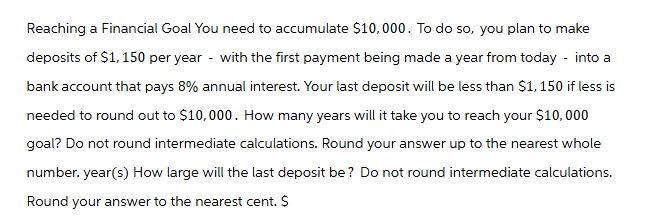 Reaching a Financial Goal You need to accumulate $10,000. To do so, you plan to make
deposits of $1,150 per year - with the first payment being made a year from today - into a
bank account that pays 8% annual interest. Your last deposit will be less than $1,150 if less is
needed to round out to $10,000. How many years wil it take you to reach your $10,000
goal? Do not round intermediate calculations. Round your answer up to the nearest whole
number. year(s) How large will the last deposit be ? Do not round intermediate calculations.
Round your answer to the nearest cent.
This is AI generated Response.
Asked by: gvr
Created at: 2025-07-28 09:57:22
Asked by: gvr
Created at: 2025-07-28 09:57:22
Final Answer:
Rendered
Raw Text
Did you like this answer?
Let's break down the problem step by step:
### **Given:**
- Goal (FV): \$10,000
- Annual deposit (PMT): \$1,150 (except possibly the last deposit)
- Interest rate (r): 8% per year
- First payment is made 1 year from today (ordinary annuity)
- Last deposit may be less than \$1,150 to round out to \$10,000
---
## **Step 1: Formula for Future Value of an Ordinary Annuity**
The future value of an ordinary annuity is:
\[
FV = PMT \times \frac{(1 + r)^n - 1}{r}
\]
Where:
- \(FV\) = Future Value (\$10,000)
- \(PMT\) = Payment per period (\$1,150)
- \(r\) = Interest rate per period (0.08)
- \(n\) = Number of periods (years, to be found)
---
## **Step 2: Plug in the values and solve for \(n\)**
\[
10,000 = 1,150 \times \frac{(1 + 0.08)^n - 1}{0.08}
\]
\[
10,000 = 1,150 \times \frac{(1.08)^n - 1}{0.08}
\]
\[
\frac{10,000}{1,150} = \frac{(1.08)^n - 1}{0.08}
\]
\[
8.69565 = \frac{(1.08)^n - 1}{0.08}
\]
\[
8.69565 \times 0.08 = (1.08)^n - 1
\]
\[
0.695652 = (1.08)^n - 1
\]
\[
0.695652 + 1 = (1.08)^n
\]
\[
1.695652 = (1.08)^n
\]
---
## **Step 3: Solve for \(n\) using logarithms**
\[
(1.08)^n = 1.695652
\]
\[
n = \frac{\ln(1.695652)}{\ln(1.08)}
\]
\[
n = \frac{0.52887}{0.07696}
\]
\[
n = 6.87
\]
Round **up to the nearest whole number**: **7 years**
---
## **Step 4: Find the size of the last deposit**
We need to find out how much will be required in the 7th year to reach exactly \$10,000.
First, calculate the accumulated amount after 6 full deposits:
\[
FV_6 = 1,150 \times \frac{(1.08)^6 - 1}{0.08}
\]
\[
(1.08)^6 = 1.586874
\]
\[
FV_6 = 1,150 \times \frac{1.586874 - 1}{0.08}
\]
\[
FV_6 = 1,150 \times \frac{0.586874}{0.08}
\]
\[
FV_6 = 1,150 \times 7.335925
\]
\[
FV_6 = 8,436.31
\]
Now, this amount will grow for one more year at 8% interest:
\[
FV_{6, \text{after 1 year}} = 8,436.31 \times 1.08 = 9,110.22
\]
Now, the last deposit (\(X\)) will be made at the end of year 7, so it does **not** earn interest.
\[
\text{Total FV after 7 years} = 9,110.22 + X = 10,000
\]
\[
X = 10,000 - 9,110.22 = 889.78
\]
---
## **Step 5: Final Answers**
### (a) **Number of years:**
**7 years**
### (b) **Last deposit amount:**
**\$889.78**
---
### **Summary Table**
| Step | Value |
|--------------------------|------------|
| Number of years (n) | 7 years |
| Last deposit (rounded) | \$889.78 |
---
**Final Answers:**
- **Years:** 7
- **Last deposit:** \$889.78
Question:
i need step by step detailed calculations along with the final answers with given data
This is AI generated Response.
Asked by: gvr
Created at: 2025-07-28 10:00:23
Asked by: gvr
Created at: 2025-07-28 10:00:23
Final Answer:
Rendered
Raw Text
Did you like this answer?
Let's carefully work through the problem step by step, providing detailed calculations and explanations.
---
### **Problem Recap:**
- You want to save **\$10,000**.
- You will deposit **\$1,150** annually, starting **1 year from today**.
- The bank pays **8% interest** annually.
- The last deposit may be less than \$1,150 if needed to reach exactly \$10,000.
---
### **Step 1: Understand the type of problem**
This is a future value (FV) of an **ordinary annuity** problem, where deposits are made at the end of each period, and interest accrues annually.
**Given:**
- \(FV = \$10,000\)
- \(PMT = \$1,150\)
- \(r = 8\% = 0.08\)
- Payments are made **annually**, starting 1 year from today.
---
### **Step 2: Use the FV of an ordinary annuity formula**
\[
FV = PMT \times \frac{(1 + r)^n - 1}{r}
\]
We need to find **n**, the number of years.
---
### **Step 3: Set up the equation**
\[
10,000 = 1,150 \times \frac{(1.08)^n - 1}{0.08}
\]
Divide both sides by 1,150:
\[
\frac{10,000}{1,150} = \frac{(1.08)^n - 1}{0.08}
\]
Calculate:
\[
8.69565 = \frac{(1.08)^n - 1}{0.08}
\]
Multiply both sides by 0.08:
\[
8.69565 \times 0.08 = (1.08)^n - 1
\]
\[
0.69565 = (1.08)^n - 1
\]
Add 1 to both sides:
\[
(1.08)^n = 1 + 0.69565 = 1.69565
\]
---
### **Step 4: Solve for \(n\) using logarithms**
\[
n = \frac{\ln(1.69565)}{\ln(1.08)}
\]
Calculate numerator:
\[
\ln(1.69565) \approx 0.527
\]
Calculate denominator:
\[
\ln(1.08) \approx 0.077
\]
Now:
\[
n = \frac{0.527}{0.077} \approx 6.84
\]
Since fractional years are not practical for the number of deposits, **round up**:
\[
\boxed{
n = 7 \text{ years}
}
\]
---
### **Step 5: Calculate the total amount after 6 years**
To determine the size of the last deposit, first compute the accumulated amount after 6 full deposits, just before the 7th deposit.
**Calculate FV after 6 deposits:**
\[
FV_6 = 1,150 \times \frac{(1.08)^6 - 1}{0.08}
\]
Calculate \((1.08)^6\):
\[
(1.08)^6 \approx 1.586874
\]
Compute numerator:
\[
1.586874 - 1 = 0.586874
\]
Compute FV:
\[
FV_6 = 1,150 \times \frac{0.586874}{0.08} = 1,150 \times 7.335925 \approx 8,436.31
\]
---
### **Step 6: Grow the amount after 6 years to the end of year 7**
The amount after 6 deposits will grow for one more year at 8%:
\[
FV_{after\, 6\, years} = 8,436.31 \times 1.08 \approx 9,110.22
\]
### **Step 7: Determine last deposit amount**
To reach **\$10,000** at the end of year 7:
\[
\text{Last deposit} = 10,000 - 9,110.22 = \$889.78
\]
This is the size of the **final deposit** needed.
---
### **### Final Answers:**
**a) Number of years needed:**
\[
\boxed{
\textbf{7 years}
}
\]
**b) Size of the last deposit:**
\[
\boxed{
\$889.78
}
\]
---
### **Summary:**
| Step | Calculation | Result |
|---------|-----------------------|---------|
| Number of years | \(\frac{\ln(1.69565)}{\ln(1.08)} \approx 6.84\) | **7 years** (rounded up) |
| Last deposit | \(10,000 - 8,436.31 \times 1.08 \approx 889.78\) | **\$889.78** |
This detailed calculation confirms it will take **7 years** to reach the \$10,000 goal, with the final deposit being approximately **\$889.78**.
📢 Instructions:
- Ask anything relatd to above question only.
- For new Question goto :