 VIPSolutions
Give step-by-step solution with explanation and final answer:Hilarie 25 23355358353 2 §: AEH PU EE EERE §- RHEE RTE § $liagsidsl 454s SI THEE EL 3 :3fy uziii ig i © He REE EE HEE RR IRY aie EH RE RR = DEER : 5 Er H iz REESE Sigal = = Hy HE : 3 IR iil Ei] os Pehl Be Col Riag
Question:
Give step-by-step solution with explanation and final answer: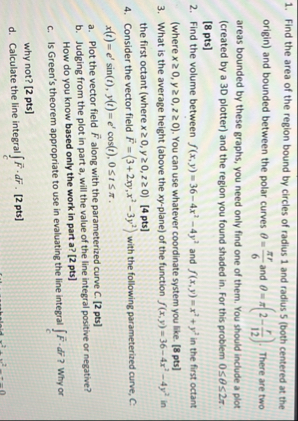 Hilarie
25 23355358353 2 §:
AEH PU EE EERE §-
RHEE RTE
§ $liagsidsl 454s
SI THEE EL
3 :3fy uziii ig i
© He REE EE
HEE RR IRY
aie EH RE RR
= DEER
: 5 Er H
iz REESE
Sigal
= = Hy HE
: 3 IR iil
Ei] os Pehl
Be Col Riag
This is AI generated Response.
Asked by: gvr
Created at: 2025-07-28 09:25:08
Asked by: gvr
Created at: 2025-07-28 09:25:08
Final Answer:
Rendered
Raw Text
Did you like this answer?
Let's solve **Question 1** step-by-step:
---
### **1. Find the area of the region bounded by circles of radius 1 and 2 (both centered at the origin) and bounded between the polar curves \( r = 4\sin\theta \) and \( r = 2 \).**
#### **Step 1: Sketch and Understand the Problem**
- Circles: \( r = 1 \) and \( r = 2 \)
- Curves: \( r = 4\sin\theta \) (a limacon, passes through origin at \( \theta = 0, \pi \)), and \( r = 2 \) (a circle)
- We want the area between these two curves, but only in the region where \( 1 \leq r \leq 2 \).
#### **Step 2: Find Points of Intersection**
Set \( 4\sin\theta = 2 \):
\[
4\sin\theta = 2 \implies \sin\theta = \frac{1}{2} \implies \theta = \frac{\pi}{6},\, \frac{5\pi}{6}
\]
So, the two curves intersect at \( \theta = \frac{\pi}{6} \) and \( \theta = \frac{5\pi}{6} \).
#### **Step 3: Set up the Area Integral**
The area between two polar curves \( r_1(\theta) \) and \( r_2(\theta) \) from \( \theta = a \) to \( \theta = b \) is:
\[
A = \frac{1}{2} \int_a^b \left( r_1^2 - r_2^2 \right) d\theta
\]
Here:
- Outer curve: \( r = 4\sin\theta \)
- Inner curve: \( r = 2 \)
- Limits: \( \theta = \frac{\pi}{6} \) to \( \theta = \frac{5\pi}{6} \)
\[
A = \frac{1}{2} \int_{\pi/6}^{5\pi/6} \left( (4\sin\theta)^2 - (2)^2 \right) d\theta
\]
#### **Step 4: Simplify the Integrand**
\[
(4\sin\theta)^2 = 16\sin^2\theta
\]
\[
(2)^2 = 4
\]
So,
\[
A = \frac{1}{2} \int_{\pi/6}^{5\pi/6} (16\sin^2\theta - 4) d\theta
\]
\[
A = \frac{1}{2} \int_{\pi/6}^{5\pi/6} 16\sin^2\theta d\theta - \frac{1}{2} \int_{\pi/6}^{5\pi/6} 4 d\theta
\]
\[
A = 8 \int_{\pi/6}^{5\pi/6} \sin^2\theta d\theta - 2 \int_{\pi/6}^{5\pi/6} d\theta
\]
#### **Step 5: Integrate \(\sin^2\theta\)**
Recall:
\[
\sin^2\theta = \frac{1 - \cos 2\theta}{2}
\]
So,
\[
8 \int_{\pi/6}^{5\pi/6} \sin^2\theta d\theta = 8 \int_{\pi/6}^{5\pi/6} \frac{1 - \cos 2\theta}{2} d\theta = 4 \int_{\pi/6}^{5\pi/6} (1 - \cos 2\theta) d\theta
\]
\[
= 4 \left[ \int_{\pi/6}^{5\pi/6} 1 d\theta - \int_{\pi/6}^{5\pi/6} \cos 2\theta d\theta \right]
\]
\[
= 4 \left[ \theta \bigg|_{\pi/6}^{5\pi/6} - \frac{1}{2} \sin 2\theta \bigg|_{\pi/6}^{5\pi/6} \right]
\]
#### **Step 6: Compute the Integrals**
First, \( \theta \) from \( \frac{\pi}{6} \) to \( \frac{5\pi}{6} \):
\[
\Delta\theta = \frac{5\pi}{6} - \frac{\pi}{6} = \frac{4\pi}{6} = \frac{2\pi}{3}
\]
Now, \( \sin 2\theta \):
- At \( \theta = \frac{\pi}{6} \): \( 2\theta = \frac{\pi}{3} \), \( \sin \frac{\pi}{3} = \frac{\sqrt{3}}{2} \)
- At \( \theta = \frac{5\pi}{6} \): \( 2\theta = \frac{5\pi}{3} \), \( \sin \frac{5\pi}{3} = -\frac{\sqrt{3}}{2} \)
So,
\[
\sin 2\theta \bigg|_{\pi/6}^{5\pi/6} = \sin \frac{5\pi}{3} - \sin \frac{\pi}{3} = -\frac{\sqrt{3}}{2} - \frac{\sqrt{3}}{2} = -\sqrt{3}
\]
So,
\[
-\frac{1}{2} \sin 2\theta \bigg|_{\pi/6}^{5\pi/6} = -\frac{1}{2}(-\sqrt{3}) = \frac{\sqrt{3}}{2}
\]
Plug back in:
\[
4 \left[ \frac{2\pi}{3} + \frac{\sqrt{3}}{2} \right] = \frac{8\pi}{3} + 2\sqrt{3}
\]
Now, subtract the other term:
\[
-2 \int_{\pi/6}^{5\pi/6} d\theta = -2 \left( \frac{5\pi}{6} - \frac{\pi}{6} \right) = -2 \left( \frac{4\pi}{6} \right) = -2 \left( \frac{2\pi}{3} \right) = -\frac{4\pi}{3}
\]
#### **Step 7: Final Area**
Combine:
\[
A = \left( \frac{8\pi}{3} + 2\sqrt{3} \right) - \frac{4\pi}{3}
\]
\[
A = \left( \frac{8\pi}{3} - \frac{4\pi}{3} \right) + 2\sqrt{3}
\]
\[
A = \frac{4\pi}{3} + 2\sqrt{3}
\]
---
### **Final Answer:**
\[
\boxed{A = \frac{4\pi}{3} + 2\sqrt{3}}
\]
This is the area of the region bounded by the circles of radii 1 and 2, and between the polar curves \( r = 4\sin\theta \) and \( r = 2 \).
📢 Instructions:
- Ask anything relatd to above question only.
- For new Question goto :