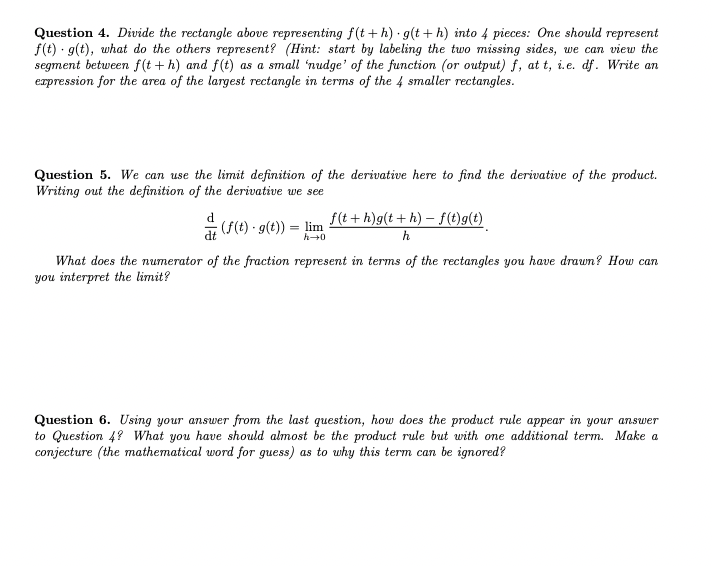
Give step-by-step solution with explanation and final answer:Question 4. Divide the rectangle above representing f(t +h) - g(t + ) into 4 pieces: One should represent
F(t) - 9(t), what do the others represent? (Hint: start by labeling the tuo missing sides, we can view the
segment between f(t +h) and f(t) as a small ‘nudge’ of the function (or output) f, att, i.e. df. Write an
expression for the area of the largest rectangle in terms of the 4 smaller rectangles.
Question 5. We can use the limit definition of the derivative here to find the derivative of the product.
Writing out the definition of the derivative we see
4 _ pm LE Rat +1) = £000)
FU 9(0) = fim = .
What does the numerator of the fraction represent in terms of the rectangles you have drawn? How can
you interpret the limit?
Question 6. Using your answer from the last question, how docs the product rule appear in your answer
to Question 47 What you have should almost be the product rule but with one additional term. Make a
conjecture (the mathematical word for guess) as to why this term can be ignored?
Question:
Give step-by-step solution with explanation and final answer:Question 4. Divide the rectangle above representing f(t +h) - g(t + ) into 4 pieces: One should represent
F(t) - 9(t), what do the others represent? (Hint: start by labeling the tuo missing sides, we can view the
segment between f(t +h) and f(t) as a small ‘nudge’ of the function (or output) f, att, i.e. df. Write an
expression for the area of the largest rectangle in terms of the 4 smaller rectangles.
Question 5. We can use the limit definition of the derivative here to find the derivative of the product.
Writing out the definition of the derivative we see
4 _ pm LE Rat +1) = £000)
FU 9(0) = fim = .
What does the numerator of the fraction represent in terms of the rectangles you have drawn? How can
you interpret the limit?
Question 6. Using your answer from the last question, how docs the product rule appear in your answer
to Question 47 What you have should almost be the product rule but with one additional term. Make a
conjecture (the mathematical word for guess) as to why this term can be ignored?
This is AI generated Response.
Asked by: gvr
Created at: 2025-07-28 04:57:49
Final Answer:
RenderedRaw Text
Did you like this answer?
Let's answer each question step by step:
---
### **Question 4**: **Dividing the rectangle**
We start with a rectangle whose area is \((f(t+h)) \cdot (g(t+h))\). We want to break this area into four smaller rectangles, using the idea that \(f(t+h) = f(t) + \Delta f\) and \(g(t+h) = g(t) + \Delta g\), where \(\Delta f = f(t+h) - f(t)\) and \(\Delta g = g(t+h) - g(t)\).
So, the rectangle can be written as:
\[
f(t+h)g(t+h) = [f(t) + \Delta f][g(t) + \Delta g]
\]
Expanding this:
\[
= f(t)g(t) + f(t)\Delta g + g(t)\Delta f + \Delta f \Delta g
\]
So, the four parts are:
- \(f(t)g(t)\): Area of the original rectangle at \(t\)
- \(f(t)\Delta g\): Rectangle with width \(f(t)\) and height \(\Delta g\)
- \(g(t)\Delta f\): Rectangle with width \(g(t)\) and height \(\Delta f\)
- \(\Delta f \Delta g\): Smallest rectangle, area due to both \(f\) and \(g\) changing
**Largest rectangle:** \(f(t)g(t)\)
**Expression:**
\[
f(t+h)g(t+h) = f(t)g(t) + f(t)\Delta g + g(t)\Delta f + \Delta f \Delta g
\]
---
### **Question 5**: **Limit definition and rectangles**
Recall:
\[
\frac{d}{dt}(f(t)g(t)) = \lim_{h \to 0} \frac{f(t+h)g(t+h) - f(t)g(t)}{h}
\]
From above, \(f(t+h)g(t+h) = f(t)g(t) + f(t)\Delta g + g(t)\Delta f + \Delta f \Delta g\).
So,
\[
f(t+h)g(t+h) - f(t)g(t) = f(t)\Delta g + g(t)\Delta f + \Delta f \Delta g
\]
So the numerator is the sum of the areas of the three rectangles **other than** the original one (the changes as you nudge both functions).
**Interpretation:**
- \(f(t)\Delta g\): Area due to change in \(g\)
- \(g(t)\Delta f\): Area due to change in \(f\)
- \(\Delta f \Delta g\): Area due to both changing
**The limit:**
As \(h \to 0\), \(\Delta f\) and \(\Delta g\) become infinitesimally small, and the last term \(\Delta f \Delta g\) becomes negligible compared to the other two.
---
### **Question 6**: **Connection to product rule**
Plug into the limit:
\[
\lim_{h \to 0} \frac{f(t)\Delta g + g(t)\Delta f + \Delta f \Delta g}{h}
\]
Write \(\Delta f = f(t+h) - f(t), \Delta g = g(t+h) - g(t)\):
\[
= \lim_{h \to 0} \left( f(t)\frac{\Delta g}{h} + g(t)\frac{\Delta f}{h} + \frac{\Delta f \Delta g}{h} \right)
\]
As \(h \to 0\):
- \(\frac{\Delta f}{h} \to f'(t)\)
- \(\frac{\Delta g}{h} \to g'(t)\)
- \(\frac{\Delta f \Delta g}{h}\) goes to 0 (since both \(\Delta f, \Delta g \sim h\), so their product is \(\sim h^2\), and \(\frac{h^2}{h} \to 0\))
So,
\[
\frac{d}{dt}(f(t)g(t)) = f(t)g'(t) + g(t)f'(t)
\]
**Conjecture for ignoring the last term:**
The term \(\frac{\Delta f \Delta g}{h}\) can be ignored because as \(h \to 0\), it shrinks faster than the other terms (second-order smallness). This is why the product rule only contains two terms.
---
## **Final Answers:**
### **Q4:**
\[
f(t+h)g(t+h) = f(t)g(t) + f(t)\Delta g + g(t)\Delta f + \Delta f \Delta g
\]
### **Q5:**
The numerator represents the combined area of the three rectangles reflecting the change due to \(f\), \(g\), and both. The limit shows how these changes behave as \(h \to 0\).
### **Q6:**
The product rule arises because the extra term \(\frac{\Delta f \Delta g}{h}\) becomes negligible as \(h \to 0\). This term can be ignored since it's of higher order (goes to zero faster). Thus,
\[
\frac{d}{dt}(f(t)g(t)) = f(t)g'(t) + g(t)f'(t)
\]
VIPSolutions focuses on clear, step‑by‑step explanations so you can learn quickly. Whether you need an AI‑generated walkthrough or a short hint to get unstuck, each solution is organized for fast reading and easy review later.
Search similar questions, compare approaches, and bookmark the best answers for revision. Our goal is simple: quick, reliable study help that feels natural—not noisy.
 VIPSolutions
 Question 4. Divide the rectangle above representing f(t +h) - g(t + ) into 4 pieces: One should represent
F(t) - 9(t), what do the others represent? (Hint: start by labeling the tuo missing sides, we can view the
segment between f(t +h) and f(t) as a small ‘nudge’ of the function (or output) f, att, i.e. df. Write an
expression for the area of the largest rectangle in terms of the 4 smaller rectangles.
Question 5. We can use the limit definition of the derivative here to find the derivative of the product.
Writing out the definition of the derivative we see
4 _ pm LE Rat +1) = £000)
FU 9(0) = fim = .
What does the numerator of the fraction represent in terms of the rectangles you have drawn? How can
you interpret the limit?
Question 6. Using your answer from the last question, how docs the product rule appear in your answer
to Question 47 What you have should almost be the product rule but with one additional term. Make a
conjecture (the mathematical word for guess) as to why this term can be ignored?