 VIPSolutions
Give step-by-step solution with explanation and final answer:dence interval conStUEEERTETET 7 suppose (FX) satisfy the 16050 squares assumptions in KY Concept 4 dom sample of size = 25015 drawn and yields §=54422X. R= 026, SER = 62. G1 09) a. Tost Ho: pr = Ove HBr 7 0 at the 5% level b. Construct 95% confidence jnterval for Bi Suppose you learned that ¥iand were independent. Would YO! be surprised? Explain. ——————— Bercises 203 4. Suppose Y;and X, are independent an ‘of the samples would Ho from (2) b oi i} ) mes Inwhitfmeton | : o rejected? In what fraction of sample § would the value §; = 0 bein i samples [2 Included in the confidence interval from (0)? 1 ek vn By
Question:
Give step-by-step solution with explanation and final answer: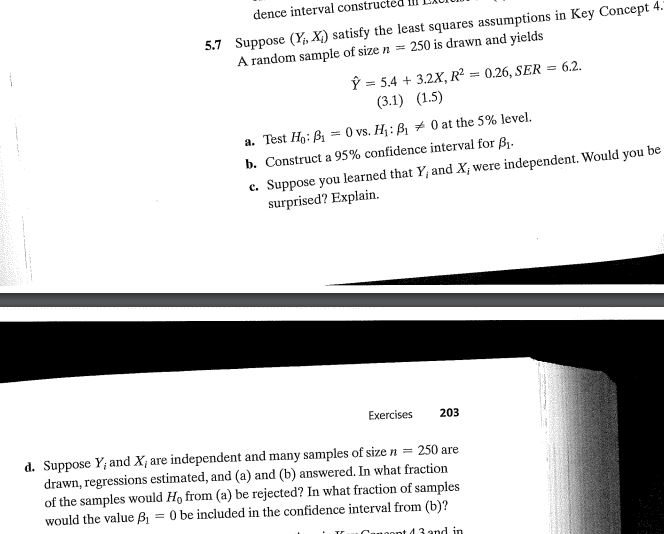 dence interval conStUEEERTETET
7 suppose (FX) satisfy the 16050 squares assumptions in KY Concept 4
dom sample of size = 25015 drawn and yields
§=54422X. R= 026, SER = 62.
G1 09)
a. Tost Ho: pr = Ove HBr 7 0 at the 5% level
b. Construct 95% confidence jnterval for Bi
Suppose you learned that ¥iand were independent. Would YO! be
surprised? Explain.
———————
Bercises 203
4. Suppose Y;and X, are independent an
‘of the samples would Ho from (2) b oi i} ) mes Inwhitfmeton |
: o rejected? In what fraction of sample §
would the value §; = 0 bein i samples
[2 Included in the confidence interval from (0)? 1
ek vn By
This is AI generated Response.
Asked by: Umesh
Created at: 2025-07-28 00:11:43
Asked by: Umesh
Created at: 2025-07-28 00:11:43
Final Answer:
Rendered
Raw Text
Did you like this answer?
Let's solve each part step by step:
---
**Given regression output:**
\[
\hat{Y} = 5.4 + 3.2X, \qquad R^2 = 0.26, \qquad SER = 6.2
\]
- Standard error of intercept: (3.1)
- Standard error of slope: (1.5)
- Sample size \( n = 250 \)
### **a. Test \( H_0: \beta_1 = 0 \) vs. \( H_1: \beta_1 \neq 0 \) at 5% level**
#### **Step 1: Find test statistic**
\[
t = \frac{\hat{\beta}_1 - 0}{SE(\hat{\beta}_1)} = \frac{3.2 - 0}{1.5} = \frac{3.2}{1.5} = 2.13
\]
#### **Step 2: Find critical value**
- Degrees of freedom: \( df = n - 2 = 248 \). For large \( n \), \( t_{0.025, 248} \approx 1.96 \).
#### **Step 3: Compare and decide**
\[
|t| = 2.13 > 1.96
\]
- **Reject \( H_0 \) at the 5% significance level.**
---
### **b. Construct a 95% confidence interval for \( \beta_1 \)**
#### **Step 1: Formula**
\[
\hat{\beta}_1 \pm t^* \times SE(\hat{\beta}_1)
\]
- \( t^* \approx 1.96 \)
#### **Step 2: Plug in values**
\[
3.2 \pm 1.96 \times 1.5 = 3.2 \pm 2.94
\]
\[
\text{Interval: } [3.2 - 2.94,\ 3.2 + 2.94] = [0.26,\ 6.14]
\]
---
### **c. Suppose you learned that \( Y_i \) and \( X_i \) were independent. Would you be surprised? Explain.**
- If \( Y_i \) and \( X_i \) were truly independent, in the population, \( \beta_1 \) should equal zero.
- Here, the sample estimate \( \hat{\beta}_1 = 3.2 \), and the 95% CI barely excludes zero.
- However, in a sample of 250, it's not *impossible* to get a coefficient this far from zero just by chance, but it's somewhat unlikely (about 5% chance under the null).
- Since we rejected the null at 5%, it would be **somewhat surprising** to learn \( Y_i \) and \( X_i \) are independent, but it's not impossible due to sampling variability.
---
### **d. Suppose \( Y_i \) and \( X_i \) are independent and many samples of size \( n = 250 \) are drawn, regressions estimated, and (a) and (b) answered.**
#### - In what fraction of the samples would \( H_0 \) from (a) be rejected?
- This is the **Type I error rate**, which is the significance level (5%).
- **Answer:** About 5% of samples.
#### - In what fraction of samples would the value \( \beta_1 = 0 \) be included in the confidence interval from (b)?
- The true value will be inside the 95% CI **95% of the time**.
---
## **Summary of Answers:**
**a.** Reject \( H_0 \) at 5% level; \( t = 2.13 \) is greater than 1.96.
**b.** 95% confidence interval for \( \beta_1 \): **[0.26, 6.14]**
**c.** Somewhat surprising, but not impossible; would expect this about 5% of the time by chance.
**d.**
- \( H_0 \) rejected in **5%** of samples (Type I error).
- \( \beta_1 = 0 \) included in **95%** of confidence intervals.
Let me know if you need more detailed explanation or calculations!
📢 Instructions:
- Ask anything relatd to above question only.
- For new Question goto :