This is AI generated Response.
Asked by: gvr
Created at: 2025-07-27 22:23:09
Final Answer:
RenderedRaw Text
Did you like this answer?
Let's solve **Question 8** and **Question 9** step by step:
---
## **Question 8**
> There is a path through the woods that goes up a hill. Suppose \( f(s) \) gives the slope of the path as a function of how far along the path you are. What might \( \int_0^a f(s)\, ds \) tell you? What about \( \int_0^a |f(s)|\, ds \) ?
### **Step-by-step Solution:**
#### **A. Interpreting \( \int_0^a f(s)\, ds \):**
- **\( f(s) \) gives the slope at each point along the path.**
- **The integral \( \int_0^a f(s) ds \) adds up (accumulates) all these slopes over the distance from 0 to \( a \).**
- **But what does the integral of slope over distance give?**
Recall:
- The slope at a point is \( \frac{dh}{ds} \), where \( h(s) \) is the height at distance \( s \).
- Therefore, \( f(s) = \frac{dh}{ds} \).
So:
\[
\int_0^a f(s) ds = \int_0^a \frac{dh}{ds} ds = h(a) - h(0)
\]
- **This tells you the net change in elevation after traveling from 0 to \( a \) along the path** (i.e., how much higher or lower you are at the end compared to the start).
#### **B. Interpreting \( \int_0^a |f(s)| ds \):**
- **Here, you are integrating the absolute value of the slope.**
- This means:
- Uphill and downhill are both counted as positive.
- So, \( \int_0^a |f(s)|\, ds \) gives the **total amount of elevation change**, regardless of direction.
**In other words:**
- **If you go up 10 meters and down 8 meters, \( \int_0^a f(s) ds = 2 \) meters (net gain), but \( \int_0^a |f(s)| ds = 18 \) meters (total elevation climbed and descended).**
---
### **Summary Table**
| Integral | What it tells you |
|---------------------------|--------------------------------------------------|
| \( \int_0^a f(s) ds \) | Net elevation change (end height - start height) |
| \( \int_0^a |f(s)| ds \) | Total elevation climbed and descended |
---
## **Question 9**
> Two bicyclists are competing in a race. Their velocities are given as \( v_1(t) \) and \( v_2(t) \) where \( t \) is the time in minutes after they start. How would you interpret \( \int_0^a (v_1(t) - v_2(t)) dt \)? What about \( \int_0^a |v_1(t) - v_2(t)| dt \)?
### **Step-by-step Solution:**
#### **A. Interpreting \( \int_0^a (v_1(t) - v_2(t)) dt \):**
- \( v_1(t) \) and \( v_2(t) \) are the velocities of the two bicyclists.
- The difference \( v_1(t) - v_2(t) \) is how much faster (or slower, if negative) cyclist 1 is compared to cyclist 2 at each moment.
- **Integrating velocity over time gives displacement (distance traveled).**
So,
\[
\int_0^a (v_1(t) - v_2(t)) dt = \text{(distance traveled by 1 from 0 to a)} - \text{(distance traveled by 2 from 0 to a)}
\]
- **This tells you how much farther cyclist 1 is ahead of cyclist 2 (net distance difference) after \( a \) minutes.**
- If the answer is positive, cyclist 1 is ahead; if negative, cyclist 2 is ahead.
#### **B. Interpreting \( \int_0^a |v_1(t) - v_2(t)| dt \):**
- **Here, you are adding up the absolute value of the speed difference at every moment.**
- This tells you the **total amount by which their positions have differed over time, regardless of who is ahead**.
- **In effect, it's the total "lead distance" accumulated, counting both whenever cyclist 1 is ahead and whenever cyclist 2 is ahead**.
---
### **Summary Table**
| Integral | What it tells you |
|--------------------------------------|-----------------------------------------------------------------------|
| \( \int_0^a (v_1(t) - v_2(t)) dt \) | Net distance one cyclist is ahead of the other after \( a \) minutes |
| \( \int_0^a |v_1(t) - v_2(t)| dt \) | Total lead distance, regardless of who is ahead at any moment |
---
## **Final Answers**
### **Question 8:**
- \( \int_0^a f(s) ds \) tells you the **net change in elevation** (how much higher or lower you are at the end).
- \( \int_0^a |f(s)| ds \) tells you the **total elevation climbed and descended** (total vertical distance traveled, regardless of direction).
### **Question 9:**
- \( \int_0^a (v_1(t) - v_2(t)) dt \) tells you the **net distance by which cyclist 1 is ahead of cyclist 2 after \( a \) minutes**.
- \( \int_0^a |v_1(t) - v_2(t)| dt \) tells you the **total "lead distance"**, adding up all moments when either cyclist is ahead, regardless of who is leading.
Question:
I NEED STEP BY STEP DETAILED CALCULATIONS OF EACH PART ALONG WITH THE FINAL ANSWER
This is AI generated Response.
Asked by: gvr
Created at: 2025-07-27 22:24:53
Final Answer:
RenderedRaw Text
Did you like this answer?
Certainly! Let's carefully break down each question with **step-by-step reasoning** and **detailed explanations**.
---
# **Question 8**
> There is a path through the woods that goes up a hill. Suppose \( f(s) \) gives the slope of the path as a function of how far along the path you are.
> What might \( \int_0^a f(s) ds \) tell you?
> What about \( \int_0^a |f(s)| ds \)?
---
## **Understanding the problem:**
- \( s \) is the distance *along* the path.
- \( f(s) \) is the slope at each point, i.e., the rate of change of height \( h(s) \) with respect to \( s \):
\[
f(s) = \frac{dh}{ds}
\]
---
## **Step 1: Interpret \( \int_0^a f(s) ds \)**
- Using the **Fundamental Theorem of Calculus**:
\[
\int_0^a \frac{dh}{ds} ds = h(a) - h(0)
\]
- So, this integral **gives the net change in height** from the start (\( s=0 \)) to the end (\( s=a \)).
### **Conclusion:**
\[
\boxed{
\int_0^a f(s) ds = \text{Net elevation change} = h(a) - h(0)
}
\]
**Meaning:**
- If the value is positive, you ended higher than you started.
- If negative, you ended lower.
---
## **Step 2: Interpret \( \int_0^a |f(s)| ds \)**
- The **absolute value** of the slope at each point accounts for **all elevation changes**, regardless of whether you're going uphill or downhill.
- When you integrate \( |f(s)| \), you **sum the magnitude of all slopes** along the path, which corresponds to the **total vertical distance climbed and descended**.
### **Example:**
- Suppose you climb 10 meters, then descend 8 meters:
- Net change: \( 10 - 8 = 2 \) meters.
- Total movement: \( 10 + 8 = 18 \) meters.
**Thus:**
\[
\boxed{
\int_0^a |f(s)| ds = \text{Total elevation change} = \text{Sum of all uphill and downhill segments}
}
\]
---
# **Summary for Question 8**
| Integral | Interpretation |
|------------|----------------|
| \( \int_0^a f(s) ds \) | Net change in elevation from start to end |
| \( \int_0^a |f(s)| ds \) | Total elevation climbed and descended |
---
# **Question 9**
> Two bicyclists are competing in a race. Their velocities are \( v_1(t) \) and \( v_2(t) \). How do you interpret:
> 1. \( \int_0^a (v_1(t) - v_2(t)) dt \)
> 2. \( \int_0^a |v_1(t) - v_2(t)| dt \)
---
## **Step 1: Recall basic facts**
- \( v_i(t) \): velocity of cyclist \( i \) at time \( t \).
- Displacement (distance traveled) by cyclist \( i \):
\[
\text{Displacement}_i = \int_0^a v_i(t) dt
\]
- The **difference in velocities**:
\[
v_1(t) - v_2(t)
\]
tells us **how much faster cyclist 1 is compared to cyclist 2** at each instant.
---
## **Step 2: Interpret \( \int_0^a (v_1(t) - v_2(t)) dt \)**
- **Integral of velocity difference over time**:
\[
\int_0^a (v_1(t) - v_2(t)) dt = \left( \int_0^a v_1(t) dt \right) - \left( \int_0^a v_2(t) dt \right)
\]
- **This is the difference in total distances traveled by the two cyclists** over the interval.
### **Final interpretation:**
\[
\boxed{
\int_0^a (v_1(t) - v_2(t)) dt = \text{Distance cyclist 1 has traveled} - \text{Distance cyclist 2 has traveled}
}
\]
- **Positive result**: cyclist 1 is ahead.
- **Negative result**: cyclist 2 is ahead.
---
## **Step 3: Interpret \( \int_0^a |v_1(t) - v_2(t)| dt \)**
- **Absolute value** of the velocity difference sums the **magnitude** of their separation at each moment, regardless of who is ahead.
- **What does this measure?**
It measures the **total lead distance**, i.e., how much the cyclists are separated **over the entire race**, summing all the moments when one is ahead of the other.
- **Note:** Unlike the previous integral, this does *not* cancel out when one cyclist is ahead and the other is behind; it **adds up all the lead distances**.
---
## **Final summaries:**
| Integral | Interpretation |
|------------|----------------|
| \( \int_0^a (v_1(t) - v_2(t)) dt \) | Net difference in total distance traveled (which cyclist is ahead) |
| \( \int_0^a |v_1(t) - v_2(t)| dt \) | Total accumulated lead distance (regardless of who is ahead at each moment) |
---
# **Final notes:**
- The **signed integrals** give the **net difference** in some quantity (height, distance).
- The **unsigned (absolute value)** integrals give the **total amount of change**, counting all contributions regardless of direction.
---
**Let me know if you'd like me to clarify any step further!**
VIPSolutions focuses on clear, step‑by‑step explanations so you can learn quickly. Whether you need an AI‑generated walkthrough or a short hint to get unstuck, each solution is organized for fast reading and easy review later.
Search similar questions, compare approaches, and bookmark the best answers for revision. Our goal is simple: quick, reliable study help that feels natural—not noisy.
 VIPSolutions
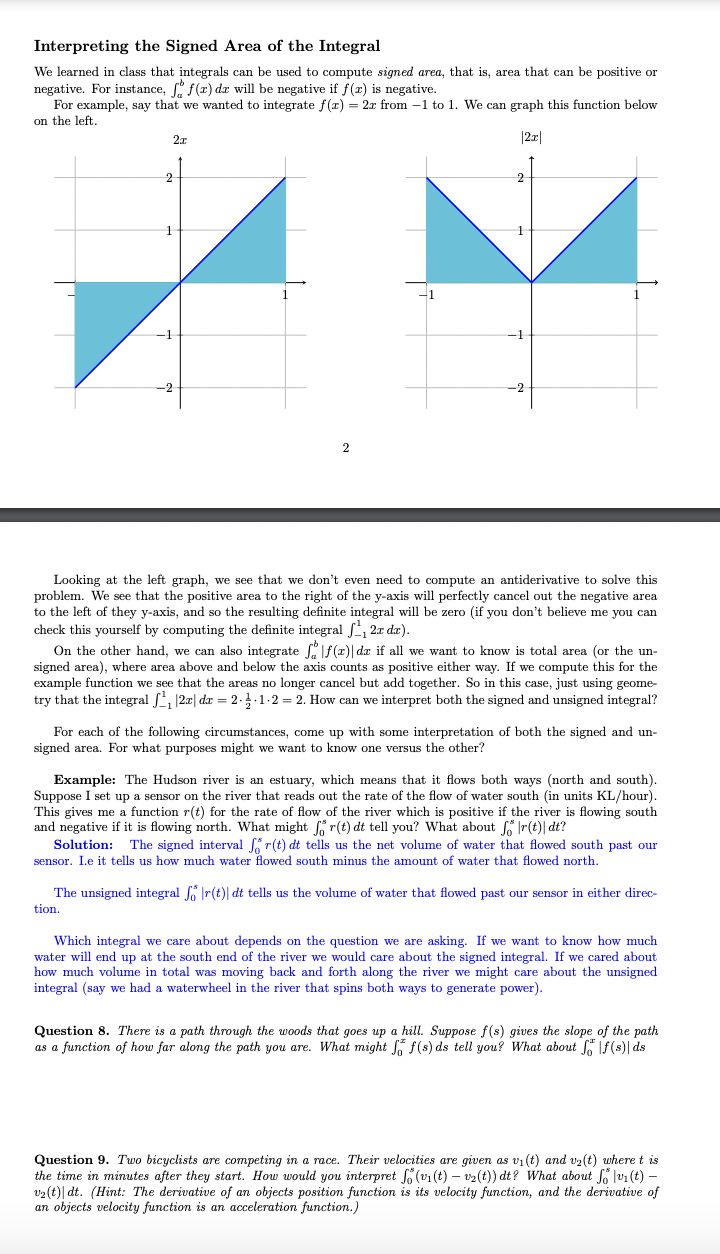 Interpreting the Signed Area of the Integral
We learned in class that integrals can be used to compute signed arca, that is, area that can be positive or
negative. For instance, |! f(z) dz will be negative if f(z) is negative.
For example, say that we wanted to integrate f(z) = 2x from —1 to 1. We can graph this function below
on the left.
2 22]
2 2
+ 1
1 En 1
— —
—2 —2
2
Ep
Looking at the left graph, we sce that we don't even need to compute an antiderivative to solve this
problem. We sce that the positive arca to the right of the y-axis will perfectly cancel out the negative area
to the left of they y-axis, and so the resulting definite integral will be zero (if you don't believe me you can
check this yourself by computing the definite integral [*, 2x dz).
On the other hand, we can also integrate [| (x)|dz if all we want to know is total area (or the un-
signed arca), where arca above and below the axis counts as positive either way. If we compute this for the
example function we sce that the areas no longer cancel but add together. So in this case, just using geome-
try that the integral | [22] dz = 2-41.2 = 2. How can we interpret both the signed and unsigned integral?
For cach of the following circumstances, come up with some interpretation of both the signed and un-
signed arca. For what purposes might we want to know one versus the other?
Example: The Hudson river is an estuary, which means that it flows both ways (north and south).
Suppose I set up a sensor on the river that reads out the rate of the flow of water south (in units KL /hor).
This gives me a function x(t) for the rate of flow of the river which is positive if the river is flowing south
and negative if it is flowing north. What might |; r(£) dt tell you? What about [[ [r(6)] dt?
Solution: The signed interval J r(t) dt tells us the net volume of water that flowed south past our
sensor. Le it tells us how much water flowed south minus the amount of water that flowed north.
The unsigned integral |; [r(t) dt tell us the volume of water that fowed past our sensor in either direc
tion.
Which integral we care about depends on the question we are asking. If we want to know how much
water will end up at the south end of the river we would care about the signed integral. If we cared abot
how much volume in total was moving back and forth along the river we might care about the unsigned
integral (say we had a waterwheel in the river that spins both ways to generate power).
Question 8. There is a path through the woods that gocs up a hill. Suppose f(s) gives the slope of the path
as a function of how far along the path you are. What might [© f(s) ds tell you? What about J; f(s) ds
Question 9. Tuo bicyclists are competing in a race. Their velocities are given as v(t) and vat) where ¢ is
the time in minutes after they start. How would you interpret J; (vy(t) — va(t)) dt? What about [[ v(t) —
y(t) dt. (Hint: The derivative of an objects position function is its velocity function, and the derivative of
an objects velocity function is an acceleration function.)