 VIPSolutions
Give step-by-step solution with explanation and final answer:-X Variance, Covariances, and Optimization Model Stock Bond SCIP [=] Average return 0148 006 0.152 Variance 0014697 0000155 0160791 Covariance with stock 0.000468 -0.002222 Covariance with bond 0000227 Minimize Variance = 0.014697x3 +0.000155x3 +0.160791x3 + 0.000936x, x, - 0.004444x, x; ~ 0.000454x,x; ic Xxx = 1 0.148x, +0.06x, + 0.152¢5 = 0.12 XXX 2 0 The Hal Chase Investment Planning Agency is in business o help invesiors optimize the retur from investment. Hal deals wilh three investmen mediums. a sock fund, a bond fund, and hs own Sports and ocng Investment Plan (SGIF) The stock And 3 mis! ond muesing in oan ded socks. Tro bor fr focuses on 1 bond marke, whch as a moe fable bt ower. oxpectad eum SCIP a high-risk scheme, often resulting in heavy losses but occasionally coming through with spectacular gains. Use the accompanying data and portfolio optimization mode! for this situation with a target return of 1291 ohana Save Sensinity Report Expain now 6 morprl he Lerange mipors fo ne constants [B] cick tre conto vw the variance, covariances, and ptmizston model. EE —————— A 1% crease in he toll alocelon auld crease the expected tum by proximally (Round 0 too decimal paces 2 nooded A increase i th eget elu fom 12% 0 13% would crease th vrience by approximately (Round to too decimal paces as nooded A unit increase i th oa locaton vould ncreese the variance by eproxmaely (Round to tee decml laces as needed ) #0. The Lagrange multiplier for the total allocation is meaningless because the total allocation must be 1. Viheh statement best ners me Lagrange mpi for he expacted ream alocaton’” A 1 uit increase i th oa locaton vould increase th varance by spprosimatly (Round ooo decimal paces as nosed An increase i th target etm rom 12% 136 would crease variance by approximately 0.167 (Round to too decimal paces as nooded A 1% cree in he toll allocation wid mcrae te expected retum by ppraxmacly (Round 0 too decimal paces 3 nooded The Lagrange mupe for te expected return alcaton s aingess because he expected relum alocation ust be 12%
Question:
Give step-by-step solution with explanation and final answer: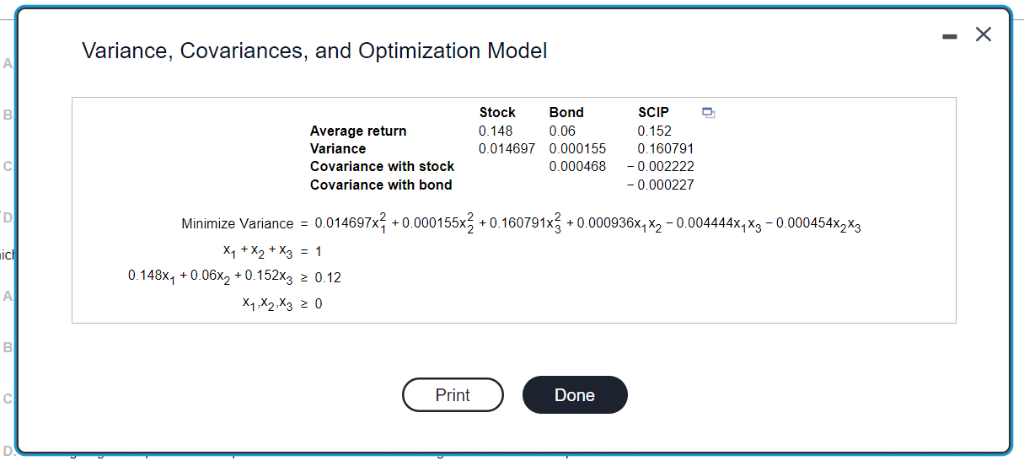
 -X
Variance, Covariances, and Optimization Model
Stock Bond SCIP [=]
Average return 0148 006 0.152
Variance 0014697 0000155 0160791
Covariance with stock 0.000468 -0.002222
Covariance with bond 0000227
Minimize Variance = 0.014697x3 +0.000155x3 +0.160791x3 + 0.000936x, x, - 0.004444x, x; ~ 0.000454x,x;
ic Xxx = 1
0.148x, +0.06x, + 0.152¢5 = 0.12
XXX 2 0
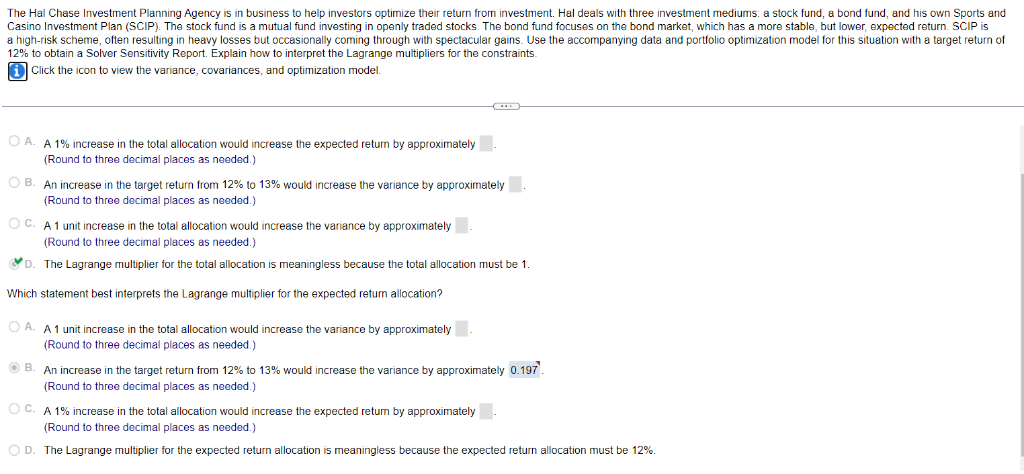
The Hal Chase Investment Planning Agency is in business o help invesiors optimize the retur from investment. Hal deals wilh three investmen mediums. a sock fund, a bond fund, and hs own Sports and
ocng Investment Plan (SGIF) The stock And 3 mis! ond muesing in oan ded socks. Tro bor fr focuses on 1 bond marke, whch as a moe fable bt ower. oxpectad eum SCIP
a high-risk scheme, often resulting in heavy losses but occasionally coming through with spectacular gains. Use the accompanying data and portfolio optimization mode! for this situation with a target return of
1291 ohana Save Sensinity Report Expain now 6 morprl he Lerange mipors fo ne constants
[B] cick tre conto vw the variance, covariances, and ptmizston model.
EE ——————
A 1% crease in he toll alocelon auld crease the expected tum by proximally
(Round 0 too decimal paces 2 nooded
A increase i th eget elu fom 12% 0 13% would crease th vrience by approximately
(Round to too decimal paces as nooded
A unit increase i th oa locaton vould ncreese the variance by eproxmaely
(Round to tee decml laces as needed )
#0. The Lagrange multiplier for the total allocation is meaningless because the total allocation must be 1.
Viheh statement best ners me Lagrange mpi for he expacted ream alocaton’”
A 1 uit increase i th oa locaton vould increase th varance by spprosimatly
(Round ooo decimal paces as nosed
An increase i th target etm rom 12% 136 would crease variance by approximately 0.167
(Round to too decimal paces as nooded
A 1% cree in he toll allocation wid mcrae te expected retum by ppraxmacly
(Round 0 too decimal paces 3 nooded
The Lagrange mupe for te expected return alcaton s aingess because he expected relum alocation ust be 12%
Asked by: gvr
Created at: 2025-07-27 22:05:47
Final Answer:
📢 Instructions:
- Ask anything relatd to above question only.
- For new Question goto :