 VIPSolutions
Give step-by-step solution with explanation and final answer:Question 11. The sign lines for a function f(z) and its derivatives are below. — & + DNE — + f JF sw —2 0 1 2 + DNE — + DNE + f pp eee =1 0 1 + DNE + DNE — i PEE = 1 In addition, you know that lim f(x) =3, lim f(z) = oo, and f(~1)=1. Sketch a possible graph of f
Question:
Give step-by-step solution with explanation and final answer: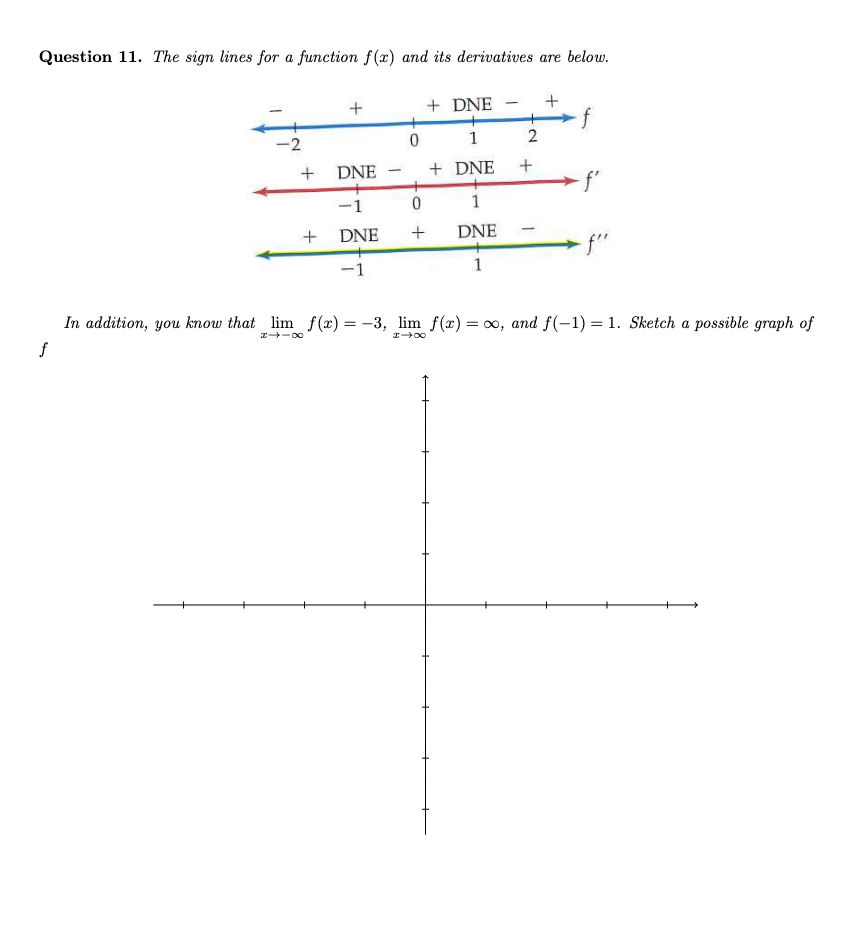 Question 11. The sign lines for a function f(z) and its derivatives are below.
— & + DNE — + f
JF sw
—2 0 1 2
+ DNE — + DNE + f
pp eee
=1 0 1
+ DNE + DNE — i
PEE
= 1
In addition, you know that lim f(x) =3, lim f(z) = oo, and f(~1)=1. Sketch a possible graph of
f
This is AI generated Response.
Asked by: gvr
Created at: 2025-07-27 20:41:47
Asked by: gvr
Created at: 2025-07-27 20:41:47
Final Answer:
Rendered
Raw Text
Did you like this answer?
Let's solve step by step:
### **Step 1: Interpreting the Sign Charts**
#### **For \( f(x) \):**
- **Intervals:**
- \( (-\infty, -2) \): \( f(x) \) is decreasing
- \( (-2, 0) \): \( f(x) \) is increasing
- \( (0, 1) \): \( f(x) \) is increasing
- \( (1, 2) \): \( f(x) \) is decreasing
- \( (2, \infty) \): \( f(x) \) is increasing
#### **For \( f'(x) \):**
- **DNE at \( x = -1 \), \( x = 1 \)**
- **Intervals:**
- \( (-\infty, -1) \): \( f'(x) > 0 \)
- \( (-1, 0) \): \( f'(x) < 0 \)
- \( (0, 1) \): \( f'(x) > 0 \)
- \( (1, \infty) \): \( f'(x) < 0 \)
#### **For \( f''(x) \):**
- **DNE at \( x = -1, 1 \)**
- **Intervals:**
- \( (-\infty, -1) \): \( f''(x) > 0 \) (concave up)
- \( (-1, 1) \): \( f''(x) < 0 \) (concave down)
- \( (1, \infty) \): \( f''(x) > 0 \) (concave up)
---
### **Step 2: Limits and Given Point**
- \( \lim_{x \to -\infty} f(x) = -3 \)
- \( \lim_{x \to \infty} f(x) = \infty \)
- \( f(-1) = 1 \)
---
### **Step 3: Key Features**
#### **Critical Points and Behavior:**
- At \( x = -2 \), \( f(x) \) switches from decreasing to increasing → local **min**.
- At \( x = 0 \), \( f(x) \) switches from increasing to increasing (no extremum), but \( f'(x) \) switches from negative to positive, so **local min** at \( x = 0 \).
- At \( x = 1 \), \( f(x) \) switches from increasing to decreasing → local **max**.
- At \( x = 2 \), \( f(x) \) switches from decreasing to increasing → local **min**.
#### **Inflection Points:**
- At \( x = -1 \): \( f''(x) \) DNE, possible cusp/vertical tangent; \( f'(x) \) switches from positive to negative → local **max** at \( x = -1 \).
- At \( x = 1 \): \( f''(x) \) DNE, possible cusp/vertical tangent; \( f'(x) \) switches from positive to negative → local **max** at \( x = 1 \).
---
### **Step 4: Sketch the Graph**
#### **Mark Key Points:**
- Start at \( y = -3 \) as \( x \to -\infty \).
- Pass through \( (-1, 1) \).
- Head up to infinity as \( x \to \infty \).
#### **Behavior:**
- **From \( x = -\infty \) to \( x = -2 \):** Decreasing and concave up.
- **At \( x = -2 \):** Local min.
- **From \( x = -2 \) to \( x = -1 \):** Increasing and concave up.
- **At \( x = -1 \):** Sharp local max at \( ( -1, 1 ) \).
- **From \( x = -1 \) to \( x = 0 \):** Decreasing and concave down.
- **At \( x = 0 \):** Local min.
- **From \( x = 0 \) to \( x = 1 \):** Increasing and concave down.
- **At \( x = 1 \):** Sharp local max.
- **From \( x = 1 \) to \( x = 2 \):** Decreasing and concave up.
- **At \( x = 2 \):** Local min.
- **From \( x = 2 \) onward:** Increasing, concave up, heads to infinity.
---
### **Step 5: Draw the Graph**
I'll describe the sketch:
- Start at left at \( y = -3 \), decreasing, concave up, hit a min at \( x = -2 \).
- Increase, hit a sharp max at \( ( -1, 1 ) \).
- Decrease (concave down), hit a min at \( x = 0 \).
- Increase (concave down), hit a sharp max at \( x = 1 \).
- Decrease (concave up), hit a min at \( x = 2 \).
- Increase (concave up), go to infinity as \( x \to \infty \).
---
### **Final Answer:**
#### **(See the sketch below; you can draw this on the axes provided.)**
```
|
∞ | /
| /
| /-------/
| /
| /-------/
| /
| /-----/
| /
-3 ___/________________________
|
-2 -1 0 1 2
```
- The graph has local mins at \( x = -2, 0, 2 \).
- Sharp local maxima at \( x = -1 \) (with \( f(-1) = 1 \)), and at \( x = 1 \).
- The function approaches \( y = -3 \) as \( x \to -\infty \) and goes to infinity as \( x \to \infty \).
---
If you want a more precise sketch, let me know and I can plot it for you!
📢 Instructions:
- Ask anything relatd to above question only.
- For new Question goto :