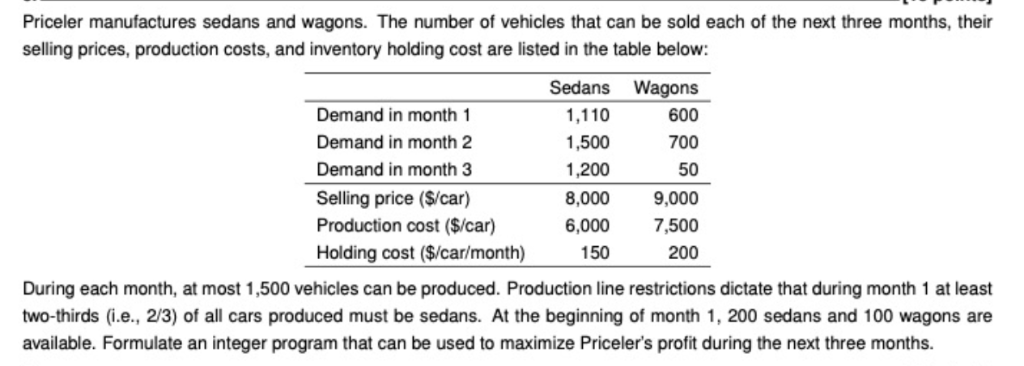
Give step-by-step solution with explanation and final answer:Priceler manufactures sedans and wagons. The number of vehicles that can be sold each of the next three months, their
selling prices, production costs, and inventory holding cost are listed in the table below:
Sedans Wagons
Demand in month 1 1,110 600
Demand in month 2 1,500 700
Demand in month 3 1,200 50
Selling price ($/car) 8,000 9,000
Production cost ($/car) 6,000 7,500
Holding cost ($/car/month) 150 200
During each month, at most 1,500 vehicles can be produced. Production line restrictions dictate that during month 1 at least
two-thirds (i.e., 2/3) of all cars produced must be sedans. At the beginning of month 1, 200 sedans and 100 wagons are
available. Formulate an integer program that can be used to maximize Priceler's profit during the next three months.
Question:
Give step-by-step solution with explanation and final answer:Priceler manufactures sedans and wagons. The number of vehicles that can be sold each of the next three months, their
selling prices, production costs, and inventory holding cost are listed in the table below:
Sedans Wagons
Demand in month 1 1,110 600
Demand in month 2 1,500 700
Demand in month 3 1,200 50
Selling price ($/car) 8,000 9,000
Production cost ($/car) 6,000 7,500
Holding cost ($/car/month) 150 200
During each month, at most 1,500 vehicles can be produced. Production line restrictions dictate that during month 1 at least
two-thirds (i.e., 2/3) of all cars produced must be sedans. At the beginning of month 1, 200 sedans and 100 wagons are
available. Formulate an integer program that can be used to maximize Priceler's profit during the next three months.
This is AI generated Response.
Asked by: gvr
Created at: 2025-07-27 16:17:13
Final Answer:
RenderedRaw Text
Did you like this answer?
Let's break down the problem **step-by-step** and formulate an **integer linear program (ILP)**.
---
### **Step 1: Define Decision Variables**
Let:
- \( S_t \): Number of **sedans produced** in month \( t \) (\( t = 1,2,3 \))
- \( W_t \): Number of **wagons produced** in month \( t \)
- \( IS_t \): **Inventory of sedans** at the end of month \( t \)
- \( IW_t \): **Inventory of wagons** at the end of month \( t \)
- \( SS_t \): **Sedans sold** in month \( t \)
- \( SW_t \): **Wagons sold** in month \( t \)
---
### **Step 2: Initial Inventory**
- At the beginning of month 1: \( IS_0 = 200 \), \( IW_0 = 100 \)
---
### **Step 3: Inventory Balance Constraints**
For each month:
- **Sedans:**
\[
IS_{t-1} + S_t - SS_t = IS_t \quad (t = 1,2,3)
\]
- **Wagons:**
\[
IW_{t-1} + W_t - SW_t = IW_t \quad (t = 1,2,3)
\]
---
### **Step 4: Sales Constraints (Cannot sell more than demand or available inventory)**
\[
SS_t \leq \text{Demand}_S(t), \quad SS_t \leq IS_{t-1} + S_t \\
SW_t \leq \text{Demand}_W(t), \quad SW_t \leq IW_{t-1} + W_t
\]
Where:
| Month | Demand\_S(t) | Demand\_W(t) |
|-------|:------------:|:------------:|
| 1 | 1,110 | 600 |
| 2 | 1,500 | 700 |
| 3 | 1,200 | 50 |
---
### **Step 5: Production Capacity Constraints**
\[
S_t + W_t \leq 1,500 \quad \forall t=1,2,3
\]
---
### **Step 6: Month 1 Sedan Production Restriction**
At least two-thirds of cars produced in month 1 must be sedans:
\[
S_1 \geq \frac{2}{3}(S_1 + W_1) \implies 3S_1 \geq 2(S_1 + W_1) \implies S_1 \geq 2W_1
\]
---
### **Step 7: Non-negativity and Integrality**
All variables must be **non-negative integers**.
---
### **Step 8: Objective Function (Profit Maximization)**
Profit = Sales Revenue - Production Cost - Inventory Holding Cost
#### **Sales Revenue:**
\[
8,000(SS_1 + SS_2 + SS_3) + 9,000(SW_1 + SW_2 + SW_3)
\]
#### **Production Cost:**
\[
6,000(S_1 + S_2 + S_3) + 7,500(W_1 + W_2 + W_3)
\]
#### **Inventory Holding Cost:**
\[
150(IS_1 + IS_2 + IS_3) + 200(IW_1 + IW_2 + IW_3)
\]
#### **Net Profit:**
\[
\text{Maximize: }
8,000(SS_1 + SS_2 + SS_3) + 9,000(SW_1 + SW_2 + SW_3)
-6,000(S_1 + S_2 + S_3) - 7,500(W_1 + W_2 + W_3)
-150(IS_1 + IS_2 + IS_3) - 200(IW_1 + IW_2 + IW_3)
\]
---
## **Step 9: Integer Program Formulation**
### **Variables:**
- \( S_t, W_t, IS_t, IW_t, SS_t, SW_t \geq 0 \) and integer, for \( t=1,2,3 \)
- \( IS_0 = 200, IW_0 = 100 \)
### **Objective:**
\[
\text{Maximize: }
8,000(SS_1 + SS_2 + SS_3) + 9,000(SW_1 + SW_2 + SW_3)
-6,000(S_1 + S_2 + S_3) - 7,500(W_1 + W_2 + W_3)
-150(IS_1 + IS_2 + IS_3) - 200(IW_1 + IW_2 + IW_3)
\]
### **Subject to:**
- Inventory balance:
- \( IS_{t-1} + S_t - SS_t = IS_t \)
- \( IW_{t-1} + W_t - SW_t = IW_t \)
- Demand and availability:
- \( SS_t \leq \text{Demand}_S(t) \)
- \( SS_t \leq IS_{t-1} + S_t \)
- \( SW_t \leq \text{Demand}_W(t) \)
- \( SW_t \leq IW_{t-1} + W_t \)
- Production capacity:
- \( S_t + W_t \leq 1,500 \)
- Month 1 restriction:
- \( S_1 \geq 2W_1 \)
- Non-negativity and integrality:
- \( S_t, W_t, IS_t, IW_t, SS_t, SW_t \geq 0 \) and integer
---
## **Final Answer: Integer Program Formulation**
**Variables**: \( S_t, W_t, IS_t, IW_t, SS_t, SW_t \) for \( t=1,2,3 \)
**Maximize:**
\[
8,000\sum_{t=1}^3 SS_t + 9,000\sum_{t=1}^3 SW_t
-6,000\sum_{t=1}^3 S_t - 7,500\sum_{t=1}^3 W_t
-150\sum_{t=1}^3 IS_t - 200\sum_{t=1}^3 IW_t
\]
**Subject to (for \( t=1,2,3 \)):**
\[
\begin{align*}
& IS_{t-1} + S_t - SS_t = IS_t \\
& IW_{t-1} + W_t - SW_t = IW_t \\
& SS_t \leq \text{Demand}_S(t) \\
& SS_t \leq IS_{t-1} + S_t \\
& SW_t \leq \text{Demand}_W(t) \\
& SW_t \leq IW_{t-1} + W_t \\
& S_t + W_t \leq 1,500 \\
\end{align*}
\]
With:
- \( S_1 \geq 2W_1 \)
- \( IS_0 = 200 \), \( IW_0 = 100 \)
- All variables are non-negative integers.
---
This is the **integer programming formulation** to maximize Pricerler's profit over the next three months. If you want to solve it, you can use any standard IP solver with this formulation!
Question:
i need step by step detailed calculations of each part along with the final answer
This is AI generated Response.
Asked by: gvr
Created at: 2025-07-27 16:19:06
Final Answer:
RenderedRaw Text
Did you like this answer?
Certainly! Let's walk through the detailed steps to formulate and understand the problem, and then discuss how you might approach solving it step-by-step.
---
## Step 1: Understanding the problem
**Priceler** manufactures sedans and wagons over 3 months, with given demands, prices, costs, and constraints. Our goal is to **maximize profit** by deciding how many of each vehicle to produce, sell, and hold as inventory each month.
---
## Step 2: Define variables
### Production variables:
- \( S_t \): sedans produced in month \( t \)
- \( W_t \): wagons produced in month \( t \)
### Inventory variables:
- \( I_{S_t} \): inventory of sedans at end of month \( t \)
- \( I_{W_t} \): inventory of wagons at end of month \( t \)
### Sales variables:
- \( SS_t \): sedans sold in month \( t \)
- \( SW_t \): wagons sold in month \( t \)
---
## Step 3: Initial inventories
- At start:
\[
I_{S_0} = 200, \quad I_{W_0} = 100
\]
---
## Step 4: Inventory balance equations
For each month:
\[
\text{Inventory at end} = \text{Inventory at start} + \text{Produced} - \text{Sold}
\]
So,
\[
\boxed{
\begin{aligned}
& I_{S_{t}} = I_{S_{t-1}} + S_t - SS_t \\
& I_{W_{t}} = I_{W_{t-1}} + W_t - SW_t
\end{aligned}
}
\]
for \( t=1,2,3 \).
---
## Step 5: Demand and sales constraints
Vehicles sold cannot exceed the demand or the available inventory:
\[
\boxed{
\begin{aligned}
& SS_t \leq \text{Demand}_S(t) \\
& SS_t \leq I_{S_{t-1}} + S_t \\
& SW_t \leq \text{Demand}_W(t) \\
& SW_t \leq I_{W_{t-1}} + W_t
\end{aligned}
}
\]
Given demands:
| Month | Sedan demand | Wagon demand |
|---------|--------------|--------------|
| 1 | 1,110 | 600 |
| 2 | 1,500 | 700 |
| 3 | 1,200 | 50 |
---
## Step 6: Production capacity constraints
Each month:
\[
S_t + W_t \leq 1,500
\]
---
## Step 7: Month 1 production restriction
At least two-thirds of production in month 1 must be sedans:
\[
S_1 \geq \frac{2}{3}(S_1 + W_1) \implies 3S_1 \geq 2(S_1 + W_1) \implies 3 S_1 \geq 2 S_1 + 2 W_1 \implies S_1 \geq 2 W_1
\]
---
## Step 8: Objective function (profit maximization)
Profit components:
- **Revenue:**
\[
8,000 \times SS_t \quad \text{(sedans)}; \quad 9,000 \times SW_t \quad \text{(wagons)}
\]
- **Production costs:**
\[
6,000 \times S_t \quad \text{(sedans)}; \quad 7,500 \times W_t \quad \text{(wagons)}
\]
- **Holding costs:**
\[
150 \times I_{S_t} \quad \text{(sedans)}; \quad 200 \times I_{W_t} \quad \text{(wagons)}
\]
**Total profit to maximize:**
\[
\boxed{
\begin{aligned}
\text{Profit} = & \sum_{t=1}^3 \left[ 8,000 \times SS_t + 9,000 \times SW_t - 6,000 \times S_t - 7,500 \times W_t - 150 \times I_{S_t} - 200 \times I_{W_t} \right]
\end{aligned}
}
\]
---
## **Step 9: Full formulation**
### **Variables:**
- \( S_t, W_t, SS_t, SW_t, I_{S_t}, I_{W_t} \), all non-negative integers.
### **Constraints:**
1. Inventory balance:
\[
I_{S_t} = I_{S_{t-1}} + S_t - SS_t, \quad I_{W_t} = I_{W_{t-1}} + W_t - SW_t
\]
for \( t=1,2,3 \), with initial inventories:
\[
I_{S_0} = 200, \quad I_{W_0} = 100
\]
2. Demand and inventory limits:
\[
\begin{aligned}
& SS_t \leq \text{Demand}_S(t), \quad SS_t \leq I_{S_{t-1}} + S_t \\
& SW_t \leq \text{Demand}_W(t), \quad SW_t \leq I_{W_{t-1}} + W_t
\end{aligned}
\]
3. Production capacity:
\[
S_t + W_t \leq 1500
\]
4. Month 1 production restriction:
\[
S_1 \geq 2 W_1
\]
---
## **Step 10: Final ILP formulation**
**Maximize:**
\[
\begin{aligned}
& 8,000 SS_1 + 8,000 SS_2 + 8,000 SS_3 + 9,000 SW_1 + 9,000 SW_2 + 9,000 SW_3 \\
& - 6,000 S_1 - 6,000 S_2 - 6,000 S_3 - 7,500 W_1 - 7,500 W_2 - 7,500 W_3 \\
& - 150 I_{S_1} - 150 I_{S_2} - 150 I_{S_3} - 200 I_{W_1} - 200 I_{W_2} - 200 I_{W_3}
\end{aligned}
\]
**Subject to:**
\[
\begin{cases}
I_{S_t} = I_{S_{t-1}} + S_t - SS_t, \\
I_{W_t} = I_{W_{t-1}} + W_t - SW_t, \\
SS_t \leq \text{Demand}_S(t), \\
SS_t \leq I_{S_{t-1}} + S_t, \\
SW_t \leq \text{Demand}_W(t), \\
SW_t \leq I_{W_{t-1}} + W_t, \\
S_t + W_t \leq 1500, \\
S_1 \geq 2 W_1, \\
I_{S_0} = 200, \quad I_{W_0} = 100, \\
\text{All variables} \geq 0, \text{ integers}
\end{cases}
\]
---
## **Summary**
This detailed formulation allows you to use an integer programming solver (like Excel Solver, Gurobi, CPLEX, etc.) to compute the optimal production, inventory, and sales plan that maximizes profit over the three months.
---
## **Final note**
The actual numerical solution requires solving this ILP using computational tools. The step-by-step setup above guides the formulation process; solving it involves applying an ILP solver to find the optimal values of all variables to maximize profit.
---
**Would you like help with setting up this problem in a solver or further explanation of the solution process?**
VIPSolutions focuses on clear, step‑by‑step explanations so you can learn quickly. Whether you need an AI‑generated walkthrough or a short hint to get unstuck, each solution is organized for fast reading and easy review later.
Search similar questions, compare approaches, and bookmark the best answers for revision. Our goal is simple: quick, reliable study help that feels natural—not noisy.
 VIPSolutions
 Priceler manufactures sedans and wagons. The number of vehicles that can be sold each of the next three months, their
selling prices, production costs, and inventory holding cost are listed in the table below:
Sedans Wagons
Demand in month 1 1,110 600
Demand in month 2 1,500 700
Demand in month 3 1,200 50
Selling price ($/car) 8,000 9,000
Production cost ($/car) 6,000 7,500
Holding cost ($/car/month) 150 200
During each month, at most 1,500 vehicles can be produced. Production line restrictions dictate that during month 1 at least
two-thirds (i.e., 2/3) of all cars produced must be sedans. At the beginning of month 1, 200 sedans and 100 wagons are
available. Formulate an integer program that can be used to maximize Priceler's profit during the next three months.