 VIPSolutions
Give step-by-step solution with explanation and final answer:7) There are three co-centric metallic shells of inner radii R, 2R and 3R, respectively. The thickness of eachof theshellsis d = 0.1R. The charges of the shells are Q, -Q and 3Q. respectively. Based on Gauss's law, find the magnitude of the electric distance = 2.05R from the center of the spheres. Express your ~~ result interns of Q, R and K=1/47z, . ofl EH #5 5 Pe Bl Bf NP
Question:
Give step-by-step solution with explanation and final answer: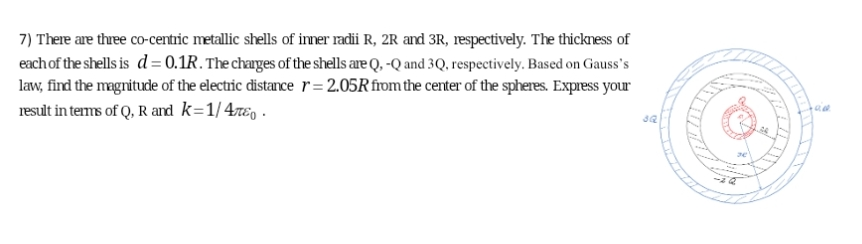 7) There are three co-centric metallic shells of inner radii R, 2R and 3R, respectively. The thickness of
eachof theshellsis d = 0.1R. The charges of the shells are Q, -Q and 3Q. respectively. Based on Gauss's
law, find the magnitude of the electric distance = 2.05R from the center of the spheres. Express your ~~
result interns of Q, R and K=1/47z, . ofl EH #5 5 Pe
Bl Bf
NP
This is AI generated Response.
Asked by: gvr
Created at: 2025-07-27 15:49:41
Asked by: gvr
Created at: 2025-07-27 15:49:41
Final Answer:
Rendered
Raw Text
Did you like this answer?
Let's break down the problem **step by step**:
### Given:
- Three concentric metallic shells.
- Inner radii: \( R, 2R, 3R \)
- Thickness of each shell: \( d = 0.1R \)
- Charges: First shell = \( Q \), Second shell = \( -Q \), Third shell = \( 3Q \)
- Find the magnitude of the electric field at \( r = 2.05R \).
- Use \( k = \frac{1}{4\pi\epsilon_0} \).
---
## **Step 1: Identify the Location**
At \( r = 2.05R \):
- \( R < 2.05R < 2R+0.1R = 2.1R \)
- So, **inside the second shell** (after passing the first shell, inside the body of the second shell).
---
## **Step 2: Gauss's Law**
The **electric field** at a distance \( r \) from the center (inside a shell or between shells) is determined **only by the total charge enclosed within \( r \)**.
\[
E \cdot 4 \pi r^2 = \frac{Q_{\text{enc}}}{\epsilon_0}
\]
\[
E = \frac{1}{4\pi\epsilon_0} \cdot \frac{Q_{\text{enc}}}{r^2} = k \frac{Q_{\text{enc}}}{r^2}
\]
---
## **Step 3: Calculate \( Q_{\text{enc}} \) at \( r = 2.05R \)**
- **First shell (radius R; thickness 0.1R):** Inner radius = \(R\), outer radius = \(1.1R\). Charge = \(Q\).
- **Second shell (radius 2R; thickness 0.1R):** Inner radius = \(2R\), outer radius = \(2.1R\). Charge = \(-Q\).
- \( 2.05R \) is between \(2R\) and \(2.1R\), **inside the conducting material** of the second shell.
#### **What is the enclosed charge?**
- Any Gaussian surface at \( r = 2.05R \) will enclose:
- Charge on the first shell: \( Q \)
- **None of the charge on the second and third shells, since their charge is on their surfaces** (by electrostatics, charge resides on the surface of conductors).
Thus, **enclosed charge \( Q_{\text{enc}} = Q \)**
---
## **Step 4: Electric Field at \( r = 2.05R \) (inside a conductor)**
BUT: Inside the conducting material of a shell, **the electric field is zero** (because the charges rearrange themselves so that the field inside the conductor cancels out).
So, **at \( r = 2.05R \), which is inside the conducting material of the second shell, the electric field is zero**.
---
## **Step 5: Final Answer**
\[
\boxed{E(r = 2.05R) = 0}
\]
**Explanation**:
- The point \( r = 2.05R \) lies within the conducting material of the second shell.
- Inside a conductor in electrostatic equilibrium, the electric field is always zero.
---
### **Summary Table**
| Region | Range | Enclosed Charge | Electric Field |
|---------------|----------------------|---------------------|-------------------------------|
| Inside 1st shell | \( r < R \) | 0 | 0 |
| Between 1st and 2nd shell | \( R < r < 1.1R \) | \( Q \) | \( k \frac{Q}{r^2} \) |
| Between shells | \( 1.1R < r < 2R \) | \( Q \) | \( k \frac{Q}{r^2} \) |
| **Inside 2nd shell (conductor)** | \( 2R < r < 2.1R \) | \( Q \) | **0** |
| Between 2nd and 3rd shell | \( 2.1R < r < 3R \) | \( Q - Q = 0 \) | 0 |
| Inside 3rd shell (conductor) | \( 3R < r < 3.1R \) | \( Q - Q = 0 \) | 0 |
---
## **Boxed Final Answer**
\[
\boxed{
E(r = 2.05R) = 0
}
\]
If you need the electric field at a different region, let me know!
📢 Instructions:
- Ask anything relatd to above question only.
- For new Question goto :