This is AI generated Response.
Asked by: gvr
Created at: 2025-07-27 11:29:15
Final Answer:
RenderedRaw Text
Did you like this answer?
Let's solve the problem step by step:
### **Step 1: List Known Values**
- Mass of loop, \( m = 50.0\, \text{g} = 0.0500\, \text{kg} \)
- Side lengths: \( a = 0.200\, \text{m},\ b = 0.100\, \text{m} \)
- Current, \( I = 3.50\, \text{A} \)
- Magnetic field, \( B = 0.0100\, \text{T} \) (in \( +y \) direction)
- Gravity, \( g = 9.8\, \text{m/s}^2 \)
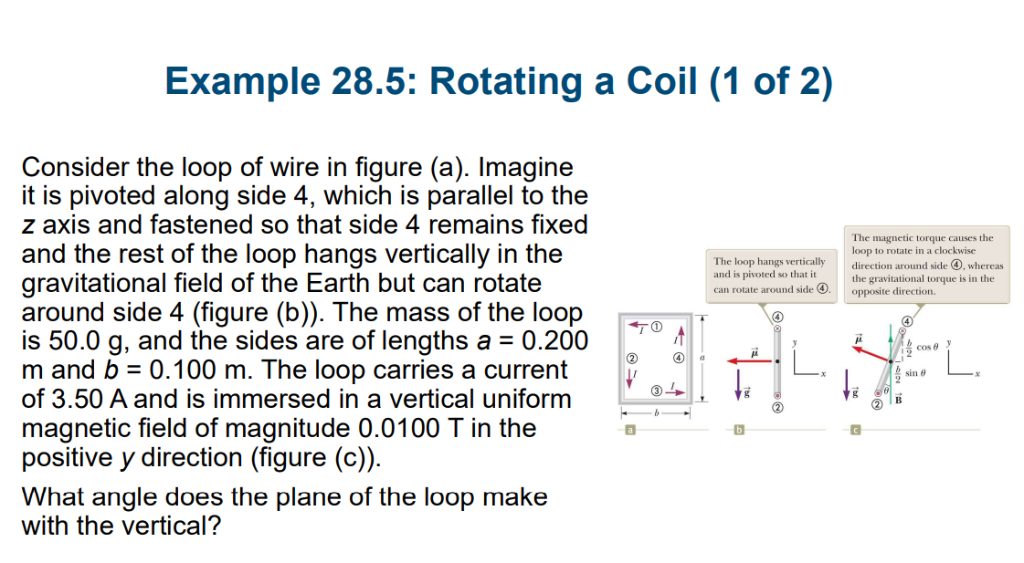
- The loop can rotate about side 4 (z-axis).
We are to find **the angle \( \theta \) that the plane of the loop makes with the vertical** (at equilibrium).
---
### **Step 2: Analyze Torques**
There are two torques on the loop:
1. **Gravitational Torque (\( \tau_g \))**: Tends to make the loop hang vertically.
2. **Magnetic Torque (\( \tau_B \))**: Tends to rotate the loop due to the interaction of current and magnetic field.
#### **a) Gravitational Torque**
- The center of mass is at the center of the rectangle.
- The lever arm from the pivot (side 4) to the center of mass is \( a/2 \).
- The torque is \( \tau_g = m g \cdot \frac{a}{2} \sin\theta \).
#### **b) Magnetic Torque**
- The magnetic moment \( \mu = I \cdot A \), where \( A = ab \).
- \( \vec{\tau}_B = \vec{\mu} \times \vec{B} \), so magnitude: \( \tau_B = \mu B \sin\phi \), where \( \phi \) is the angle between \( \vec{\mu} \) and \( \vec{B} \).
- From the diagram, as the loop rotates by angle \( \theta \), the normal to the loop makes angle \( \theta \) with the vertical (and \( \vec{B} \) is vertical), so \( \sin\phi = \cos\theta \).
- Therefore: \( \tau_B = \mu B \cos\theta \).
---
### **Step 3: Set Up the Equilibrium Condition**
At equilibrium, net torque is zero:
\[
\tau_B = \tau_g
\]
\[
\mu B \cos\theta = m g \cdot \frac{a}{2} \sin\theta
\]
---
### **Step 4: Substitute Known Quantities**
- \( \mu = Iab \)
So,
\[
Iab B \cos\theta = m g \cdot \frac{a}{2} \sin\theta
\]
Divide both sides by \( a \):
\[
IbB \cos\theta = \frac{mg}{2} \sin\theta
\]
Bring all \( \theta \)-terms to one side:
\[
\frac{\cos\theta}{\sin\theta} = \frac{mg}{2IbB}
\]
\[
\cot\theta = \frac{mg}{2IbB}
\]
---
### **Step 5: Plug in the Numbers**
- \( m = 0.0500\, \text{kg} \)
- \( g = 9.8\, \text{m/s}^2 \)
- \( I = 3.50\, \text{A} \)
- \( b = 0.100\, \text{m} \)
- \( B = 0.0100\, \text{T} \)
Calculate:
\[
\cot\theta = \frac{0.0500 \times 9.8}{2 \times 3.50 \times 0.100 \times 0.0100}
\]
Calculate numerator:
\[
0.0500 \times 9.8 = 0.49
\]
Calculate denominator:
\[
2 \times 3.50 \times 0.100 \times 0.0100 = 2 \times 3.50 \times 0.001 = 2 \times 0.0035 = 0.007
\]
So:
\[
\cot\theta = \frac{0.49}{0.007} = 70
\]
---
### **Step 6: Solve for \( \theta \)**
\[
\cot\theta = 70 \implies \theta = \cot^{-1}(70)
\]
Use a calculator:
\[
\theta \approx 0.818^\circ
\]
---
### **Final Answer**
\[
\boxed{0.82^\circ}
\]
**The plane of the loop makes an angle of approximately \( 0.82^\circ \) with the vertical.**
---
#### **Summary of Steps**
1. Set up torque equilibrium: \( \mu B \cos\theta = m g \frac{a}{2} \sin\theta \)
2. Substitute values and solve for \( \cot\theta \)
3. Calculate the angle \( \theta \)
Let me know if you need further clarifications!
Question:
I NEED STEP BY STEP DETAILED CALCULATIONS OF EACH PART ALONG WITH THE FINAL ANSWER PLEASE CALCULATE ACCURATELY
This is AI generated Response.
Asked by: gvr
Created at: 2025-07-27 11:31:12
Final Answer:
RenderedRaw Text
Did you like this answer?
Certainly! Let's go through the problem carefully and in detail, calculating each part step by step.
---
### **Given Data:**
| Quantity | Value | Units |
|------------|--------|--------|
| Mass of loop + frame | \( m = 50.0\, \text{g} \) | \( 0.0500\, \text{kg} \) |
| Length of side \( a \) | \( a = 0.200\, \text{m} \) | |
| Length of side \( b \) | \( b = 0.100\, \text{m} \) | |
| Current in loop | \( I = 3.50\, \text{A} \) | |
| Magnetic field | \( B = 0.0100\, \text{T} \) | (vertical, in \( +y \) direction) |
| Gravitational acceleration | \( g = 9.80\, \text{m/s}^2 \) | |
---
## Step 1: Understand the physical setup
- The loop is rectangular with sides \( a \) and \( b \).
- It is pivoted along side 4 (say, side \( b \)), which remains fixed, so the loop can rotate about this side.
- The loop hangs in Earth's gravity and is immersed in a magnetic field.
- The goal: Find the equilibrium angle \( \theta \) that the plane of the loop makes with the vertical.
---
## Step 2: Identify the forces and torques
### **a) Gravitational torque (\( \tau_g \))**
- The weight acts downward through the center of mass.
- The center of mass of a rectangle is at its geometric center.
- The distance from the pivot (along side 4) to the center of mass is \( a/2 \).
- The component of the weight perpendicular to the lever arm (assuming the loop is inclined at angle \( \theta \)) is \( mg \sin\theta \).
**But**, since the torque depends on the lever arm and the component perpendicular to the arm, the torque due to gravity is:
\[
\tau_g = \text{(force)} \times \text{(lever arm)} = mg \times \left( \frac{a}{2} \right) \sin\theta
\]
(Note: The \( \sin\theta \) accounts for the angle between the weight vector and the lever arm.)
### **b) Magnetic torque (\( \tau_B \))**
- Magnetic moment \( \vec{\mu} = I \times \text{area vector} \).
- For a rectangle, the area is \( A = a \times b \).
The magnitude of magnetic moment:
\[
\mu = I \times A = I \times a \times b
\]
- The magnetic torque:
\[
\tau_B = \mu B \sin\phi
\]
- The angle \( \phi \) between \( \vec{\mu} \) and \( \vec{B} \).
From the geometry:
- The magnetic field is vertical (\( y \)-direction).
- The normal to the plane makes an angle \( \theta \) with the vertical.
**Therefore:**
\[
\sin \phi = \cos \theta
\]
(assuming the magnetic moment vector is perpendicular to the plane of the loop, and the plane's inclination is \( \theta \)).
**Thus:**
\[
\tau_B = \mu B \cos \theta
\]
---
## Step 3: Write the torque balance equation at equilibrium
In equilibrium, the magnetic torque balances the gravitational torque:
\[
\boxed{
\mu B \cos \theta = mg \left( \frac{a}{2} \right) \sin \theta
}
\]
---
## Step 4: Substitute known quantities
### Calculate \( \mu \):
\[
\mu = I a b = 3.50\, \text{A} \times 0.200\, \text{m} \times 0.100\, \text{m} = 3.50 \times 0.0200 = 0.0700\, \text{A}\cdot \text{m}^2
\]
### Write the equilibrium condition:
\[
(0.0700\, \text{A}\cdot \text{m}^2) \times 0.0100\, \text{T} \times \cos \theta = 0.0500\, \text{kg} \times 9.80\, \text{m/s}^2 \times \frac{0.200\, \text{m}}{2} \times \sin \theta
\]
Calculate the left side:
\[
0.0700 \times 0.0100 = 0.000700\, \text{N}\cdot \text{m}
\]
Calculate the right side:
\[
0.0500 \times 9.80 = 0.490\, \text{N}
\]
\[
\frac{0.200}{2} = 0.100\, \text{m}
\]
\[
0.490 \times 0.100 = 0.0490\, \text{N}\cdot \text{m}
\]
Now, the equilibrium equation becomes:
\[
0.000700 \cos \theta = 0.0490 \sin \theta
\]
---
## Step 5: Solve for \( \theta \)
Divide both sides by \( \cos \theta \):
\[
0.000700 = 0.0490 \tan \theta
\]
\[
\tan \theta = \frac{0.000700}{0.0490} \approx 0.01429
\]
Finally:
\[
\theta = \arctan(0.01429)
\]
Using a calculator:
\[
\theta \approx 0.819^\circ
\]
---
## **Final Answer:**
\[
\boxed{
\text{The plane of the loop makes an angle of approximately } \boxed{0.82^\circ} \text{ with the vertical}
}
\]
---
### **Summary:**
- Calculated magnetic moment \( \mu = 0.0700\, \text{A}\cdot \text{m}^2 \)
- Set up torque balance: \( \mu B \cos \theta = mg \frac{a}{2} \sin \theta \)
- Solved for \( \theta \), resulting in about **0.82 degrees**.
Let me know if you'd like further clarifications!
VIPSolutions focuses on clear, step‑by‑step explanations so you can learn quickly. Whether you need an AI‑generated walkthrough or a short hint to get unstuck, each solution is organized for fast reading and easy review later.
Search similar questions, compare approaches, and bookmark the best answers for revision. Our goal is simple: quick, reliable study help that feels natural—not noisy.
 VIPSolutions
 Example 28.5: Rotating a Coil (1 of 2)
Consider the loop of wire in figure (a). Imagine
it is pivoted along side 4, which is parallel to the
z axis and fastened so that side 4 remains fixed ————
and the rest of the loop hangs vertically in the Toei rit | | rien et at © phen
gravitational field of the Earth but can rotate peor [Eo To
around side 4 (figure (b)). The mass of the loop + Te A
is 50.0 g, and the sides are of lengths a= 0.200 |" / = | |» & [he
m and b = 0.100 m. The loop carries a current 1° Tl L. le Ji L.
of 3.50 Aand is immersed in a vertical uniform ~~. ¥ Fal
magnetic field of magnitude 0.0100 T in the a o a
positive y direction (figure (c)).
What angle does the plane of the loop make
with the vertical?