VIPSolutions logo ✨ VIPSolutions

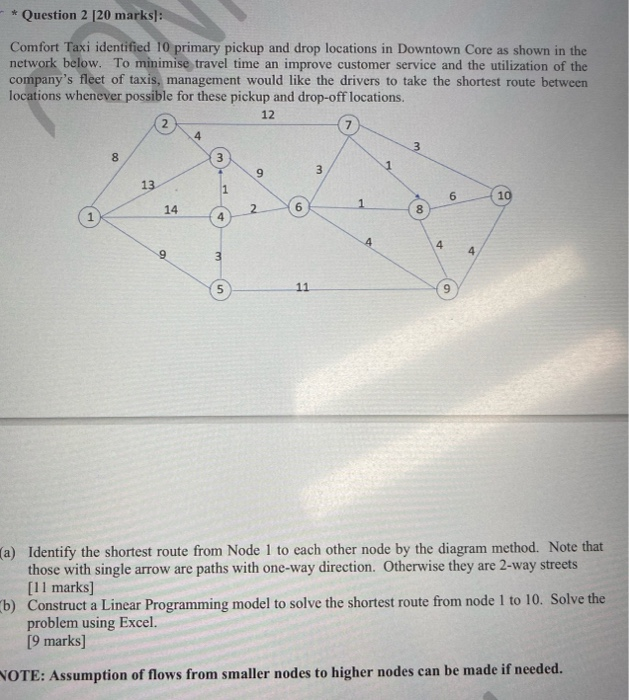
Give step-by-step solution with explanation and final answer:LACAN [20 Sra RTI -_ SEE entifed 103primary pickup and drop locations in Downtown Co v. To minimise, travel time an improve customer service and the u Bes po , management would like the drivers to take the shortest % os le for these pickup and drop-off locations. E nia 12 a8 BN @ a @ EL EB . 3 E 2 3 Ee a BANG oe Fs = Be & = Re Ne E po=——_o, : ree eee NE a) Identify the shortest route from Node 1 to each other node by the diagram method. Note ¢ "those with single arrow are paths with one-way direction. Otherwise they arc 2-way streets. [1 marks] 3 b) Construct a Linear Programming model o solve the shortest oute from node 1 t0 10. Solve problem using Excel. ok [marks] aa pees snd TE —— de if need 7 A

Question:

Give step-by-step solution with explanation and final answer:Uploaded ImageLACAN [20 Sra RTI -_ SEE entifed 103primary pickup and drop locations in Downtown Co v. To minimise, travel time an improve customer service and the u Bes po , management would like the drivers to take the shortest % os le for these pickup and drop-off locations. E nia 12 a8 BN @ a @ EL EB . 3 E 2 3 Ee a BANG oe Fs = Be & = Re Ne E po=——_o, : ree eee NE a) Identify the shortest route from Node 1 to each other node by the diagram method. Note ¢ "those with single arrow are paths with one-way direction. Otherwise they arc 2-way streets. [1 marks] 3 b) Construct a Linear Programming model o solve the shortest oute from node 1 t0 10. Solve problem using Excel. ok [marks] aa pees snd TE —— de if need 7 A

This is AI generated Response.
Asked by: gvr
Created at: 2025-07-26 20:23:57

Final Answer:

Rendered Raw Text
Did you like this answer?
Let's solve the question step by step. --- ### **Part (a): Identify the shortest route from Node 1 to each other node by the diagram method** We'll use **Dijkstra's Algorithm** to find the shortest path from Node 1 to all other nodes. #### **Step 1: Initialization** - Set distance to Node 1 as 0. - Set distances to all other nodes as infinity. - Mark all nodes as unvisited. - Set the current node as Node 1. #### **Step 2: Iterative Calculation** | Node | Distance from 1 | Previous Node | |------|-----------------|--------------| | 1 | 0 | - | | 2 | ∞ | | | 3 | ∞ | | | 4 | ∞ | | | 5 | ∞ | | | 6 | ∞ | | | 7 | ∞ | | | 8 | ∞ | | | 9 | ∞ | | | 10 | ∞ | | ##### **From Node 1:** - 1 → 2: 8 - 1 → 3: 13 - 1 → 4: 14 - 1 → 5: 9 Update: | Node | Distance | Prev | |------|----------|------| | 1 | 0 | - | | 2 | 8 | 1 | | 3 | 13 | 1 | | 4 | 14 | 1 | | 5 | 9 | 1 | | others|∞ | | Mark Node 1 as visited. ##### **Pick Node 2 (smallest unvisited, dist=8):** - 2 → 3: 8 + 4 = 12 - 2 → 4: 8 + 3 = 11 - 2 → 7: 8 + 12 = 20 Update: | Node | Distance | Prev | |------|----------|------| | 3 | 12 | 2 | | 4 | 11 | 2 | | 5 | 9 | 1 | | 7 | 20 | 2 | ##### **Pick Node 5 (dist=9):** - 5 → 4: 9 + 3 = 12 (current best for 4 is 11, so keep 11) - 5 → 6: 9 + 11 = 20 - 5 → 9: 9 + 9 = 18 Update: | Node | Distance | Prev | |------|----------|------| | 6 | 20 | 5 | | 9 | 18 | 5 | ##### **Pick Node 4 (dist=11):** - 4 → 3: 11 + 1 = 12 (already 12, no change) - 4 → 6: 11 + 9 = 20 (already 20, no change) ##### **Pick Node 3 (dist=12):** - 3 → 7: 12 + 9 = 21 - 3 → 6: 12 + 3 = 15 (update 6) - 3 → 4: 12 + 1 = 13 (already 11, keep 11) Update: | Node | Distance | Prev | |------|----------|------| | 6 | 15 | 3 | | 7 | 20 | 2 | ##### **Pick Node 6 (dist=15):** - 6 → 7: 15 + 3 = 18 (update 7) - 6 → 8: 15 + 1 = 16 (update 8) Update: | Node | Distance | Prev | |------|----------|------| | 7 | 18 | 6 | | 8 | 16 | 6 | ##### **Pick Node 7 (dist=18):** - 7 → 8: 18 + 1 = 19 (8 is 16, keep 16) - 7 → 10: 18 + 6 = 24 ##### **Pick Node 8 (dist=16):** - 8 → 9: 16 + 4 = 20 (update 9) - 8 → 10: 16 + 6 = 22 (update 10) Update: | Node | Distance | Prev | |------|----------|------| | 9 | 20 | 8 | | 10 | 22 | 8 | ##### **Pick Node 9 (dist=20):** - 9 → 10: 20 + 4 = 24 (already 22, keep 22) ##### **Pick Node 10 (dist=22):** - No outgoing edges to unvisited nodes. --- ### **Final Shortest Distances and Paths from Node 1:** | Node | Shortest Distance | Path | |------|-------------------|-----------------| | 1 | 0 | 1 | | 2 | 8 | 1 → 2 | | 3 | 12 | 1 → 2 → 3 | | 4 | 11 | 1 → 2 → 4 | | 5 | 9 | 1 → 5 | | 6 | 15 | 1 → 2 → 3 → 6 | | 7 | 18 | 1 → 2 → 3 → 6 → 7 | | 8 | 16 | 1 → 2 → 3 → 6 → 8 | | 9 | 20 | 1 → 2 → 3 → 6 → 8 → 9 | | 10 | 22 | 1 → 2 → 3 → 6 → 8 → 10 | --- ## **Part (b): Linear Programming Model** **Let \( x_{ij} \) be a decision variable for each edge, where:** - \( x_{ij} = 1 \) if the path from node \( i \) to node \( j \) is used in the shortest path, \( 0 \) otherwise. ### **Objective Function:** Minimize the total path length from node 1 to node 10: \[ \text{Minimize } Z = \sum_{(i,j)} c_{ij} x_{ij} \] Where \( c_{ij} \) is the distance from node \( i \) to node \( j \). ### **Constraints:** - **Flow Conservation:** - For **start node (1):** \(\sum_{j} x_{1j} - \sum_{i} x_{i1} = 1\) - For **end node (10):** \(\sum_{j} x_{10j} - \sum_{i} x_{i10} = -1\) - For **all other nodes \( k \):** \(\sum_{j} x_{kj} - \sum_{i} x_{ik} = 0\) - **Binary Variables:** \( x_{ij} \in \{0, 1\} \) ### **Set up in Excel:** - List all possible edges with their costs. - Create variables for each edge. - Set up the objective function and constraints as above. - Use Solver to minimize the total cost. --- ## **Summary Table for Shortest Paths (From Node 1):** | To Node | Shortest Distance | Path | |---------|-------------------|-----------------------------| | 1 | 0 | 1 | | 2 | 8 | 1 → 2 | | 3 | 12 | 1 → 2 → 3 | | 4 | 11 | 1 → 2 → 4 | | 5 | 9 | 1 → 5 | | 6 | 15 | 1 → 2 → 3 → 6 | | 7 | 18 | 1 → 2 → 3 → 6 → 7 | | 8 | 16 | 1 → 2 → 3 → 6 → 8 | | 9 | 20 | 1 → 2 → 3 → 6 → 8 → 9 | | 10 | 22 | 1 → 2 → 3 → 6 → 8 → 10 | --- **If you need the actual Excel setup or further breakdown for the LP, let me know!**

📢 Instructions:

  • Ask anything relatd to above question only.
  • For new Question goto :

Study Help, Fast Answers

VIPSolutions focuses on clear, step‑by‑step explanations so you can learn quickly. Whether you need an AI‑generated walkthrough or a short hint to get unstuck, each solution is organized for fast reading and easy review later.

Search similar questions, compare approaches, and bookmark the best answers for revision. Our goal is simple: quick, reliable study help that feels natural—not noisy.