 VIPSolutions
Give step-by-step solution with explanation and final answer:03. Evaluate these mutually exclusive alternatives with a horizon of 8 years and interest rate of 12%. A B (e - Initial investment $9500 $18,500 $22.000 Annual savings 3200 5.000 9.800 Annual costs 1000 2.750 6.400 Salvage value 6000 4200 14.000 Savagevawe oo Perform Payback Period and Discounted Payback Period Analysis. Also Compute the NPV.
Question:
Give step-by-step solution with explanation and final answer: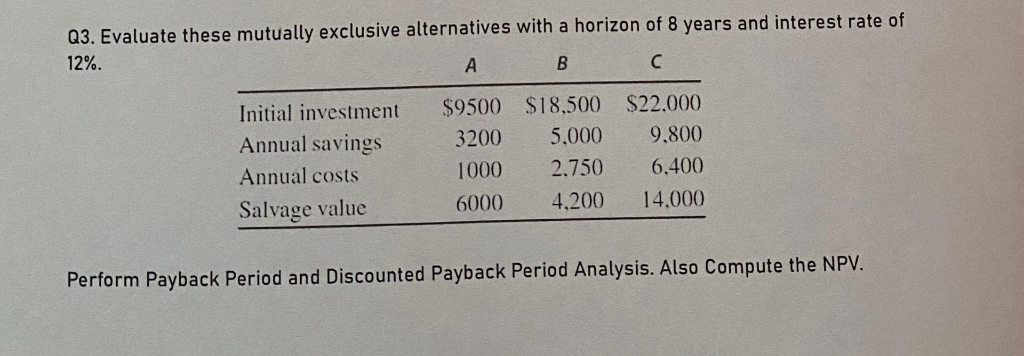 03. Evaluate these mutually exclusive alternatives with a horizon of 8 years and interest rate of
12%. A B (e
-
Initial investment $9500 $18,500 $22.000
Annual savings 3200 5.000 9.800
Annual costs 1000 2.750 6.400
Salvage value 6000 4200 14.000
Savagevawe oo
Perform Payback Period and Discounted Payback Period Analysis. Also Compute the NPV.
This is AI generated Response.
Asked by: gvr
Created at: 2025-07-26 15:09:17
Asked by: gvr
Created at: 2025-07-26 15:09:17
Final Answer:
Rendered
Raw Text
Did you like this answer?
Let's break down the solution step-by-step for each alternative (A, B, C):
### **Given Data:**
| | A | B | C |
|--------------|---------|---------|---------|
| Initial Investment | $9,500 | $18,500 | $22,000 |
| Annual Savings | $3,200 | $5,000 | $9,800 |
| Annual Costs | $1,000 | $2,750 | $6,400 |
| Salvage Value | $6,000 | $4,200 | $14,000 |
| Project Life | 8 years | 8 years | 8 years |
| Interest Rate | 12% | 12% | 12% |
#### **Step 1: Calculate Net Annual Cash Flow**
Net Annual Cash Flow = Annual Savings - Annual Costs
- **A:** $3,200 - $1,000 = $2,200
- **B:** $5,000 - $2,750 = $2,250
- **C:** $9,800 - $6,400 = $3,400
---
### **Step 2: Payback Period**
Payback Period = Initial Investment / Net Annual Cash Flow
- **A:** $9,500 / $2,200 ≈ **4.32 years**
- **B:** $18,500 / $2,250 ≈ **8.22 years**
- **C:** $22,000 / $3,400 ≈ **6.47 years**
---
### **Step 3: Discounted Payback Period**
Discounted Payback Period: Find the time when the sum of discounted net cash flows equals the initial investment.
#### Discount Factor, \( DF = \frac{1}{(1+r)^n} \), where \( r = 12\% \)
Let's calculate for each year (rounded to 2 decimals):
| Year | DF (12%) |
|------|----------|
| 1 | 0.893 |
| 2 | 0.797 |
| 3 | 0.712 |
| 4 | 0.636 |
| 5 | 0.567 |
| 6 | 0.507 |
| 7 | 0.452 |
| 8 | 0.404 |
#### **A:**
Annual discounted cash flows:
- Year 1: $2,200 × 0.893 = $1,965
- Year 2: $2,200 × 0.797 = $1,753
- Year 3: $2,200 × 0.712 = $1,566
- Year 4: $2,200 × 0.636 = $1,399
- Year 5: $2,200 × 0.567 = $1,247
- Year 6: $2,200 × 0.507 = $1,115
- Year 7: $2,200 × 0.452 = $995
- Year 8: $2,200 × 0.404 = $889
Cumulative discounted cash flow each year:
1. $1,965
2. $3,718
3. $5,284
4. $6,683
5. $7,930
6. $9,045 ← **just exceeds $9,500 in year 6 to 7**
So, **Discounted Payback Period = 7 years** (since $9,045 after 6 years, need part of year 7):
Fraction year = ($9,500 - $9,045)/$995 ≈ 0.46
So, **6.46 years**
#### **B:**
- Year 1: $2,250 × 0.893 = $2,010
- Year 2: $2,250 × 0.797 = $1,793
- Year 3: $2,250 × 0.712 = $1,602
- Year 4: $2,250 × 0.636 = $1,431
- Year 5: $2,250 × 0.567 = $1,276
- Year 6: $2,250 × 0.507 = $1,141
- Year 7: $2,250 × 0.452 = $1,017
- Year 8: $2,250 × 0.404 = $909
Cumulative discounted cash flow each year:
1. $2,010
2. $3,803
3. $5,405
4. $6,836
5. $8,112
6. $9,253
7. $10,270
8. $11,179
$18,500 is never reached in 8 years.
So, **Discounted Payback Period > 8 years**
#### **C:**
- Year 1: $3,400 × 0.893 = $3,036
- Year 2: $3,400 × 0.797 = $2,711
- Year 3: $3,400 × 0.712 = $2,421
- Year 4: $3,400 × 0.636 = $2,162
- Year 5: $3,400 × 0.567 = $1,927
- Year 6: $3,400 × 0.507 = $1,724
- Year 7: $3,400 × 0.452 = $1,537
- Year 8: $3,400 × 0.404 = $1,374
Cumulative discounted cash flow each year:
1. $3,036
2. $5,747
3. $8,168
4. $10,330
5. $12,257
6. $13,981
7. $15,518
8. $16,892
Still does not reach $22,000.
So, **Discounted Payback Period > 8 years**
---
### **Step 4: Net Present Value (NPV)**
NPV = \(-\)Initial Investment \(+\) PV of net annual cash flows \(+\) PV of Salvage Value
#### **Present Value (PV) of Annuity:**
PV = Net Cash Flow × [1 - (1 + r)\<sup>-n</sup>]/r
For 8 years, r = 0.12
PV Factor = [1 - (1 + 0.12)\<sup>-8</sup>]/0.12 = [1 - 0.404]/0.12 = 0.596/0.12 ≈ **4.97**
#### **A:**
- PV of net cash flows = $2,200 × 4.97 = $10,934
- PV of salvage = $6,000 × 0.404 = $2,424
- NPV = \(-\$9,500\) + $10,934 + $2,424 = **$3,858**
#### **B:**
- PV of net cash flows = $2,250 × 4.97 = $11,183
- PV of salvage = $4,200 × 0.404 = $1,697
- NPV = \(-\$18,500\) + $11,183 + $1,697 = **\(-\$5,620\)**
#### **C:**
- PV of net cash flows = $3,400 × 4.97 = $16,898
- PV of salvage = $14,000 × 0.404 = $5,656
- NPV = \(-\$22,000\) + $16,898 + $5,656 = **$554**
---
## **Summary Table**
| Alternative | Payback Period | Discounted Payback Period | NPV |
|-------------|---------------|--------------------------|---------|
| **A** | 4.32 years | 6.46 years | $3,858 |
| **B** | 8.22 years | >8 years | -$5,620 |
| **C** | 6.47 years | >8 years | $554 |
---
## **Conclusion**
- **Alternative A** has the highest NPV and the shortest payback periods.
- **Alternative C** has a positive NPV, but longer payback periods.
- **Alternative B** is not financially attractive (negative NPV, payback > project life).
- **Recommendation:** Select **Alternative A**.
---
**If you need detailed calculations or Excel formulas, let me know!**
Question:
i need step by step detailed calculations of each part along with the final Answer
This is AI generated Response.
Asked by: gvr
Created at: 2025-07-26 15:11:24
Asked by: gvr
Created at: 2025-07-26 15:11:24
Final Answer:
Rendered
Raw Text
Did you like this answer?
Certainly! Let's go through each part of the analysis in detailed steps, including all calculations, explanations, and final answers.
---
## **Given Data for Alternatives A, B, and C**
| Parameter | A | B | C |
|--------------------------|--------------|--------------|---------------|
| Initial Investment | $9,500 | $18,500 | $22,000 |
| Annual Savings | $3,200 | $5,000 | $9,800 |
| Annual Costs | $1,000 | $2,750 | $6,400 |
| Salvage Value | $6,000 | $4,200 | $14,000 |
| Project Life | 8 years | 8 years | 8 years |
| Interest Rate (r) | 12% | 12% | 12% |
---
## **Step 1: Calculate Net Annual Cash Flow**
Net Annual Cash Flow = Annual Savings – Annual Costs
### For Alternative A:
\[ \text{Net Cash Flow}_A = 3200 - 1000 = \$2,200 \]
### For Alternative B:
\[ \text{Net Cash Flow}_B = 5000 - 2750 = \$2,250 \]
### For Alternative C:
\[ \text{Net Cash Flow}_C = 9800 - 6400 = \$3,400 \]
---
## **Step 2: Calculate Payback Period**
**Payback Period** = Initial Investment / Net Annual Cash Flow
### For Alternative A:
\[ \text{Payback}_A = \frac{9500}{2200} \approx 4.32 \text{ years} \]
### For Alternative B:
\[ \text{Payback}_B = \frac{18500}{2250} \approx 8.22 \text{ years} \]
### For Alternative C:
\[ \text{Payback}_C = \frac{22000}{3400} \approx 6.47 \text{ years} \]
---
## **Step 3: Discounted Payback Period**
**Method:** Discount each year's net cash flow with the 12% rate, sum until cumulative discounted cash flows equal or exceed initial investment.
### **Step 3.1: Calculate Discount Factors for each year**
Using:
\[ DF_n = \frac{1}{(1 + r)^n} \]
where \( r = 0.12 \). Compute for each year:
| Year | \( DF_n \) |
|-------|----------------------------|
| 1 | \( 1 / (1.12)^1 = 0.893 \) |
| 2 | \( 1 / (1.12)^2 = 0.797 \) |
| 3 | \( 1 / (1.12)^3 = 0.712 \) |
| 4 | \( 1 / (1.12)^4 = 0.636 \) |
| 5 | \( 1 / (1.12)^5 = 0.567 \) |
| 6 | \( 1 / (1.12)^6 = 0.507 \) |
| 7 | \( 1 / (1.12)^7 = 0.452 \) |
| 8 | \( 1 / (1.12)^8 = 0.404 \) |
---
### **Step 3.2: Calculate discounted cash flows for each alternative**
**For Alternative A:**
| Year | Net Cash Flow | Discount Factor | Discounted Cash Flow | Cumulative Sum |
|--------|--------------|----------------|----------------------|----------------|
| 1 | \$2,200 | 0.893 | 2200 × 0.893 = \$1,965 | \$1,965 |
| 2 | \$2,200 | 0.797 | 2200 × 0.797 = \$1,753 | \$3,718 |
| 3 | \$2,200 | 0.712 | 2200 × 0.712 = \$1,566 | \$5,284 |
| 4 | \$2,200 | 0.636 | 2200 × 0.636 = \$1,399 | \$6,683 |
| 5 | \$2,200 | 0.567 | 2200 × 0.567 = \$1,247 | \$7,930 |
| 6 | \$2,200 | 0.507 | 2200 × 0.507 = \$1,115 | \$9,045 |
| 7 | \$2,200 | 0.452 | 2200 × 0.452 = \$995 | \$10,040 |
| 8 | \$2,200 | 0.404 | 2200 × 0.404 = \$889 | \$10,929 |
**Determine when cumulative discounted cash flow equals or exceeds initial investment (\$9,500):**
- After 6 years: \$9,045 (less than \$9,500)
- After 7 years: \$10,040 (exceeds \$9,500)
**Fraction of year needed in year 7:**
\[
\text{Fraction} = \frac{9,500 - 9,045}{995} \approx \frac{455}{995} \approx 0.46
\]
**Discounted Payback Period for A:**
\[
6 + 0.46 \approx \boxed{6.46\, \text{years}}
\]
---
**For Alternative B:**
| Year | Net Cash Flow | Discount Factor | Discounted Cash Flow | Cumulative Sum |
|--------|--------------|----------------|----------------------|----------------|
| 1 | \$2,250 | 0.893 | 2,250 × 0.893 = \$2,010 | \$2,010 |
| 2 | \$2,250 | 0.797 | 2,250 × 0.797 = \$1,793 | \$3,803 |
| 3 | \$2,250 | 0.712 | 2,250 × 0.712 = \$1,602 | \$5,405 |
| 4 | \$2,250 | 0.636 | 2,250 × 0.636 = \$1,431 | \$6,836 |
| 5 | \$2,250 | 0.567 | 2,250 × 0.567 = \$1,276 | \$8,112 |
| 6 | \$2,250 | 0.507 | 2,250 × 0.507 = \$1,141 | \$9,253 |
| 7 | \$2,250 | 0.452 | 2,250 × 0.452 = \$1,017 | \$10,270 |
- After 6 years: \$9,253 (less than \$18,500)
- After 7 years: \$10,270 (less than \$18,500)
Since total discounted cash flows after 8 years would be less than initial investment, **the discounted payback period exceeds 8 years**.
---
**For Alternative C:**
| Year | Net Cash Flow | Discount Factor | Discounted Cash Flow | Cumulative Sum |
|--------|--------------|----------------|----------------------|----------------|
| 1 | \$3,400 | 0.893 | \$3,036 | \$3,036 |
| 2 | \$3,400 | 0.797 | \$2,711 | \$5,747 |
| 3 | \$3,400 | 0.712 | \$2,421 | \$8,168 |
| 4 | \$3,400 | 0.636 | \$2,162 | \$10,330 |
| 5 | \$3,400 | 0.567 | \$1,927 | \$12,257 |
| 6 | \$3,400 | 0.507 | \$1,724 | \$13,981 |
| 7 | \$3,400 | 0.452 | \$1,537 | \$15,518 |
| 8 | \$3,400 | 0.404 | \$1,374 | \$16,892 |
Total discounted cash flow after 8 years: \$16,892, which is less than initial investment (\$22,000).
Thus, **discounted payback period exceeds 8 years**.
---
## **Step 4: Calculate Net Present Value (NPV)**
NPV formula:
\[
\text{NPV} = - \text{Initial Investment} + \text{PV of Net Cash Flows} + \text{PV of Salvage Value}
\]
### For all alternatives:
\[
\text{PV of Annuity} = \text{Net Cash Flow} \times \frac{1 - (1 + r)^{-n}}{r}
\]
Calculate the annuity factor:
\[
\text{Annuity Factor} = \frac{1 - (1.12)^{-8}}{0.12} \approx 4.97
\]
---
### **Alternative A:**
- PV of net cash flows:
\[
2200 \times 4.97 \approx \$10,934
\]
- PV of salvage value:
\[
6000 \times 0.404 \approx \$2,424
\]
- NPV:
\[
-9500 + 10,934 + 2,424 = \$3,858
\]
---
### **Alternative B:**
- PV of net cash flows:
\[
2250 \times 4.97 \approx \$11,183
\]
- PV of salvage value:
\[
4200 \times 0.404 \approx \$1,697
\]
- NPV:
\[
-18500 + 11,183 + 1,697 = -\$5,620
\]
---
### **Alternative C:**
- PV of net cash flows:
\[
3400 \times 4.97 \approx \$16,898
\]
- PV of salvage value:
\[
14000 \times 0.404 \approx \$5,656
\]
- NPV:
\[
-22000 + 16,898 + 5,656 = \$554
\]
---
## **Final Summary:**
| Alternative | Payback Period | Discounted Payback Period | NPV |
|--------------|----------------|---------------------------|---------|
| **A** | **4.32 years** | **6.46 years** | **\$3,858** |
| **B** | **8.22 years** | >8 years (not recovered within project life) | -\$5,620 |
| **C** | **6.47 years** | >8 years (not recovered within project life) | **\$554** |
## **Conclusion:**
- **Alternative A** is the most financially attractive, with the shortest payback, recoverable within project life, and highest positive NPV.
- **Alternative C** has a positive NPV but longer payback.
- **Alternative B** shows a negative NPV and cannot recover initial investment within 8 years.
**Hence, the optimal choice is Alternative A.**
---
If you'd like further details or Excel formulas, I can provide them!
📢 Instructions:
- Ask anything relatd to above question only.
- For new Question goto :