 VIPSolutions
Give step-by-step solution with explanation and final answer:1. Solve the differential equation y" + x*2y = 0 by using a power series centered at x =0. 2. Use a power series centered at x = 0 to find the first four non-zero terms of the solution to y" - 2xy" + 2y = 0. 3. Solve the equation y" + 4y = 0 using a power series about x = 0 and write the recurrence relation. 4. Classify x = 0 as an ordinary point, regular singular point, or irregular singular point for the equation x*2y" + 3xy' + y = 0. 5. Determine the type of the point x = 0 for the differential equation (x2 + 1)y" + (x -1)y'+y=0.
Question:
Give step-by-step solution with explanation and final answer: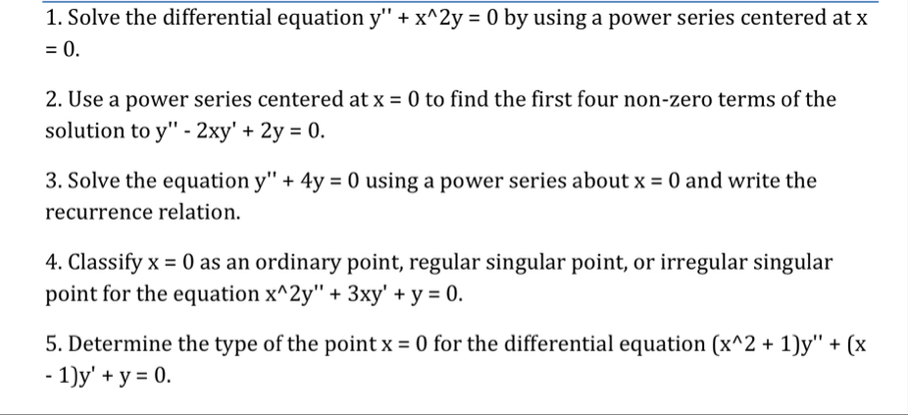 1. Solve the differential equation y" + x*2y = 0 by using a power series centered at x
=0.
2. Use a power series centered at x = 0 to find the first four non-zero terms of the
solution to y" - 2xy" + 2y = 0.
3. Solve the equation y" + 4y = 0 using a power series about x = 0 and write the
recurrence relation.
4. Classify x = 0 as an ordinary point, regular singular point, or irregular singular
point for the equation x*2y" + 3xy' + y = 0.
5. Determine the type of the point x = 0 for the differential equation (x2 + 1)y" + (x
-1)y'+y=0.
This is AI generated Response.
Asked by: gvr
Created at: 2025-07-26 12:25:12
Asked by: gvr
Created at: 2025-07-26 12:25:12
Final Answer:
Rendered
Raw Text
Did you like this answer?
Let's solve each of the questions **step by step**:
---
## **1. Solve the differential equation \( y'' + x^2 y = 0 \) using a power series centered at \( x = 0 \).**
### **Step 1: Assume a Power Series Solution**
Let \( y(x) = \sum_{n=0}^{\infty} a_n x^n \).
Then,
- \( y'(x) = \sum_{n=1}^{\infty} n a_n x^{n-1} \)
- \( y''(x) = \sum_{n=2}^{\infty} n(n-1) a_n x^{n-2} \)
### **Step 2: Substitute into the Equation**
Substitute into \( y'' + x^2y = 0 \):
\[
y'' + x^2 y = \sum_{n=2}^{\infty} n(n-1) a_n x^{n-2} + x^2 \sum_{n=0}^{\infty} a_n x^n = 0
\]
\[
= \sum_{n=2}^{\infty} n(n-1) a_n x^{n-2} + \sum_{n=0}^{\infty} a_n x^{n+2} = 0
\]
### **Step 3: Adjust Indices to Combine Sums**
Let \( k = n-2 \) for the first sum:
- When \( n = 2 \), \( k = 0 \), so \( n = k+2 \)
\[
\sum_{k=0}^{\infty} (k+2)(k+1) a_{k+2} x^k + \sum_{n=0}^{\infty} a_n x^{n+2} = 0
\]
Now, in the second sum, let \( m = n+2 \implies n = m-2 \):
\[
\sum_{k=0}^{\infty} (k+2)(k+1) a_{k+2} x^k + \sum_{m=2}^{\infty} a_{m-2} x^m = 0
\]
Rewriting both sums in terms of \( x^k \):
\[
\sum_{k=0}^{\infty} \left[ (k+2)(k+1) a_{k+2} + a_{k-2} \right] x^k = 0
\]
For \( k < 2 \), \( a_{k-2} = 0 \).
### **Step 4: Recurrence Relation**
So,
\[
(k+2)(k+1) a_{k+2} + a_{k-2} = 0 \implies a_{k+2} = -\frac{1}{(k+2)(k+1)} a_{k-2}
\]
### **Step 5: Initial Conditions**
Let \( a_0 = A \), \( a_1 = B \) (arbitrary constants).
### **Step 6: Write Out the First Few Terms**
- \( a_2 = -\frac{1}{2 \cdot 1} a_{0} = -\frac{1}{2}A \)
- \( a_3 = -\frac{1}{3 \cdot 2} a_{1} = -\frac{1}{6}B \)
- \( a_4 = -\frac{1}{4 \cdot 3} a_{2} = -\frac{1}{12}(-\frac{1}{2}A) = \frac{1}{24}A \)
- \( a_5 = -\frac{1}{5 \cdot 4} a_{3} = -\frac{1}{20}(-\frac{1}{6}B) = \frac{1}{120}B \)
### **Step 7: Write the Series Solution**
\[
y(x) = A\left[1 - \frac{1}{2}x^2 + \frac{1}{24}x^4 + \cdots \right] + B\left[x - \frac{1}{6}x^3 + \frac{1}{120}x^5 + \cdots \right]
\]
---
## **2. Use a power series centered at \( x = 0 \) to find the first four non-zero terms of the solution to \( y'' - 2x y' + 2y = 0 \).**
**Let \( y(x) = \sum_{n=0}^{\infty} a_n x^n \).**
- \( y'(x) = \sum_{n=1}^{\infty} n a_n x^{n-1} \)
- \( y''(x) = \sum_{n=2}^{\infty} n(n-1) a_n x^{n-2} \)
Substitute into the equation:
\[
y'' - 2x y' + 2y = 0
\]
\[
\sum_{n=2}^{\infty} n(n-1) a_n x^{n-2} - 2x \sum_{n=1}^{\infty} n a_n x^{n-1} + 2\sum_{n=0}^{\infty} a_n x^n = 0
\]
\[
= \sum_{n=2}^{\infty} n(n-1) a_n x^{n-2} - 2\sum_{n=1}^{\infty} n a_n x^{n} + 2\sum_{n=0}^{\infty} a_n x^n = 0
\]
Let’s shift the first sum to powers of \( x^n \):
Let \( k = n-2 \Rightarrow n = k+2 \):
\[
\sum_{k=0}^{\infty} (k+2)(k+1) a_{k+2} x^k - 2\sum_{n=1}^{\infty} n a_n x^n + 2\sum_{n=0}^{\infty} a_n x^n = 0
\]
Now, write all terms as \( x^n \), and combine:
- First sum: \( (n+2)(n+1)a_{n+2}x^n \)
- Second sum: \( -2n a_n x^n \) (from \( n=1 \))
- Third sum: \( 2 a_n x^n \)
So, for \( n \geq 0 \):
\[
(n+2)(n+1) a_{n+2} - 2n a_n + 2a_n = 0
\implies (n+2)(n+1) a_{n+2} + 2(1-n)a_n = 0
\implies a_{n+2} = -\frac{2(1-n)}{(n+2)(n+1)} a_n
\]
**Initial terms:**
Let \( a_0 = A \), \( a_1 = B \):
- For \( n=0 \): \( a_2 = -\frac{2(1-0)}{2 \cdot 1}a_0 = -\frac{2}{2}A = -A \)
- For \( n=1 \): \( a_3 = -\frac{2(1-1)}{3 \cdot 2}a_1 = 0 \)
- For \( n=2 \): \( a_4 = -\frac{2(1-2)}{4 \cdot 3}a_2 = -\frac{2(-1)}{12}(-A) = -\frac{2}{12}(-A) = \frac{A}{6} \)
- For \( n=3 \): \( a_5 = -\frac{2(1-3)}{5 \cdot 4}a_3 = -\frac{2(-2)}{20}(0) = 0 \)
- For \( n=4 \): \( a_6 = -\frac{2(1-4)}{6 \cdot 5}a_4 = -\frac{2(-3)}{30} \left(\frac{A}{6}\right) = \frac{6}{30} \cdot \frac{A}{6} = \frac{A}{30} \)
### **First Four Non-Zero Terms:**
\[
y(x) = A \left[1 - x^2 + \frac{1}{6} x^4 + \frac{1}{30} x^6 + \dots \right] + Bx
\]
---
## **3. Solve \( y'' + 4y = 0 \) using a power series about \( x = 0 \) and write the recurrence relation.**
Assume \( y(x) = \sum_{n=0}^{\infty} a_n x^n \).
- \( y'' = \sum_{n=2}^{\infty} n(n-1) a_n x^{n-2} \)
- \( 4y = 4\sum_{n=0}^{\infty} a_n x^n \)
Write \( y'' \) as \( x^n \):
Let \( k = n-2 \implies n = k+2 \):
\[
\sum_{k=0}^{\infty} (k+2)(k+1) a_{k+2} x^k + 4\sum_{k=0}^{\infty} a_k x^k = 0
\]
\[
\sum_{k=0}^{\infty} \left[(k+2)(k+1)a_{k+2} + 4a_k \right]x^k = 0
\]
So the **recurrence relation** is:
\[
a_{k+2} = -\frac{4}{(k+2)(k+1)} a_k
\]
---
## **4. Classify \( x = 0 \) as an ordinary point, regular singular point, or irregular singular point for \( x^2 y'' + 3x y' + y = 0 \).**
Write in standard form:
\[
y'' + \frac{3}{x} y' + \frac{1}{x^2} y = 0
\]
- \( P(x) = \frac{3}{x} \)
- \( Q(x) = \frac{1}{x^2} \)
- \( x P(x) = 3 \) (analytic at \( x=0 \))
- \( x^2 Q(x) = 1 \) (analytic at \( x=0 \))
Since both are analytic at \( x=0 \), **\( x=0 \) is a regular singular point**.
---
## **5. Determine the type of the point \( x=0 \) for \((x^2 + 1) y'' + (x-1)y' + y = 0\).**
Write in standard form:
\[
y'' + \frac{x-1}{x^2+1} y' + \frac{1}{x^2+1} y = 0
\]
- \( P(x) = \frac{x-1}{x^2+1} \)
- \( Q(x) = \frac{1}{x^2+1} \)
Both \( P(x) \) and \( Q(x) \) are analytic at \( x=0 \) (denominator is 1).
So, **\( x=0 \) is an ordinary point**.
---
### **Summary of Final Answers:**
1. **Power series solution:**
\[
y(x) = A\left[1 - \frac{1}{2}x^2 + \frac{1}{24}x^4 + \cdots \right] + B\left[x - \frac{1}{6}x^3 + \frac{1}{120}x^5 + \cdots\right]
\]
2. **First four non-zero terms:**
\[
y(x) = A \left[1 - x^2 + \frac{1}{6} x^4 + \frac{1}{30} x^6 + \dots \right] + Bx
\]
3. **Recurrence relation:** \( a_{k+2} = -\frac{4}{(k+2)(k+1)} a_k \)
4. **\( x=0 \) is a regular singular point.**
5. **\( x=0 \) is an ordinary point.**
📢 Instructions:
- Ask anything relatd to above question only.
- For new Question goto :