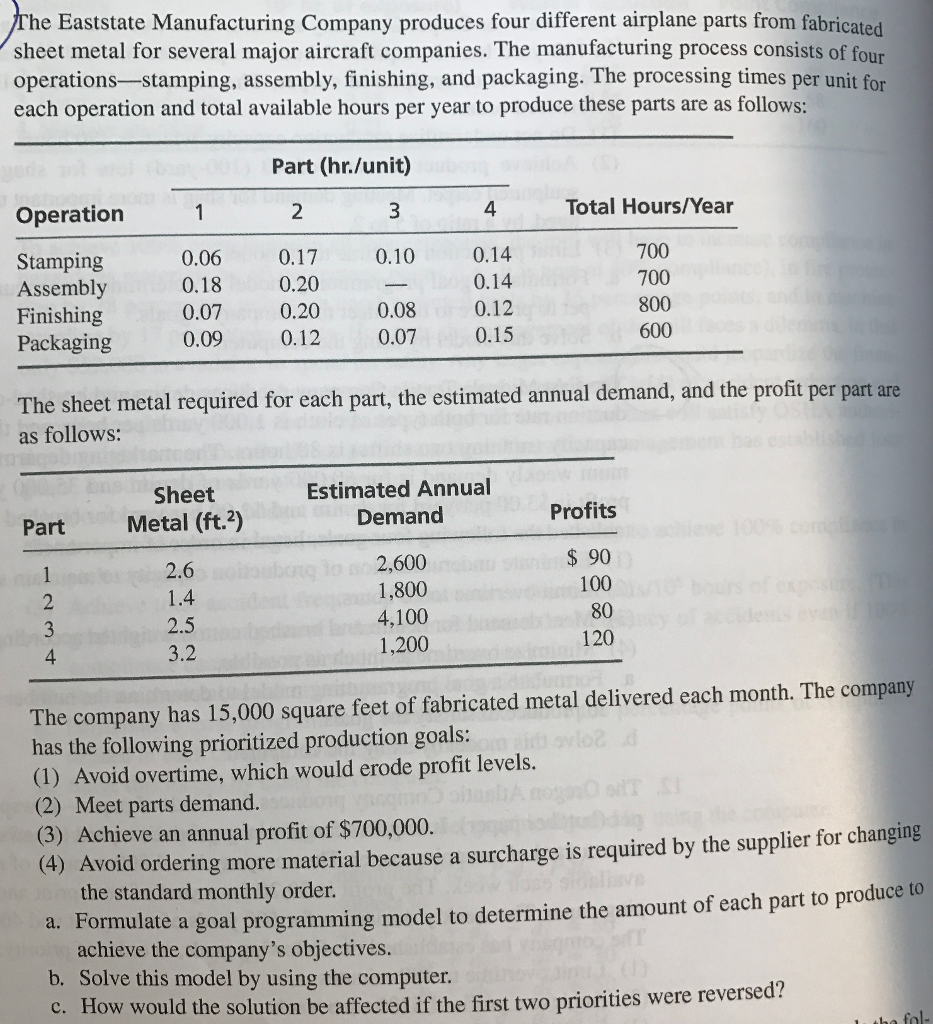
Give step-by-step solution with explanation and final answer:Jn he Eaststate Manufacturing Company produces four different airplane parts from fabri .
sheet metal for several major aircraft companies. The manufacturing process consists: of §
gperations—stamping, assembly, finishing, and packaging. The processing times per Ee
each operation and total available hours per year to produce these parts are as follows: vl
oN
Part (hr./unit) 2
meme CoE a 0 f
Stamping 0.06 0.17 0.10 0.14 700 1 :
Assembly 018 020 — 0.14 700 &
Finishing 0.07 0.20 0.08 0.12 800 .
Packaging 0.09 0.12 0.07 0.15 600 Ee
The sheet metal required for each part, the estimated annual demand, and the profit per
as follows:
bh
Sheet Estimated Annual
Part Metal (ft.2) Demand Profits
1 2:6 2,600 $ 90
7% 1.4 1,800 100
A} 0.5 4,100 80
4 3.2 1,200 120 1
The company has 15,000 square feet of fabricated metal delivered each month. The com
has the following prioritized production goals:
(1) Avoid overtime, which would erode profit levels.
: ie) cetpers demand.
(3 Achieve an annual profit of $700,000. P
(4) Avoid ordering more material because a surcharge is required by the supplier for cha
~ the standard monthly order. 4
oyu te a goal programming model to determine the amount of each part to prodsy
lieve the company’s objectives.
Solve this mo del by using the computer.
flow would the solution be affected if the first two priorities were reversed?
J.
Question:
Give step-by-step solution with explanation and final answer:Jn he Eaststate Manufacturing Company produces four different airplane parts from fabri .
sheet metal for several major aircraft companies. The manufacturing process consists: of §
gperations—stamping, assembly, finishing, and packaging. The processing times per Ee
each operation and total available hours per year to produce these parts are as follows: vl
oN
Part (hr./unit) 2
meme CoE a 0 f
Stamping 0.06 0.17 0.10 0.14 700 1 :
Assembly 018 020 — 0.14 700 &
Finishing 0.07 0.20 0.08 0.12 800 .
Packaging 0.09 0.12 0.07 0.15 600 Ee
The sheet metal required for each part, the estimated annual demand, and the profit per
as follows:
bh
Sheet Estimated Annual
Part Metal (ft.2) Demand Profits
1 2:6 2,600 $ 90
7% 1.4 1,800 100
A} 0.5 4,100 80
4 3.2 1,200 120 1
The company has 15,000 square feet of fabricated metal delivered each month. The com
has the following prioritized production goals:
(1) Avoid overtime, which would erode profit levels.
: ie) cetpers demand.
(3 Achieve an annual profit of $700,000. P
(4) Avoid ordering more material because a surcharge is required by the supplier for cha
~ the standard monthly order. 4
oyu te a goal programming model to determine the amount of each part to prodsy
lieve the company’s objectives.
Solve this mo del by using the computer.
flow would the solution be affected if the first two priorities were reversed?
J.
This is AI generated Response.
Asked by: gvr
Created at: 2025-07-26 11:49:30
Final Answer:
RenderedRaw Text
Did you like this answer?
Let's break down the problem and **formulate a goal programming model** as requested in part (a).
---
## **Step 1: Define Decision Variables**
Let:
- \( x_1 \) = Number of units of part 1 to produce per year
- \( x_2 \) = Number of units of part 2 to produce per year
- \( x_3 \) = Number of units of part 3 to produce per year
- \( x_4 \) = Number of units of part 4 to produce per year
---
## **Step 2: List the Objectives (Goals) and Constraints**
### **Resources and Limits**
- **Stamping hours:** \(0.06x_1 + 0.17x_2 + 0.10x_3 + 0.14x_4 \leq 700\)
- **Assembly hours:** \(0.18x_1 + 0.20x_2 + 0.08x_3 + 0.14x_4 \leq 700\)
- **Finishing hours:** \(0.07x_1 + 0.20x_2 + 0.08x_3 + 0.12x_4 \leq 800\)
- **Packaging hours:** \(0.09x_1 + 0.12x_2 + 0.07x_3 + 0.15x_4 \leq 600\)
- **Sheet metal:** \(2.6x_1 + 1.4x_2 + 2.5x_3 + 3.2x_4 \leq 12 \times 15,000 = 180,000\) (since the demand and production are annual)
### **Demand (Goal 2):**
- \(x_1 \leq 2,600\)
- \(x_2 \leq 1,800\)
- \(x_3 \leq 4,100\)
- \(x_4 \leq 1,200\)
### **Profit (Goal 3):**
- \(90x_1 + 100x_2 + 80x_3 + 120x_4 \geq 700,000\)
---
## **Step 3: Introduce Deviational Variables**
For each goal, introduce deviational variables:
- **For each resource constraint:** Let \(d_{i}^{-}\) and \(d_{i}^{+}\) be under- and over-utilization of resource \(i\) (where \(+\) means overtime, which we want to avoid).
- **For demand:** Let \(d_{j}^{-}\) and \(d_{j}^{+}\) be under- and over-production for part \(j\).
- **For profit:** Let \(d_P^{-}\) (underachievement of profit) and \(d_P^{+}\) (overachievement of profit).
---
## **Step 4: Write the Goal Constraints**
### **Resource Constraints (avoiding overtime):**
\[
\begin{align*}
0.06x_1 + 0.17x_2 + 0.10x_3 + 0.14x_4 + d_1^{-} - d_1^{+} &= 700 \\
0.18x_1 + 0.20x_2 + 0.08x_3 + 0.14x_4 + d_2^{-} - d_2^{+} &= 700 \\
0.07x_1 + 0.20x_2 + 0.08x_3 + 0.12x_4 + d_3^{-} - d_3^{+} &= 800 \\
0.09x_1 + 0.12x_2 + 0.07x_3 + 0.15x_4 + d_4^{-} - d_4^{+} &= 600 \\
\end{align*}
\]
- \(d_i^{+}\) represents overtime (to be minimized).
### **Demand Constraints:**
\[
\begin{align*}
x_1 + d_{d1}^{-} - d_{d1}^{+} &= 2,600 \\
x_2 + d_{d2}^{-} - d_{d2}^{+} &= 1,800 \\
x_3 + d_{d3}^{-} - d_{d3}^{+} &= 4,100 \\
x_4 + d_{d4}^{-} - d_{d4}^{+} &= 1,200 \\
\end{align*}
\]
- \(d_{dj}^{-}\): underproduction (to be minimized).
### **Profit Constraint:**
\[
90x_1 + 100x_2 + 80x_3 + 120x_4 + d_P^{-} - d_P^{+} = 700,000
\]
- \(d_P^{-}\): underachievement of profit (to be minimized).
### **Material Constraint:**
\[
2.6x_1 + 1.4x_2 + 2.5x_3 + 3.2x_4 + d_M^{-} - d_M^{+} = 180,000
\]
- \(d_M^{+}\): overuse (to be minimized).
---
## **Step 5: Set Up the Goal Programming Objective Function**
Prioritize the goals as specified:
- \(P_1\): Avoid overtime (\(\sum d_i^{+}\))
- \(P_2\): Meet demand (\(\sum d_{dj}^{-}\))
- \(P_3\): Achieve profit (\(d_P^{-}\))
- \(P_4\): Avoid overuse of material (\(d_M^{+}\))
The lexicographic (pre-emptive) goal programming objective function is:
\[
\text{Minimize: } P_1 (\sum_{i=1}^4 d_i^{+}) + P_2 (\sum_{j=1}^4 d_{dj}^{-}) + P_3 (d_P^{-}) + P_4 (d_M^{+})
\]
where \(P_1 \gg P_2 \gg P_3 \gg P_4\).
---
## **Step 6: Non-negativity Constraints**
All variables and deviational variables must be non-negative.
---
## **Final Formulation**
### **Decision Variables:**
- \(x_1, x_2, x_3, x_4 \geq 0\)
### **Deviational Variables:**
- \(d_i^{-}, d_i^{+}, d_{dj}^{-}, d_{dj}^{+}, d_P^{-}, d_P^{+}, d_M^{-}, d_M^{+} \geq 0\)
### **Objective:**
\[
\text{Minimize: } P_1 (\sum_{i=1}^4 d_i^{+}) + P_2 (\sum_{j=1}^4 d_{dj}^{-}) + P_3 (d_P^{-}) + P_4 (d_M^{+})
\]
### **Subject to:**
\[
\begin{align*}
0.06x_1 + 0.17x_2 + 0.10x_3 + 0.14x_4 + d_1^{-} - d_1^{+} &= 700 \\
0.18x_1 + 0.20x_2 + 0.08x_3 + 0.14x_4 + d_2^{-} - d_2^{+} &= 700 \\
0.07x_1 + 0.20x_2 + 0.08x_3 + 0.12x_4 + d_3^{-} - d_3^{+} &= 800 \\
0.09x_1 + 0.12x_2 + 0.07x_3 + 0.15x_4 + d_4^{-} - d_4^{+} &= 600 \\
x_1 + d_{d1}^{-} - d_{d1}^{+} &= 2,600 \\
x_2 + d_{d2}^{-} - d_{d2}^{+} &= 1,800 \\
x_3 + d_{d3}^{-} - d_{d3}^{+} &= 4,100 \\
x_4 + d_{d4}^{-} - d_{d4}^{+} &= 1,200 \\
90x_1 + 100x_2 + 80x_3 + 120x_4 + d_P^{-} - d_P^{+} &= 700,000 \\
2.6x_1 + 1.4x_2 + 2.5x_3 + 3.2x_4 + d_M^{-} - d_M^{+} &= 180,000 \\
x_1, x_2, x_3, x_4, d_i^{-}, d_i^{+}, d_{dj}^{-}, d_{dj}^{+}, d_P^{-}, d_P^{+}, d_M^{-}, d_M^{+} &\geq 0
\end{align*}
\]
---
## **(a) This is the goal programming model as requested.**
---
### **(b) & (c)**
- For (b), you would solve this using a linear programming solver.
- For (c), if the first two priorities were reversed, you would minimize unmet demand before overtime, changing the order of \(P_1\) and \(P_2\) in the objective function.
---
**If you need the solution for (b) or (c) or a numerical solution, let me know!**
VIPSolutions focuses on clear, step‑by‑step explanations so you can learn quickly. Whether you need an AI‑generated walkthrough or a short hint to get unstuck, each solution is organized for fast reading and easy review later.
Search similar questions, compare approaches, and bookmark the best answers for revision. Our goal is simple: quick, reliable study help that feels natural—not noisy.
 VIPSolutions
 Jn he Eaststate Manufacturing Company produces four different airplane parts from fabri .
sheet metal for several major aircraft companies. The manufacturing process consists: of §
gperations—stamping, assembly, finishing, and packaging. The processing times per Ee
each operation and total available hours per year to produce these parts are as follows: vl
oN
Part (hr./unit) 2
meme CoE a 0 f
Stamping 0.06 0.17 0.10 0.14 700 1 :
Assembly 018 020 — 0.14 700 &
Finishing 0.07 0.20 0.08 0.12 800 .
Packaging 0.09 0.12 0.07 0.15 600 Ee
The sheet metal required for each part, the estimated annual demand, and the profit per
as follows:
bh
Sheet Estimated Annual
Part Metal (ft.2) Demand Profits
1 2:6 2,600 $ 90
7% 1.4 1,800 100
A} 0.5 4,100 80
4 3.2 1,200 120 1
The company has 15,000 square feet of fabricated metal delivered each month. The com
has the following prioritized production goals:
(1) Avoid overtime, which would erode profit levels.
: ie) cetpers demand.
(3 Achieve an annual profit of $700,000. P
(4) Avoid ordering more material because a surcharge is required by the supplier for cha
~ the standard monthly order. 4
oyu te a goal programming model to determine the amount of each part to prodsy
lieve the company’s objectives.
Solve this mo del by using the computer.
flow would the solution be affected if the first two priorities were reversed?
J.