This is AI generated Response.
Asked by: Pagal
Created at: 2025-07-26 09:59:00
Final Answer:
RenderedRaw Text
Did you like this answer?
Let's **walk through the sensitivity analysis** step by step for the given change:
### **Step 1: Understanding the Change**
- **Original coefficient of \( x_3 \) in the objective function:** \( c_3 = 13 \)
- **New coefficient:** \( c_3 = 7 \)
We need to **analyze the effect of this change** on the current solution using the tableau provided.
---
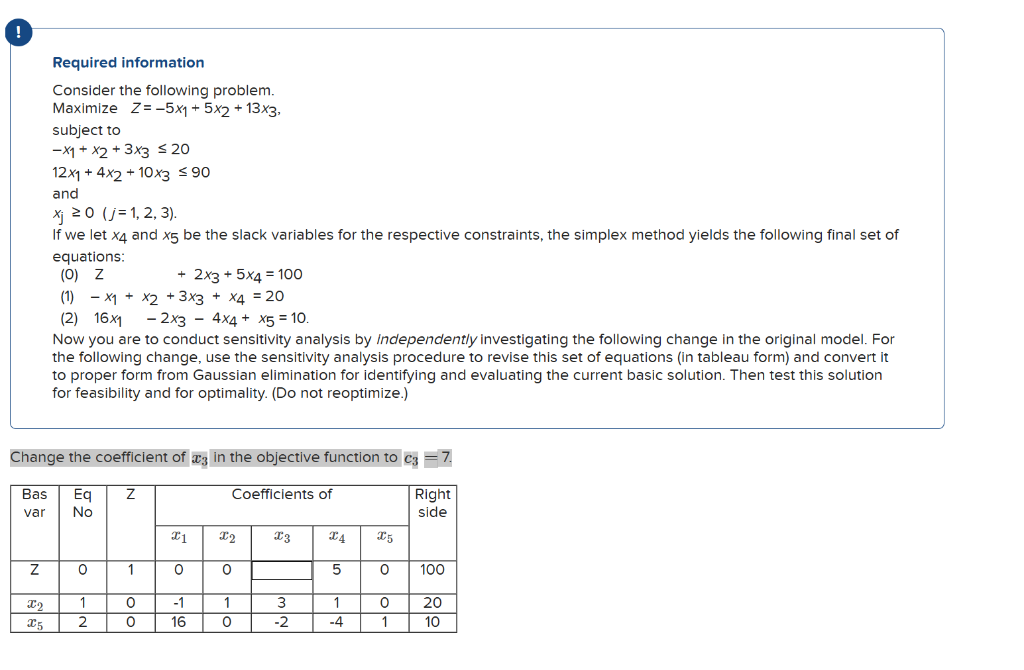
### **Step 2: The Current Tableau**
| Bas var | Eq No | Z | \(x_1\) | \(x_2\) | \(x_3\) | \(x_4\) | \(x_5\) | Right side |
|---------|-------|---|--------|--------|--------|--------|--------|------------|
| Z | 0 | 1 | 0 | 0 | 5 | 2 | 0 | 100 |
| \(x_2\) | 1 | 0 | -1 | 1 | 3 | 1 | 0 | 20 |
| \(x_5\) | 2 | 0 | 16 | 0 | -2 | -4 | 1 | 10 |
---
### **Step 3: Update the Objective Row**
Because **only \( c_3 \) changes** (from 13 to 7), we update the \( Z \) row using the formula:
\[
\text{New } Z \text{ row} = \text{Old } Z \text{ row} + (c_3^{\text{new}} - c_3^{\text{old}}) \times (\text{row of } x_3)
\]
But since we have already the final tableau, we need to compute the new **reduced cost** for the non-basic variables under the new \( c_3 \):
#### **Compute new Z-row coefficients**
- The non-basic variables in the current basis are: \( x_1, x_3, x_4 \)
- The basic variables are: \( x_2, x_5 \)
The formula for the new reduced cost for variable \( j \) is:
\[
\bar{c}_j = c_j - \sum_{i \in B} c_{B_i} a_{ij}
\]
Where:
- \( c_j \) is the new cost coefficient for variable \( j \)
- \( c_{B_i} \) is the cost coefficient for basic variable \( i \)
- \( a_{ij} \) is the coefficient in the tableau
Let's find the new Z-row coefficients for \( x_3 \):
#### **Find the new Z-row coefficient for \( x_3 \):**
- \( x_2 \) and \( x_5 \) are basic, so their original costs are 5 and 0, respectively (from the original objective function).
- From the tableau, the coefficients of \( x_3 \) in the \( x_2 \) and \( x_5 \) rows are:
- For \( x_2 \): 3
- For \( x_5 \): -2
\[
\text{New Z-row for } x_3 = c_3 - (c_{x_2} \cdot 3 + c_{x_5} \cdot -2)
\]
But in the original problem, \( c_{x_2} = 5 \), \( c_{x_5} = 0 \).
\[
\text{New Z-row for } x_3 = 7 - (5 \cdot 3 + 0 \cdot -2) = 7 - 15 = -8
\]
#### **Compute for other variables if needed**
You can check for \( x_1 \) and \( x_4 \) as well for completeness:
- \( x_1 \): coefficients in \( x_2 \) and \( x_5 \) rows are \(-1\) and \(16\)
\[
\text{New Z-row for } x_1 = c_1 - (c_{x_2} \cdot -1 + c_{x_5} \cdot 16) = -5 - (5 \cdot -1 + 0 \cdot 16) = -5 + 5 = 0
\]
- \( x_4 \): coefficients in \( x_2 \) and \( x_5 \) rows are \(1\) and \(-4\)
\[
\text{New Z-row for } x_4 = c_4 - (c_{x_2} \cdot 1 + c_{x_5} \cdot -4) = 0 - (5 \cdot 1 + 0 \cdot -4) = 0 - 5 = -5
\]
---
### **Step 4: Write the Updated Tableau**
| Bas var | Eq No | Z | \(x_1\) | \(x_2\) | \(x_3\) | \(x_4\) | \(x_5\) | Right side |
|---------|-------|---|--------|--------|--------|--------|--------|------------|
| Z | 0 | 1 | 0 | 0 | **-8** | -5 | 0 | 0 |
| \(x_2\) | 1 | 0 | -1 | 1 | 3 | 1 | 0 | 20 |
| \(x_5\) | 2 | 0 | 16 | 0 | -2 | -4 | 1 | 10 |
---
### **Step 5: Test Feasibility and Optimality**
#### **Feasibility**
- The current solution is still feasible because the right-hand sides of the constraints are unchanged and non-negative.
#### **Optimality**
- For a maximization problem, the solution is optimal if all coefficients in the Z-row for non-basic variables are **≤ 0**.
- \( x_1: 0 \)
- \( x_3: -8 \)
- \( x_4: -5 \)
All are ≤ 0, so the current solution **remains optimal**.
---
### **Step 6: Final Answer**
#### **Summary Table**
| Bas var | Eq No | Z | \(x_1\) | \(x_2\) | \(x_3\) | \(x_4\) | \(x_5\) | Right side |
|---------|-------|---|--------|--------|--------|--------|--------|------------|
| Z | 0 | 1 | 0 | 0 | **-8** | -5 | 0 | 0 |
| \(x_2\) | 1 | 0 | -1 | 1 | 3 | 1 | 0 | 20 |
| \(x_5\) | 2 | 0 | 16 | 0 | -2 | -4 | 1 | 10 |
- **Current basic solution remains feasible and optimal.**
- **No need to reoptimize.**
---
#### **Final Answer:**
> **With the change \( c_3 = 7 \), the current basic solution remains feasible and optimal. The new reduced cost for \( x_3 \) is \( -8 \), and all Z-row coefficients for non-basic variables are ≤ 0.**
---
**If you need the actual values for \( x_1, x_2, x_3 \), they are:**
- \( x_2 = 20 \)
- \( x_5 = 10 \)
- All non-basic variables (\( x_1, x_3, x_4 \)) = 0
---
**Let me know if you need further explanation or calculation!**
VIPSolutions focuses on clear, step‑by‑step explanations so you can learn quickly. Whether you need an AI‑generated walkthrough or a short hint to get unstuck, each solution is organized for fast reading and easy review later.
Search similar questions, compare approaches, and bookmark the best answers for revision. Our goal is simple: quick, reliable study help that feels natural—not noisy.
 VIPSolutions
 '
Required information
Consider the following problem.
Maximize Z=-5x + 5x3 + 13x3,
subject to
—x1+ xp +3x3 £20
12x + 4x + 10x3 £90
and
X20 (j=1,2,3).
If we let x4 and xg be the slack variables for the respective constraints, the simplex method yields the following final set of
equations:
© z + 2x3 + 5x4 = 100
() =x + x2 +3x3 + x4 =20
(2) 16x —2x3 — dxg+ x5=10.
Now you are to conduct sensitivity analysis by independently investigating the following change in the original model. For
the following change, use the sensitivity analysis procedure to revise this set of equations (in tableau form) and convert it
to proper form from Gaussian elimination for identifying and evaluating the current basic solution. Then test this solution
for feasibility and for optimality. (Do not reoptimize.)
Change the coefficient of a3 In the objective function to ¢; =7.
Bas z Coefiicients of Right
var side
I I I I i = I hd
1
[mT [oA [13 [1 [02]
[zs 2]ofw[of[ 2-41 [iw]