 VIPSolutions
Give step-by-step solution with explanation and final answer:1=L—-11sth = L-1nlsn+1,n = 1,23, ... eat = L—-11s—asin(kt ) = £-1ks2 + kz cos(kt) = £—15s2 + k2sinh(kt) = £—1ks2 — k2 cosh(kt ) = £~1ss2 — k2 Use appropriate algebra and Theorem 7.2.1 to find the given inverse Laplace transform. (Write your answer as a function oft.) £—1= (8s —16)/[(s2 + 9)(s2 + 1)]
Question:
Give step-by-step solution with explanation and final answer: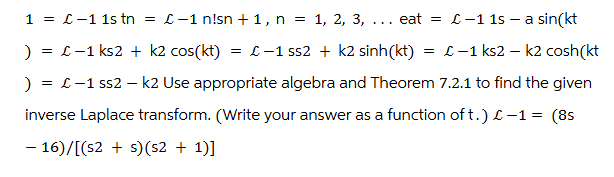 1=L—-11sth = L-1nlsn+1,n = 1,23, ... eat = L—-11s—asin(kt
) = £-1ks2 + kz cos(kt) = £—15s2 + k2sinh(kt) = £—1ks2 — k2 cosh(kt
) = £~1ss2 — k2 Use appropriate algebra and Theorem 7.2.1 to find the given
inverse Laplace transform. (Write your answer as a function oft.) £—1= (8s
—16)/[(s2 + 9)(s2 + 1)]
This is AI generated Response.
Asked by: gvr
Created at: 2025-07-26 02:49:14
Asked by: gvr
Created at: 2025-07-26 02:49:14
Final Answer:
Rendered
Raw Text
Did you like this answer?
Let's solve the given inverse Laplace transform step-by-step:
Given:
\[
\mathcal{L}^{-1}\left\{ \frac{8s-16}{(s^2 + s)(s^2 + 1)} \right\}
\]
### **Step 1: Factor and Set Up Partial Fractions**
First, factor the denominator:
\[
(s^2 + s)(s^2 + 1) = s(s + 1)(s^2 + 1)
\]
Write the expression as partial fractions:
\[
\frac{8s-16}{s(s+1)(s^2+1)} = \frac{A}{s} + \frac{B}{s+1} + \frac{Cs+D}{s^2+1}
\]
### **Step 2: Find the Constants**
Multiply both sides by the denominator:
\[
8s-16 = A(s+1)(s^2+1) + B s(s^2+1) + (Cs+D)s(s+1)
\]
Expand:
- \(A(s+1)(s^2+1) = A(s+1)(s^2+1) = A(s^3 + s^2 + s + 1)\)
- \(B s(s^2+1) = B(s^3 + s)\)
- \((Cs+D)s(s+1) = Cs^2(s+1) + Ds(s+1) = Cs^3 + Cs^2 + Ds^2 + Ds\)
So,
\[
8s-16 = A(s^3 + s^2 + s + 1) + B(s^3 + s) + C(s^3 + s^2) + D(s^2 + s)
\]
Group like powers:
\[
8s-16 = (A+B+C)s^3 + (A+C+D)s^2 + (A+B+D)s + A
\]
### **Step 3: Set Up Equations for Coefficients**
Match coefficients with \(8s-16\):
- \(s^3\): \(A + B + C = 0\)
- \(s^2\): \(A + C + D = 0\)
- \(s^1\): \(A + B + D = 8\)
- constant: \(A = -16\)
From here:
1. \(A = -16\)
2. \(A + B + C = 0 \implies -16 + B + C = 0 \implies B + C = 16\)
3. \(A + C + D = 0 \implies -16 + C + D = 0 \implies C + D = 16\)
4. \(A + B + D = 8 \implies -16 + B + D = 8 \implies B + D = 24\)
Now solve this system:
From (2): \(B + C = 16\)
From (3): \(C + D = 16\)
From (4): \(B + D = 24\)
Let’s solve for \(B, C, D\):
From (2): \(B = 16 - C\)
From (3): \(D = 16 - C\)
Plug into (4): \(B + D = 24\):
\[
(16 - C) + (16 - C) = 24 \implies 32 - 2C = 24 \implies C = 4
\]
Now,
\(B = 16 - 4 = 12\)
\(D = 16 - 4 = 12\)
So,
\[
A = -16, \quad B = 12, \quad C = 4, \quad D = 12
\]
### **Step 4: Write Out the Partial Fractions**
\[
\frac{8s-16}{s(s+1)(s^2+1)} = \frac{-16}{s} + \frac{12}{s+1} + \frac{4s+12}{s^2+1}
\]
### **Step 5: Take the Inverse Laplace Transform**
Recall:
- \(\mathcal{L}^{-1}\left\{ \frac{1}{s} \right\} = 1\)
- \(\mathcal{L}^{-1}\left\{ \frac{1}{s+a} \right\} = e^{-at}\)
- \(\mathcal{L}^{-1}\left\{ \frac{s}{s^2+1} \right\} = \cos t\)
- \(\mathcal{L}^{-1}\left\{ \frac{1}{s^2+1} \right\} = \sin t\)
So,
\[
\mathcal{L}^{-1}\left\{ \frac{-16}{s} \right\} = -16
\]
\[
\mathcal{L}^{-1}\left\{ \frac{12}{s+1} \right\} = 12 e^{-t}
\]
\[
\mathcal{L}^{-1}\left\{ \frac{4s}{s^2+1} \right\} = 4\cos t
\]
\[
\mathcal{L}^{-1}\left\{ \frac{12}{s^2+1} \right\} = 12\sin t
\]
### **Final Answer**
\[
\boxed{
f(t) = -16 + 12e^{-t} + 4\cos t + 12\sin t
}
\]
📢 Instructions:
- Ask anything relatd to above question only.
- For new Question goto :