 VIPSolutions
Give step-by-step solution with explanation and final answer:22 — | BSL als a Sis 3, $l 2 2 tes In Exercises 15-28, use the Limit Comparison Tes to determioe the convergence or divergence of the series.
Question:
Give step-by-step solution with explanation and final answer: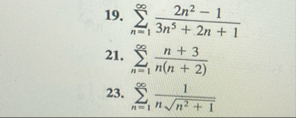
 22 — |
BSL
als
a Sis
3, $l
2 2 tes
In Exercises 15-28, use the Limit Comparison Tes to determioe
the convergence or divergence of the series.
This is AI generated Response.
Asked by: gvr
Created at: 2025-07-26 02:40:42
Asked by: gvr
Created at: 2025-07-26 02:40:42
Final Answer:
Rendered
Raw Text
Did you like this answer?
Let's solve each problem step by step **using the Limit Comparison Test** as instructed.
---
### **19.** \(\sum_{n=1}^{\infty} \frac{2n^2 - 1}{3n^5 + 2n + 1}\)
#### **Step 1: Identify dominant terms**
- Numerator: \(2n^2\) (as \(n \to \infty\))
- Denominator: \(3n^5\) (as \(n \to \infty\))
So, for large \(n\), \(\frac{2n^2 - 1}{3n^5 + 2n + 1} \sim \frac{2n^2}{3n^5} = \frac{2}{3n^3}\).
#### **Step 2: Choose comparison series**
Compare with \(b_n = \frac{1}{n^3}\), which is a **p-series** with \(p = 3 > 1\) (converges).
#### **Step 3: Compute the limit**
\[
\lim_{n \to \infty} \frac{a_n}{b_n} = \lim_{n \to \infty} \frac{\frac{2n^2 - 1}{3n^5 + 2n + 1}}{\frac{1}{n^3}} = \lim_{n \to \infty} \frac{(2n^2 - 1)n^3}{3n^5 + 2n + 1}
\]
\[
= \lim_{n \to \infty} \frac{2n^5 - n^3}{3n^5 + 2n + 1}
\]
Divide numerator and denominator by \(n^5\):
\[
= \lim_{n \to \infty} \frac{2 - \frac{1}{n^2}}{3 + \frac{2}{n^4} + \frac{1}{n^5}} = \frac{2}{3}
\]
#### **Step 4: Conclude**
Limit is a positive, finite number (\(\frac{2}{3}\)), so both series **converge or diverge together**. Since \(\sum \frac{1}{n^3}\) converges, **the given series converges**.
---
### **21.** \(\sum_{n=1}^{\infty} \frac{n + 3}{n(n+2)}\)
#### **Step 1: Identify dominant terms**
- Numerator: \(n\)
- Denominator: \(n^2\)
So for large \(n\), \(\frac{n + 3}{n(n+2)} \sim \frac{n}{n^2} = \frac{1}{n}\).
#### **Step 2: Choose comparison series**
Compare with \(b_n = \frac{1}{n}\) (**harmonic series**, diverges).
#### **Step 3: Compute the limit**
\[
\lim_{n \to \infty} \frac{\frac{n+3}{n(n+2)}}{\frac{1}{n}} = \lim_{n \to \infty} \frac{n+3}{n(n+2)} \cdot n = \lim_{n \to \infty} \frac{n(n+3)}{n(n+2)} = \lim_{n \to \infty} \frac{n+3}{n+2} = 1
\]
#### **Step 4: Conclude**
Limit is 1 (positive, finite). The series behaves like the harmonic series, which **diverges**.
**Final Answer:** The given series **diverges**.
---
### **23.** \(\sum_{n=1}^{\infty} \frac{1}{n\sqrt{n^2 + 1}}\)
#### **Step 1: Identify dominant terms**
For large \(n\), \(\sqrt{n^2+1} \sim n\), so denominator is \(n \cdot n = n^2\).
So, \(\frac{1}{n\sqrt{n^2 + 1}} \sim \frac{1}{n^2}\).
#### **Step 2: Choose comparison series**
Compare with \(b_n = \frac{1}{n^2}\), a **p-series** with \(p = 2 > 1\) (converges).
#### **Step 3: Compute the limit**
\[
\lim_{n \to \infty} \frac{\frac{1}{n\sqrt{n^2+1}}}{\frac{1}{n^2}} = \lim_{n \to \infty} \frac{n^2}{n\sqrt{n^2+1}} = \lim_{n \to \infty} \frac{n}{\sqrt{n^2+1}}
\]
\[
= \lim_{n \to \infty} \frac{1}{\sqrt{1 + \frac{1}{n^2}}} = 1
\]
#### **Step 4: Conclude**
Limit is 1. The comparison series converges, therefore,
**Final Answer:** The given series **converges**.
---
## **Summary of Answers**
- **19:** Converges
- **21:** Diverges
- **23:** Converges
Let me know if you want further explanation or details on any step!
📢 Instructions:
- Ask anything relatd to above question only.
- For new Question goto :