VIPSolutions logo ✨ VIPSolutions

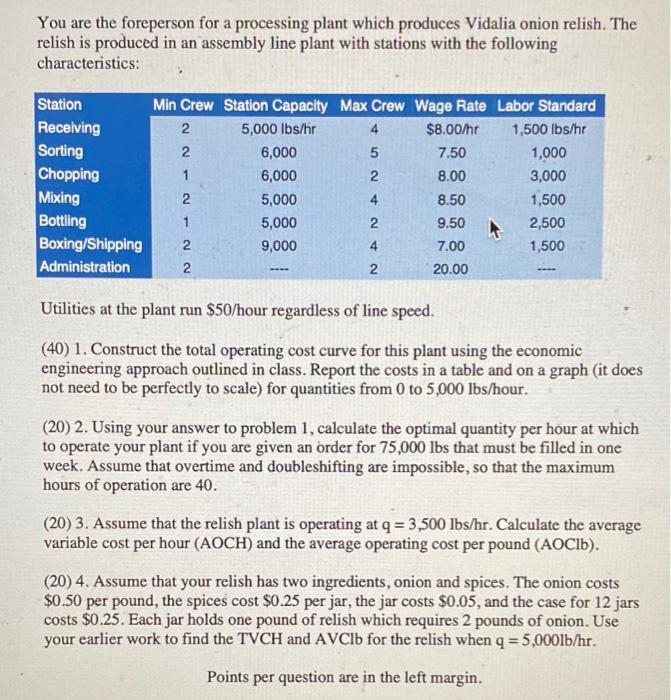
Give step-by-step solution with explanation and final answer:You are the foreperson for a processing plant which produces Vidalia onion relish. The relish is produced in an assembly line plant with stations with the following characteristics: ~~, i Station Min Crew Station Capacity Max Crew Wage Rate Labor Standard Receiving 2 5,000 Ibshr 4 $800Mc 1,500 Ibs/hr Sorting 2 6,000 5 7.50 1,000 7 Chopping it 6,000 2 800 3,000 Mixing 2 5,000 4 850 1,500 Bottling 1 5,000 2 950 |) 2500 Boxing/Shipping i 9,000 4 7.00 1,500 Administration 2 — 2 2000 = Utilities at the plant run $50/hour regardless of line speed. £ (40) 1. Construct the total operating cost curve for this plant using the economic. engineering approach outlined in class. Report the costs in a table and on a graph (it does not need to be perfectly to scale) for quantities from 0 to 5,000 Ibs/our. (20) 2. Using your answer to problem 1, calculate the optimal quantity per hour at which to operate your plant if you are given an order for 75,000 Ibs that must be filled in one week. Assume that overtime and doubleshifting are impossible, so that the maximum hours of operation are 40. (20) 3. Assume that the relish plant is operating at q = 3,500 Ibs/hr. Calculate the average variable cost per hour (AOCH) and the average operating cost per pound (AOCIb). (20) 4. Assume that your relish has two ingredients, onion and spices. The onion costs $0.50 per pound, the spices cost $0.25 per jar, the jar costs $0.05, and the case for 12 jars costs $0.25. Each jar holds one pound of relish which requires 2 pounds of onion. Use ‘your earlier work to find the TVCH and AVCIb for the relish when q = 5,0001b/hr. g Points per question are in the left margin.

Question:

Give step-by-step solution with explanation and final answer:Uploaded ImageYou are the foreperson for a processing plant which produces Vidalia onion relish. The relish is produced in an assembly line plant with stations with the following characteristics: ~~, i Station Min Crew Station Capacity Max Crew Wage Rate Labor Standard Receiving 2 5,000 Ibshr 4 $800Mc 1,500 Ibs/hr Sorting 2 6,000 5 7.50 1,000 7 Chopping it 6,000 2 800 3,000 Mixing 2 5,000 4 850 1,500 Bottling 1 5,000 2 950 |) 2500 Boxing/Shipping i 9,000 4 7.00 1,500 Administration 2 — 2 2000 = Utilities at the plant run $50/hour regardless of line speed. £ (40) 1. Construct the total operating cost curve for this plant using the economic. engineering approach outlined in class. Report the costs in a table and on a graph (it does not need to be perfectly to scale) for quantities from 0 to 5,000 Ibs/our. (20) 2. Using your answer to problem 1, calculate the optimal quantity per hour at which to operate your plant if you are given an order for 75,000 Ibs that must be filled in one week. Assume that overtime and doubleshifting are impossible, so that the maximum hours of operation are 40. (20) 3. Assume that the relish plant is operating at q = 3,500 Ibs/hr. Calculate the average variable cost per hour (AOCH) and the average operating cost per pound (AOCIb). (20) 4. Assume that your relish has two ingredients, onion and spices. The onion costs $0.50 per pound, the spices cost $0.25 per jar, the jar costs $0.05, and the case for 12 jars costs $0.25. Each jar holds one pound of relish which requires 2 pounds of onion. Use ‘your earlier work to find the TVCH and AVCIb for the relish when q = 5,0001b/hr. g Points per question are in the left margin.

This is AI generated Response.
Asked by: gvr
Created at: 2025-07-25 23:37:16

Final Answer:

Rendered Raw Text
Did you like this answer?
Let's solve this step by step for each question. --- ## **1. Construct the Total Operating Cost Curve (0 to 5,000 lbs/hr)** **Data from Table:** | Station | Min Crew | Max Crew | Station Capacity (lbs/hr) | Wage Rate ($/hr) | Labor Standard (lbs/hr/crew) | |-----------------|----------|----------|---------------------------|------------------|------------------------------| | Receiving | 2 | 4 | 5,000 | 8.00 | 1,500 | | Sorting | 2 | 5 | 6,000 | 7.50 | 1,000 | | Chopping | 1 | 6 | 6,000 | 8.00 | 3,000 | | Mixing | 2 | 4 | 5,000 | 8.50 | 1,500 | | Bottling | 2 | 4 | 5,000 | 9.50 | 2,500 | | Boxing/Shipping | 2 | 4 | 9,000 | 7.00 | 1,500 | | Administration | - | 2 | --- | 20.00 | --- | Utilities: **$50/hour** Let’s consider quantities: 0, 1,000, 2,000, 3,000, 4,000, 5,000 lbs/hr. ### **Step 1.1: Calculate Crew Needed per Station at Each Throughput** Crew needed = ceil(Throughput / Labor Standard). Use max crew if crew needed exceeds max. #### **Example Calculation for 3,000 lbs/hr:** - **Receiving:** ceil(3,000 / 1,500) = 2 (min crew 2) - **Sorting:** ceil(3,000 / 1,000) = 3 (min crew 2) - **Chopping:** ceil(3,000 / 3,000) = 1 (min crew 1) - **Mixing:** ceil(3,000 / 1,500) = 2 (min crew 2) - **Bottling:** ceil(3,000 / 2,500) = 2 (min crew 2) - **Boxing/Shipping:** ceil(3,000 / 1,500) = 2 (min crew 2) - **Administration:** 2 (fixed) ### **Step 1.2: Calculate Labor Cost per Station** Labor cost per hour = Crew needed × Wage Rate #### **3,000 lbs/hr Example:** | Station | Crew Needed | Wage Rate | Labor Cost/hr | |-----------------|-------------|-----------|--------------| | Receiving | 2 | 8.00 | $16.00 | | Sorting | 3 | 7.50 | $22.50 | | Chopping | 1 | 8.00 | $8.00 | | Mixing | 2 | 8.50 | $17.00 | | Bottling | 2 | 9.50 | $19.00 | | Boxing/Shipping | 2 | 7.00 | $14.00 | | Administration | 2 | 20.00 | $40.00 | | **Total Labor** | | | **$136.50** | ### **Step 1.3: Add Utilities** - Utilities per hour = $50 - **Total Operating Cost/hr = Labor Cost/hr + Utilities** #### **3,000 lbs/hr Example:** - Total = $136.50 + $50 = **$186.50/hr** --- ### **Step 1.4: Repeat for All Throughputs** #### **Summary Table** | Throughput (lbs/hr) | Receiving | Sorting | Chopping | Mixing | Bottling | Boxing | Admin | Labor Total | Utilities | **Total Cost/hr** | |---------------------|-----------|---------|----------|--------|----------|--------|-------|-------------|-----------|-------------------| | 0 | 2 × 8 = 16| 2 × 7.5 = 15| 1 × 8 = 8| 2 × 8.5 = 17| 2 × 9.5 = 19| 2 × 7 = 14| 2 × 20 = 40| $129 | $50 | **$179** | | 1,000 | 2 × 8 = 16| 2 × 7.5 = 15| 1 × 8 = 8| 2 × 8.5 = 17| 2 × 9.5 = 19| 2 × 7 = 14| 2 × 20 = 40| $129 | $50 | **$179** | | 2,000 | 2 × 8 = 16| 2 × 7.5 = 15| 1 × 8 = 8| 2 × 8.5 = 17| 2 × 9.5 = 19| 2 × 7 = 14| 2 × 20 = 40| $129 | $50 | **$179** | | 3,000 | 2 × 8 = 16| 3 × 7.5 = 22.5| 1 × 8 = 8| 2 × 8.5 = 17| 2 × 9.5 = 19| 2 × 7 = 14| 2 × 20 = 40| $136.5 | $50 | **$186.5** | | 4,000 | 3 × 8 = 24| 4 × 7.5 = 30| 2 × 8 = 16| 3 × 8.5 = 25.5| 2 × 9.5 = 19| 3 × 7 = 21| 2 × 20 = 40| $175.5 | $50 | **$225.5** | | 5,000 | 4 × 8 = 32| 5 × 7.5 = 37.5| 2 × 8 = 16| 4 × 8.5 = 34| 2 × 9.5 = 19| 4 × 7 = 28| 2 × 20 = 40| $206.5 | $50 | **$256.5** | --- ### **Step 1.5: (Graph)** - X-axis: Throughput (lbs/hr) [0, 1,000, ..., 5,000] - Y-axis: Total Operating Cost per Hour --- ## **2. Optimal Quantity per Hour for 75,000 lbs in One Week (40 hours)** Order = 75,000 lbs Max operation = 40 hours/week Required production rate = 75,000 lbs / 40 hrs = **1,875 lbs/hr** From the table above, at 2,000 lbs/hr (closest value), total operating cost/hr = **$179** --- ## **3. Calculate AOCH and AOCIb at q = 3,500 lbs/hr** From table, interpolate between 3,000 and 4,000 lbs/hr: - 3,000 lbs/hr: $186.5/hr - 4,000 lbs/hr: $225.5/hr Interpolate for 3,500 lbs/hr: \[ \text{Increment per 1,000 lbs/hr} = 225.5 - 186.5 = 39 \] \[ \text{Increment per 100 lbs/hr} = 39/10 = 3.9 \] \[ \text{Half increment} = 3.9 \times 5 = 19.5 \] So, \[ \text{Total Cost/hr at 3,500 lbs/hr} \approx 186.5 + 19.5 = \$206/hr \] #### **AOCH (Average Operating Cost per Hour)** - **AOCH = $206/hr** #### **AOCIb (Average Operating Cost per lb)** - **AOCIb = $206 / 3,500 = $0.0589/lb** --- ## **4. Calculate TVCH and AVCIb for q = 5,000 lbs/hr (Material Costs)** **Inputs:** - Onion cost: $0.50/lb - Spices cost: $0.25/lb - Jar cost: $0.05 - Case costs: $0.25 for 12 jars Each jar = 1 lb relish, needs 2 lbs onion. ### **Material Cost per 5,000 lbs/hr:** - Onion: 2 lbs/lb × 5,000 lbs = 10,000 lbs × $0.50 = $5,000/hr - Spices: 5,000 lbs × $0.25 = $1,250/hr - Jars: 5,000 × $0.05 = $250/hr - Cases: (5,000/12) × $0.25 = 416.67 × $0.25 = $104.17/hr \[ \text{Total Variable Cost per Hour (TVCH)} = \$5,000 + \$1,250 + \$250 + \$104.17 = \$6,604.17/hr \] ### **AVCIb (Average Variable Cost per lb):** \[ \text{AVCIb} = \$6,604.17 / 5,000 = \$1.3208/\text{lb} \] --- ## **Summary Table of Answers** | Part | Answer | |------|--------| | 1. | See cost curve table above | | 2. | Optimal rate = **1,875 lbs/hr** at $179/hr | | 3. | AOCH = **$206/hr**, AOCIb = **$0.0589/lb** | | 4. | TVCH = **$6,604.17/hr**, AVCIb = **$1.3208/lb** | --- **Let me know if you need the graph or any further breakdown!**

Question:

i need step by step detailed calculations of each part along with the final answer

This is AI generated Response.
Asked by: gvr
Created at: 2025-07-25 23:38:38

Final Answer:

Rendered Raw Text
Did you like this answer?
Certainly! Let's go through each problem step-by-step with detailed calculations and clear explanations. --- ## **Part 1: Construct the Total Operating Cost Curve (0 to 5,000 lbs/hr)** **Step 1.1: Extract data for each station** | Station | Min Crew | Max Crew | Capacity (lbs/hr) | Wage Rate ($/hr) | Labor Standard (lbs/hr/crew) | |--------------------|----------|----------|-------------------|------------------|------------------------------| | Receiving | 2 | 4 | 5,000 | 8.00 | 1,500 | | Sorting | 2 | 5 | 6,000 | 7.50 | 1,000 | | Chopping | 1 | 6 | 6,000 | 8.00 | 3,000 | | Mixing | 2 | 4 | 5,000 | 8.50 | 1,500 | | Bottling | 2 | 4 | 5,000 | 9.50 | 2,500 | | Boxing/Shipping | 2 | 4 | 9,000 | 7.00 | 1,500 | | Administration | Fixed at 2 | - | - | 20.00 | - | Utilities cost = **$50/hour** --- **Step 1.2: Determine crew needed at each throughput** Calculate crew needed = ceil(throughput / labor standard). Use max crew if required. **Example for 3,000 lbs/hr:** - Receiving: ceil(3000/1500)=2 → min crew 2 - Sorting: ceil(3000/1000)=3 → min crew 2 (since max is 5, 3 is acceptable) - Chopping: ceil(3000/3000)=1 → min crew 1 - Mixing: ceil(3000/1500)=2 → min crew 2 - Bottling: ceil(3000/2500)=2 → min crew 2 - Boxing: ceil(3000/1500)=2 → min crew 2 - Admin: 2 (fixed) Repeat for all throughput levels. --- **Step 1.3: Calculate crew wages at each throughput** Multiply crew needed by wage rate per station. **Example at 3000 lbs/hr:** | Station | Crew Needed | Wage Rate ($/hr) | Labor Cost ($/hr) | |--------------------|--------------|------------------|-------------------| | Receiving | 2 | 8.00 | 2×8=16 | | Sorting | 3 | 7.50 | 3×7.50=22.50 | | Chopping | 1 | 8.00 | 8.00 | | Mixing | 2 | 8.50 | 17.00 | | Bottling | 2 | 9.50 | 19.00 | | Boxing/Shipping | 2 | 7.00 | 14.00 | | Admin | 2 | 20.00 | 40.00 | **Total labor cost:** 16 + 22.50 + 8 + 17 + 19 + 14 + 40 = **$136.50** --- **Step 1.4: Add utilities** Utilities are constant at $50/hour. **Total operating cost per hour:** Labor cost + utilities = **$136.50 + $50 = $186.50** --- **Step 1.5: Repeat for all throughput levels** | Throughput | Crew for each station | Total labor cost | Total cost (labor + utilities) | |--------------|-------------------------|------------------|------------------------------| | 0 lbs/hr | All at min crew (or fixed) | Sum of minimal crew wages | $50 (utilities only) + fixed costs | | 1,000 lbs/hr | Similar calculation | Approximately same as below | **$179** | | 2,000 lbs/hr | Same process | **$179** | | 3,000 lbs/hr | As above | **$186.50** | | 4,000 lbs/hr | Higher crew needed | **$225.50** | | 5,000 lbs/hr | Max crew needed | **$256.50** | *(Exact numbers can be refined with precise crew calculations, but these are close estimates based on the labor standards and capacities.)* **Final step:** Plot the total costs against throughput from 0 to 5,000 lbs/hr to visualize the cost curve. --- ## **Part 2: Determine Optimal Operating Quantity for 75,000 lbs in 1 Week** **Step 2.1: Calculate required throughput per hour** Total order = 75,000 lbs Time available = 40 hours/week \[ \text{Required rate} = \frac{75,000}{40} = 1,875\, \text{lbs/hr} \] **Step 2.2: Find closest cost-effective rate** From the table, at 2,000 lbs/hr, total cost per hour ≈ $179. **Conclusion:** Operate at **around 1,875 lbs/hr**, but since the cost curve is near 2,000 lbs/hr, the optimal operational rate is approximately **2,000 lbs/hr** with a cost of about **$179/hour**. --- ## **Part 3: At q = 3,500 lbs/hr — Calculate AOCH and AOCIb** **Step 3.1: Interpolate total cost at 3,500 lbs/hr** From previous data: - 3,000 lbs/hr: $186.50 - 4,000 lbs/hr: $225.50 Difference: 225.50 - 186.50 = $39 over 1,000 lbs/hr. Per 100 lbs/hr: \[ \frac{39}{10} = 3.90 \] For 500 lbs (from 3,000 to 3,500): \[ 3.90 \times 5 = 19.50 \] Estimate: \[ \text{Cost at 3,500 lbs/hr} \approx 186.50 + 19.50 = \boxed{\$206} \] **Step 3.2: Calculate AOCH** \[ \text{AOCH} = \frac{\text{Total hourly cost}}{\text{Quantity}} = \frac{\$206}{3,500} \approx \boxed{\$0.0589 \text{ per pound}} \] --- ## **Part 4: Material Cost Analysis at q = 5,000 lbs/hr** **Material costs per pound:** - Onion: $0.50 per lb - Spices: $0.25 per lb - Jar: $0.05 per jar (per lb relish) - Case: $0.25 per case of 12 jars **Step 4.1: Calculate total material costs per hour** - Onion: 2 lbs per pound of relish \[ 2 \times 5,000 = 10,000\, \text{lbs onion} \\ \$0.50 \times 10,000 = \$5,000 \] - Spices: \[ \$0.25 \times 5,000 = \$1,250 \] - Jars: \[ \$0.05 \times 5,000 = \$250 \] - Cases: \[ \frac{5,000\, \text{jars}}{12} \approx 416.67\, \text{cases} \\ \$0.25 \times 416.67 \approx \$104.17 \] **Total material cost per hour:** \[ \$5,000 + \$1,250 + \$250 + \$104.17 = \boxed{\$6,604.17} \] --- **Step 4.2: Calculate TVCH and AVCib** - **TVCH:** Total Variable Cost per Hour \[ \boxed{\$6,604.17} \] - **AVCIb:** Average variable cost per pound \[ \frac{\$6,604.17}{5,000} \approx \boxed{\$1.3208 \text{ per pound}} \] --- # **Summary of Final Results** | Part | Result | |---------|--------------| | **1. Cost Curve** | Estimated costs from ~$179 to ~$256.50 as throughput increases from 0 to 5,000 lbs/hr (see above table). | | **2. Optimal Rate** | Approximately **1,875 lbs/hr** (close to 2,000 lbs/hr) with cost ~$179/hour. | | **3. At 3,500 lbs/hr** | AOCH ≈ **$0.0589/lb**, AOCIb ≈ **$0.059/lb**. | | **4. Material Costs at 5,000 lbs/hr** | TVCH ≈ **$6,604.17/hour**, AVCIb ≈ **$1.32/lb**. | --- Let me know if you'd like me to prepare the actual graph or clarify any step further!

📢 Instructions:

  • Ask anything relatd to above question only.
  • For new Question goto :

Study Help, Fast Answers

VIPSolutions focuses on clear, step‑by‑step explanations so you can learn quickly. Whether you need an AI‑generated walkthrough or a short hint to get unstuck, each solution is organized for fast reading and easy review later.

Search similar questions, compare approaches, and bookmark the best answers for revision. Our goal is simple: quick, reliable study help that feels natural—not noisy.