 VIPSolutions
Give step-by-step solution with explanation and final answer:2. (6 pts) Use the following table to answer a-d. The payoffs are in COSTS. [1 stpe2s | s2=) | s3p=2) | s4(p=25 | [ar so [ 10 TT 3 | 30 | [ae [0 [es [35 | 15 | [as [ss [as | of 0 | Lae [ss [2a [15 | 10 | a. (1.5 pts) In a situation of uncertainty, what is the best alternative? [Use the expected value criteria to find the associated payoffs for cach alternative and choose the best one.] b. (1.5 pts) Construct a regret table using the table above. [Toston [| se) [| ssa) | sappezn) | [ee ET I ER EE — c. (15pts) Using EOL, what is the best alternative and associated payoff? d. (1.5 pts) Calculate the expected value of perfect information
Question:
Give step-by-step solution with explanation and final answer: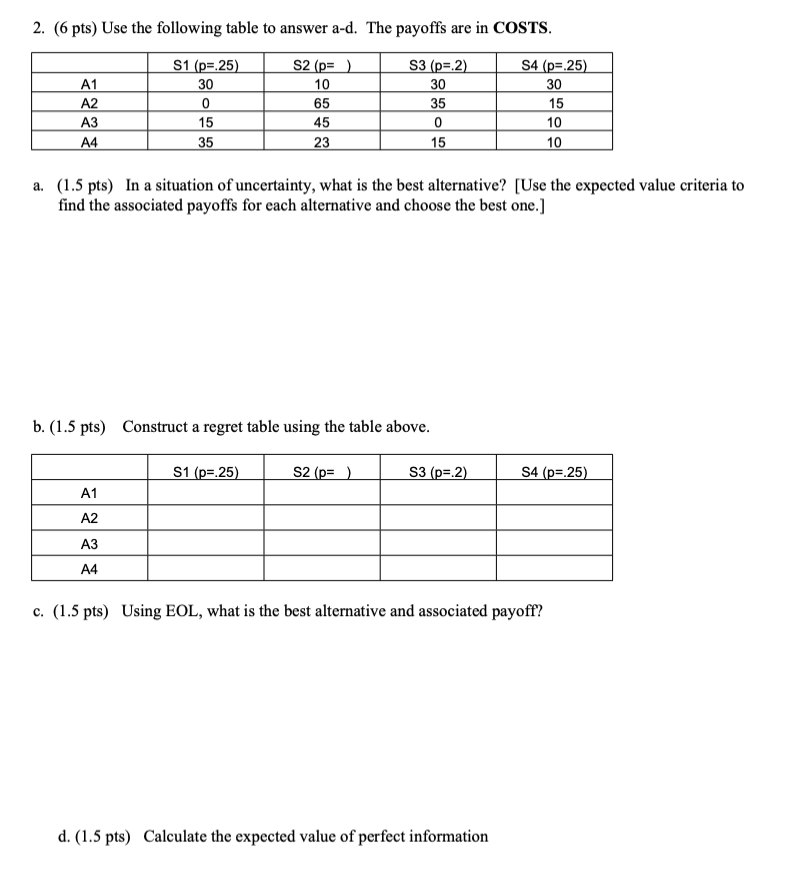 2. (6 pts) Use the following table to answer a-d. The payoffs are in COSTS.
[1 stpe2s | s2=) | s3p=2) | s4(p=25 |
[ar so [ 10 TT 3 | 30 |
[ae [0 [es [35 | 15 |
[as [ss [as | of 0 |
Lae [ss [2a [15 | 10 |
a. (1.5 pts) In a situation of uncertainty, what is the best alternative? [Use the expected value criteria to
find the associated payoffs for cach alternative and choose the best one.]
b. (1.5 pts) Construct a regret table using the table above.
[Toston [| se) [| ssa) | sappezn) |
[ee
ET I ER EE —
c. (15pts) Using EOL, what is the best alternative and associated payoff?
d. (1.5 pts) Calculate the expected value of perfect information
This is AI generated Response.
Asked by: gvr
Created at: 2025-07-25 15:16:14
Asked by: gvr
Created at: 2025-07-25 15:16:14
Final Answer:
Rendered
Raw Text
Did you like this answer?
Let's solve each part step-by-step:
---
**Given:**
| | S1 (p=0.25) | S2 (p=___) | S3 (p=0.2) | S4 (p=0.25) |
|------|:-----------:|:----------:|:----------:|:-----------:|
| A1 | 30 | 10 | 30 | 30 |
| A2 | 0 | 65 | 35 | 15 |
| A3 | 15 | 45 | 0 | 10 |
| A4 | 35 | 23 | 15 | 10 |
We need to find the missing probability for S2. The total probability must be 1:
\[
p_1 + p_2 + p_3 + p_4 = 1 \implies 0.25 + p_2 + 0.2 + 0.25 = 1
\]
\[
p_2 = 1 - (0.25 + 0.2 + 0.25) = 1 - 0.7 = 0.3
\]
So, S2 has a probability of 0.3.
---
### a. **Expected Value (Best Alternative using Expected Value Criterion)**
For each alternative, calculate the expected cost (lower is better):
\[
\text{EV} = p_1C_1 + p_2C_2 + p_3C_3 + p_4C_4
\]
#### A1:
\[
= 0.25(30) + 0.3(10) + 0.2(30) + 0.25(30)
= 7.5 + 3 + 6 + 7.5 = 24
\]
#### A2:
\[
= 0.25(0) + 0.3(65) + 0.2(35) + 0.25(15)
= 0 + 19.5 + 7 + 3.75 = 30.25
\]
#### A3:
\[
= 0.25(15) + 0.3(45) + 0.2(0) + 0.25(10)
= 3.75 + 13.5 + 0 + 2.5 = 19.75
\]
#### A4:
\[
= 0.25(35) + 0.3(23) + 0.2(15) + 0.25(10)
= 8.75 + 6.9 + 3 + 2.5 = 21.15
\]
**Best Alternative (minimum expected cost):** **A3** with **19.75**
### **Answer for (a):**
> The best alternative is **A3**, with an expected cost of **19.75**.
---
### b. **Regret Table**
First, for each state, find the minimum cost. Then, for each cell, compute Regret = Cost - Min Cost (for that state).
- **S1:** min(30, 0, 15, 35) = 0
- **S2:** min(10, 65, 45, 23) = 10
- **S3:** min(30, 35, 0, 15) = 0
- **S4:** min(30, 15, 10, 10) = 10
Now, fill the regret table:
| | S1 (p=0.25) | S2 (p=0.3) | S3 (p=0.2) | S4 (p=0.25) |
|------|:-----------:|:----------:|:----------:|:-----------:|
| **A1** | 30-0=30 | 10-10=0 | 30-0=30 | 30-10=20 |
| **A2** | 0-0=0 | 65-10=55 | 35-0=35 | 15-10=5 |
| **A3** | 15-0=15 | 45-10=35 | 0-0=0 | 10-10=0 |
| **A4** | 35-0=35 | 23-10=13 | 15-0=15 | 10-10=0 |
### **Regret Table**
| | S1 (0.25) | S2 (0.3) | S3 (0.2) | S4 (0.25) |
|------|:---------:|:--------:|:--------:|:---------:|
| A1 | 30 | 0 | 30 | 20 |
| A2 | 0 | 55 | 35 | 5 |
| A3 | 15 | 35 | 0 | 0 |
| A4 | 35 | 13 | 15 | 0 |
---
### c. **EOL (Expected Opportunity Loss)**
Calculate EOL for each alternative (weighted sum of regrets):
#### A1:
\[
= 0.25(30) + 0.3(0) + 0.2(30) + 0.25(20)
= 7.5 + 0 + 6 + 5 = 18.5
\]
#### A2:
\[
= 0.25(0) + 0.3(55) + 0.2(35) + 0.25(5)
= 0 + 16.5 + 7 + 1.25 = 24.75
\]
#### A3:
\[
= 0.25(15) + 0.3(35) + 0.2(0) + 0.25(0)
= 3.75 + 10.5 + 0 + 0 = 14.25
\]
#### A4:
\[
= 0.25(35) + 0.3(13) + 0.2(15) + 0.25(0)
= 8.75 + 3.9 + 3 + 0 = 15.65
\]
**Best (lowest) EOL:** **A3** with **14.25**
---
### **Answer for (c):**
> The best alternative using EOL is **A3**, with an expected opportunity loss of **14.25**.
---
### d. **Expected Value of Perfect Information (EVPI)**
\[
\text{EVPI} = \text{Expected Value with Perfect Information} - \text{Minimum Expected Cost}
\]
- **Expected Value with Perfect Information (EVwPI):**
- For each state, choose the minimum cost for that state, then multiply by the probability and sum.
\[
= 0.25 \times 0 + 0.3 \times 10 + 0.2 \times 0 + 0.25 \times 10
= 0 + 3 + 0 + 2.5 = 5.5
\]
- **Minimum Expected Cost (from part a):** 19.75
So,
\[
\text{EVPI} = 19.75 - 5.5 = 14.25
\]
---
## **Summary of Answers**
**a.** The best alternative is **A3**, with an expected cost of **19.75**.
**b.** Regret Table:
| | S1 (0.25) | S2 (0.3) | S3 (0.2) | S4 (0.25) |
|------|:---------:|:--------:|:--------:|:---------:|
| A1 | 30 | 0 | 30 | 20 |
| A2 | 0 | 55 | 35 | 5 |
| A3 | 15 | 35 | 0 | 0 |
| A4 | 35 | 13 | 15 | 0 |
**c.** The best alternative using EOL is **A3** with an EOL of **14.25**.
**d.** The expected value of perfect information (EVPI) is **14.25**.
📢 Instructions:
- Ask anything relatd to above question only.
- For new Question goto :