Give step-by-step solution with explanation and final answer:4.(30 points)
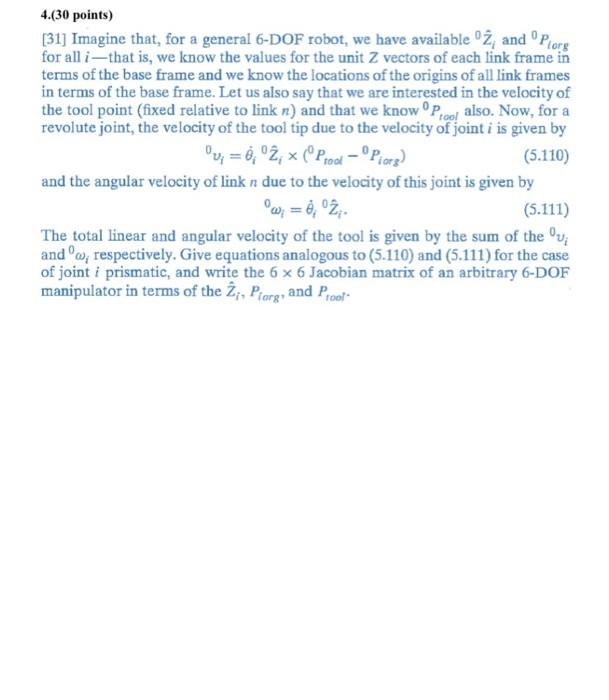
[31] Imagine that, for a general 6-DOF robot, we have available °Z; and °F,
for all i —that is, we know the values for the unit Z vectors of each link frame in
terms of the base frame and we know the locations of the origins of all link frames
in terms of the base frame. Let us also say that we are interested in the velocity of
the tool point (fixed relative to link n) and that we know °P, ,, also. Now, for a
revolute joint, the velocity of the tool tip due to the velocity of joint i is given by
Ou = 6,92, x CProgy = Pry) (5110)
and the angular velocity of link n due to the velocity of this joint is given by
Cw; =6,°Z;. (5.111)
The total linear and angular velocity of the tool is given by the sum of the %;
and “w, respectively. Give equations analogous to (5.110) and (5.111) for the case
of joint i prismatic, and write the 6 x 6 Jacobian matrix of an arbitrary 6-DOF
‘manipulator in terms of the Z;, Fy, ,, and Py.
Question:
Give step-by-step solution with explanation and final answer:4.(30 points)
[31] Imagine that, for a general 6-DOF robot, we have available °Z; and °F,
for all i —that is, we know the values for the unit Z vectors of each link frame in
terms of the base frame and we know the locations of the origins of all link frames
in terms of the base frame. Let us also say that we are interested in the velocity of
the tool point (fixed relative to link n) and that we know °P, ,, also. Now, for a
revolute joint, the velocity of the tool tip due to the velocity of joint i is given by
Ou = 6,92, x CProgy = Pry) (5110)
and the angular velocity of link n due to the velocity of this joint is given by
Cw; =6,°Z;. (5.111)
The total linear and angular velocity of the tool is given by the sum of the %;
and “w, respectively. Give equations analogous to (5.110) and (5.111) for the case
of joint i prismatic, and write the 6 x 6 Jacobian matrix of an arbitrary 6-DOF
‘manipulator in terms of the Z;, Fy, ,, and Py.
This is AI generated Response.
Asked by: gvr
Created at: 2025-07-25 14:57:45
Final Answer:
RenderedRaw Text
Did you like this answer?
Let's break down the problem **step by step**:
---
### **Step 1: Equations for Revolute Joint (Given)**
For a revolute joint \(i\):
- **Linear velocity contribution:**
\[
{^0}\mathbf{v}_{i} = \dot{\theta}_i \; {^0}\mathbf{Z}_i \times ({^0}\mathbf{P}_{tool} - {^0}\mathbf{P}_{i_{org}})
\]
(Eq. 5.110)
- **Angular velocity contribution:**
\[
{^0}\boldsymbol{\omega}_{i} = \dot{\theta}_i \; {^0}\mathbf{Z}_i
\]
(Eq. 5.111)
---
### **Step 2: Analogous Equations for Prismatic Joint**
For a prismatic joint \(i\):
- **Linear velocity contribution:**
For a prismatic joint, the joint variable is the displacement \(d_i\), and the motion is along the \(Z_i\) direction:
\[
{^0}\mathbf{v}_{i} = \dot{d}_i \; {^0}\mathbf{Z}_i
\]
- **Angular velocity contribution:**
Prismatic joints do **not** contribute to angular velocity:
\[
{^0}\boldsymbol{\omega}_{i} = \mathbf{0}
\]
---
### **Step 3: Write the Jacobian Matrix for 6-DOF Manipulator**
The Jacobian relates joint velocities to the end-effector's linear and angular velocities:
\[
\begin{bmatrix}
\mathbf{v}_{tool} \\
\boldsymbol{\omega}_{tool}
\end{bmatrix}
= \mathbf{J} \; \dot{\mathbf{q}}
\]
Each column \(i\) of the Jacobian corresponds to joint \(i\):
#### **If joint \(i\) is revolute:**
\[
\mathbf{J}_{v,i} = {^0}\mathbf{Z}_i \times ({^0}\mathbf{P}_{tool} - {^0}\mathbf{P}_{i_{org}})
\]
\[
\mathbf{J}_{\omega,i} = {^0}\mathbf{Z}_i
\]
#### **If joint \(i\) is prismatic:**
\[
\mathbf{J}_{v,i} = {^0}\mathbf{Z}_i
\]
\[
\mathbf{J}_{\omega,i} = \mathbf{0}
\]
---
### **Step 4: Write the General Jacobian Matrix**
So, the **general \(6 \times 6\) Jacobian** for a 6-DOF manipulator can be written as:
\[
\mathbf{J}_i =
\begin{cases}
\begin{bmatrix}
{^0}\mathbf{Z}_i \times ({^0}\mathbf{P}_{tool} - {^0}\mathbf{P}_{i_{org}}) \\
{^0}\mathbf{Z}_i
\end{bmatrix}
& \text{if joint \(i\) is revolute} \\
\\
\begin{bmatrix}
{^0}\mathbf{Z}_i \\
\mathbf{0}
\end{bmatrix}
& \text{if joint \(i\) is prismatic}
\end{cases}
\]
Or, **for all joints:**
\[
\mathbf{J} =
\begin{bmatrix}
\mathbf{J}_{v,1} & \mathbf{J}_{v,2} & \cdots & \mathbf{J}_{v,6} \\
\mathbf{J}_{\omega,1} & \mathbf{J}_{\omega,2} & \cdots & \mathbf{J}_{\omega,6}
\end{bmatrix}
\]
where
\[
\mathbf{J}_{v,i} =
\begin{cases}
{^0}\mathbf{Z}_i \times ({^0}\mathbf{P}_{tool} - {^0}\mathbf{P}_{i_{org}}), & \text{revolute} \\
{^0}\mathbf{Z}_i, & \text{prismatic}
\end{cases}
\]
\[
\mathbf{J}_{\omega,i} =
\begin{cases}
{^0}\mathbf{Z}_i, & \text{revolute} \\
\mathbf{0}, & \text{prismatic}
\end{cases}
\]
---
### **Final Answer (Summary Table)**
| Joint Type | \(\mathbf{J}_{v,i}\) | \(\mathbf{J}_{\omega,i}\) |
|---------------|------------------------------------------------------------------|-------------------------------------|
| Revolute | \({^0}\mathbf{Z}_i \times ({^0}\mathbf{P}_{tool} - {^0}\mathbf{P}_{i_{org}})\) | \({^0}\mathbf{Z}_i\) |
| Prismatic | \({^0}\mathbf{Z}_i\) | \(\mathbf{0}\) |
Where:
- \({^0}\mathbf{Z}_i\): Unit Z vector of frame \(i\) in base frame
- \({^0}\mathbf{P}_{i_{org}}\): Origin of frame \(i\) in base frame
- \({^0}\mathbf{P}_{tool}\): Tool point in base frame
---
**This is the step-by-step solution and the final form of the 6x6 Jacobian in terms of the given quantities.**
Question:
I NEED STEP BY STEP DETAILED EXPLANATION AND CALCULATIONS ALONG WITH THE FINAL ANSWER
This is AI generated Response.
Asked by: gvr
Created at: 2025-07-25 14:59:47
Final Answer:
RenderedRaw Text
Did you like this answer?
Certainly! Let's walk through the detailed step-by-step derivation, including explanations, reasoning, and calculations.
---
## **Problem Restatement**
Given a 6-DOF robot manipulator:
- For each link \(i\), we know:
- The unit vector \(\mathbf{Z}_i\) (direction of joint axis) in the base frame.
- The position vector \(\mathbf{P}_i\) (origin of link \(i\)) in the base frame.
- The goal:
- To find the velocity of the tool point (fixed relative to link \(n\)) in terms of the joint velocities.
- To derive equations analogous to (5.110) and (5.111) for **prismatic joints**.
- To formulate the **6×6 Jacobian matrix** in terms of \(\mathbf{Z}_i\), \(\mathbf{P}_i\), and the position of the tool point \(\mathbf{P}_{tool}\).
---
## **Step 1: Understanding the given equations for revolute joints**
### **Revolute Joint**
- **Angular velocity contribution:**
\[
\boxed{
{^0}\boldsymbol{\omega}_i = \dot{\theta}_i \; {^0}\mathbf{Z}_i
}
\]
- **Linear velocity contribution:**
\[
\boxed{
{^0}\mathbf{v}_i = \dot{\theta}_i \; {^0}\mathbf{Z}_i \times \left( {^0}\mathbf{P}_{tool} - {^0}\mathbf{P}_i \right)
}
\]
**Interpretation:**
- Rotation about axis \(\mathbf{Z}_i\) with rate \(\dot{\theta}_i\).
- The linear velocity at the tool point due to joint \(i\) is the cross product of \(\mathbf{Z}_i\) and the vector from joint \(i\) to the tool point.
---
## **Step 2: Equations for prismatic joints**
### **Prismatic Joint**
- **Linear velocity:**
Since prismatic joints translate along their axis:
\[
{^0}\mathbf{v}_i = \dot{d}_i \; {^0}\mathbf{Z}_i
\]
- **Angular velocity:**
Prismatic joints do **not** contribute to angular velocity:
\[
{^0}\boldsymbol{\omega}_i = \mathbf{0}
\]
**Summary:**
| Joint Type | Linear velocity contribution \(\mathbf{v}_i\) | Angular velocity contribution \(\boldsymbol{\omega}_i\) |
|--------------|--------------------------------------------------|--------------------------------------------------------|
| Revolute | \(\dot{\theta}_i \; {^0}\mathbf{Z}_i \times \left( {^0}\mathbf{P}_{tool} - {^0}\mathbf{P}_i \right)\) | \(\dot{\theta}_i \; {^0}\mathbf{Z}_i\) |
| Prismatic | \(\dot{d}_i \; {^0}\mathbf{Z}_i\) | \(\mathbf{0}\) |
---
## **Step 3: Expressing the Jacobian**
The **Jacobian** relates joint velocities \(\dot{\mathbf{q}}\) (vector of all joint rates) to the end-effector (tool point) velocities:
\[
\boxed{
\begin{bmatrix}
{^0}\mathbf{v}_{tool} \\
{^0}\boldsymbol{\omega}_{tool}
\end{bmatrix}
= \mathbf{J} \; \dot{\mathbf{q}}
}
\]
where:
- \(\mathbf{J}\) is a \(6 \times 6\) matrix composed of columns \(\mathbf{J}_i\), each associated with joint \(i\).
---
## **Step 4: Derive the Jacobian columns for each joint**
### **For joint \(i\), the contribution is:**
\[
\mathbf{J}_i =
\begin{bmatrix}
\mathbf{J}_{v,i} \\
\mathbf{J}_{\omega,i}
\end{bmatrix}
\]
- **Revolute joint:**
\[
\boxed{
\mathbf{J}_{v,i} = {^0}\mathbf{Z}_i \times \left( {^0}\mathbf{P}_{tool} - {^0}\mathbf{P}_i \right)
}
\]
\[
\boxed{
\mathbf{J}_{\omega,i} = {^0}\mathbf{Z}_i
}
\]
- **Prismatic joint:**
\[
\boxed{
\mathbf{J}_{v,i} = {^0}\mathbf{Z}_i
}
\]
\[
\boxed{
\mathbf{J}_{\omega,i} = \mathbf{0}
}
\]
---
## **Step 5: Construct the full Jacobian matrix**
Putting it all together:
\[
\boxed{
\mathbf{J} =
\begin{bmatrix}
\mathbf{J}_{v,1} & \mathbf{J}_{v,2} & \dots & \mathbf{J}_{v,6} \\
\mathbf{J}_{\omega,1} & \mathbf{J}_{\omega,2} & \dots & \mathbf{J}_{\omega,6}
\end{bmatrix}
}
\]
with each \(\mathbf{J}_{v,i}\) and \(\mathbf{J}_{\omega,i}\) as above.
---
## **Final Formulation:**
### **For each joint \(i\):**
\[
\boxed{
\mathbf{J}_i =
\begin{bmatrix}
\mathbf{J}_{v,i} \\
\mathbf{J}_{\omega,i}
\end{bmatrix}
=
\begin{cases}
\begin{bmatrix}
{^0}\mathbf{Z}_i \times \left( {^0}\mathbf{P}_{tool} - {^0}\mathbf{P}_i \right) \\
{^0}\mathbf{Z}_i
\end{bmatrix}
& \text{if joint \(i\) is revolute} \\
\\
\begin{bmatrix}
{^0}\mathbf{Z}_i \\
\mathbf{0}
\end{bmatrix}
& \text{if joint \(i\) is prismatic}
\end{cases}
}
\]
---
## **Summary of Key Equations:**
| **Joint Type** | **Linear velocity component \(\mathbf{J}_{v,i}\)** | **Angular velocity component \(\mathbf{J}_{\omega,i}\)** |
|----------------|--------------------------------------------------------|---------------------------------------------------------|
| **Revolute** | \(\boxed{{^0}\mathbf{Z}_i \times \left( {^0}\mathbf{P}_{tool} - {^0}\mathbf{P}_i \right)}\) | \(\boxed{{^0}\mathbf{Z}_i}\) |
| **Prismatic** | \(\boxed{{^0}\mathbf{Z}_i}\) | \(\boxed{\mathbf{0}}\) |
---
## **Note:**
- \({^0}\mathbf{Z}_i\) is the unit vector of joint \(i\)’s axis in the base frame.
- \({^0}\mathbf{P}_i\) is the position of joint \(i\)’s origin in the base frame.
- \({^0}\mathbf{P}_{tool}\) is the position of the tool point in the base frame.
---
## **Final statement:**
**The 6x6 Jacobian matrix** for a general 6-DOF manipulator, considering both revolute and prismatic joints, is:
\[
\boxed{
\mathbf{J} =
\begin{bmatrix}
\mathbf{J}_v \\
\mathbf{J}_\omega
\end{bmatrix}
\]
where
\[
\mathbf{J}_v = \left[ \mathbf{J}_{v,1} \quad \mathbf{J}_{v,2} \quad \dots \quad \mathbf{J}_{v,6} \right], \quad
\mathbf{J}_\omega = \left[ \mathbf{J}_{\omega,1} \quad \mathbf{J}_{\omega,2} \quad \dots \quad \mathbf{J}_{\omega,6} \right]
\]
with each \(\mathbf{J}_{v,i}\), \(\mathbf{J}_{\omega,i}\) as above.
---
This detailed derivation provides the **step-by-step reasoning**, **equations**, and **final form** of the Jacobian for any 6-DOF robot with mixed joint types.
VIPSolutions focuses on clear, step‑by‑step explanations so you can learn quickly. Whether you need an AI‑generated walkthrough or a short hint to get unstuck, each solution is organized for fast reading and easy review later.
Search similar questions, compare approaches, and bookmark the best answers for revision. Our goal is simple: quick, reliable study help that feels natural—not noisy.
 VIPSolutions
 4.(30 points)
[31] Imagine that, for a general 6-DOF robot, we have available °Z; and °F,
for all i —that is, we know the values for the unit Z vectors of each link frame in
terms of the base frame and we know the locations of the origins of all link frames
in terms of the base frame. Let us also say that we are interested in the velocity of
the tool point (fixed relative to link n) and that we know °P, ,, also. Now, for a
revolute joint, the velocity of the tool tip due to the velocity of joint i is given by
Ou = 6,92, x CProgy = Pry) (5110)
and the angular velocity of link n due to the velocity of this joint is given by
Cw; =6,°Z;. (5.111)
The total linear and angular velocity of the tool is given by the sum of the %;
and “w, respectively. Give equations analogous to (5.110) and (5.111) for the case
of joint i prismatic, and write the 6 x 6 Jacobian matrix of an arbitrary 6-DOF
‘manipulator in terms of the Z;, Fy, ,, and Py.