 VIPSolutions
Give step-by-step solution with explanation and final answer:Lt Coetheainey = 8VE for 125 2
Question:
Give step-by-step solution with explanation and final answer: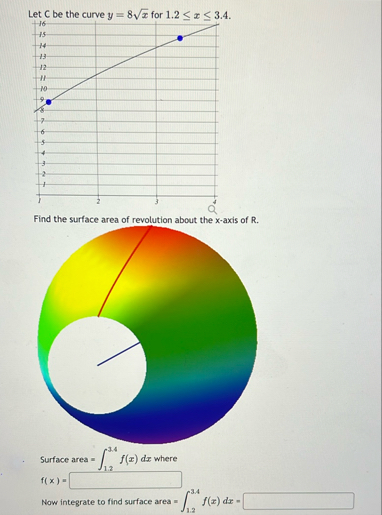 Lt Coetheainey = 8VE for 125 2
This is AI generated Response.
Asked by: gvr
Created at: 2025-07-24 08:43:26
Asked by: gvr
Created at: 2025-07-24 08:43:26
Final Answer:
Rendered
Raw Text
Did you like this answer?
Let's solve the problem step by step:
**Given:**
Curve \( y = 8\sqrt{x} \) for \( 1.2 \leq x \leq 3.4 \).
We are to find the **surface area of revolution** about the **x-axis**.
---
### **Step 1: Formula for Surface Area of Revolution**
For a curve \( y = f(x) \) revolved about the x-axis from \( x = a \) to \( x = b \):
\[
S = \int_a^b 2\pi y \sqrt{1 + \left(\frac{dy}{dx}\right)^2} dx
\]
---
### **Step 2: Find \(\frac{dy}{dx}\)** for \( y = 8\sqrt{x} \)
- \( y = 8x^{1/2} \)
- \( \frac{dy}{dx} = 8 \cdot \frac{1}{2}x^{-1/2} = 4x^{-1/2} = \frac{4}{\sqrt{x}} \)
---
### **Step 3: Plug into the Formula**
\[
S = \int_{1.2}^{3.4} 2\pi (8\sqrt{x}) \sqrt{1 + \left(\frac{4}{\sqrt{x}}\right)^2} dx
\]
---
### **Step 4: Simplify the Expression**
\[
\left(\frac{4}{\sqrt{x}}\right)^2 = \frac{16}{x}
\]
\[
\sqrt{1 + \left(\frac{4}{\sqrt{x}}\right)^2} = \sqrt{1 + \frac{16}{x}}
\]
So the integrand becomes:
\[
2\pi \cdot 8\sqrt{x} \cdot \sqrt{1 + \frac{16}{x}}
\]
\[
= 16\pi \sqrt{x} \sqrt{1 + \frac{16}{x}}
\]
Combine under one square root:
\[
\sqrt{x} \sqrt{1 + \frac{16}{x}}
= \sqrt{x \left(1 + \frac{16}{x}\right)}
= \sqrt{x + 16}
\]
So the integrand is:
\[
16\pi \sqrt{x + 16}
\]
---
### **Step 5: Write the Final Integral**
\[
\boxed{
S = \int_{1.2}^{3.4} 16\pi \sqrt{x + 16} \, dx
}
\]
---
### **Step 6: Integrate**
Let’s integrate \( 16\pi \sqrt{x + 16} \):
Let \( u = x + 16 \), so \( du = dx \).
When \( x = 1.2 \), \( u = 17.2 \).
When \( x = 3.4 \), \( u = 19.4 \).
The integral becomes:
\[
16\pi \int_{17.2}^{19.4} u^{1/2} du
= 16\pi \left[ \frac{2}{3} u^{3/2} \right]_{17.2}^{19.4}
= \frac{32\pi}{3} \left[ (19.4)^{3/2} - (17.2)^{3/2} \right]
\]
---
### **Step 7: Final Answer**
\[
\boxed{
S = \frac{32\pi}{3} \left[ (19.4)^{3/2} - (17.2)^{3/2} \right]
}
\]
---
**You can leave it in this form, or plug in the numbers for a decimal value if needed!**
---
#### **Summary Table**
| Step | Explanation | Result |
|------|-------------|--------|
| 1 | Surface area formula | \( S = \int_a^b 2\pi y \sqrt{1 + \left(\frac{dy}{dx}\right)^2} dx \) |
| 2 | Differentiate \( y \) | \( \frac{dy}{dx} = \frac{4}{\sqrt{x}} \) |
| 3 | Plug in | \( S = \int_{1.2}^{3.4} 16\pi \sqrt{x + 16} dx \) |
| 4 | Substitute \( u = x + 16 \) | \( S = 16\pi \int_{17.2}^{19.4} u^{1/2} du \) |
| 5 | Integrate | \( S = \frac{32\pi}{3} \left[ (19.4)^{3/2} - (17.2)^{3/2} \right] \) |
---
**That’s the detailed solution!**
📢 Instructions:
- Ask anything relatd to above question only.
- For new Question goto :