 VIPSolutions
Give step-by-step solution with explanation and final answer:Again ecesider the function x FGu3) = e*eos(y) (a) Conalder the cross - section of f(x,y) aty = 3 Find and graph this 1 - variable function. (Be sure to label your aweel) (b) Find the slope of the tangent at x = 0 to the function you found is (a) . (€) Expess your asswer to (b) in terma of partial derivatives and check that it nerve ville (b). (d) Bhosily your samer to 3b be the same as to 2b? Why or shy nad?
Question:
Give step-by-step solution with explanation and final answer: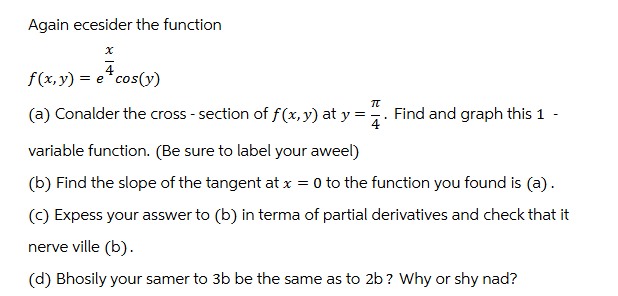 Again ecesider the function
x
FGu3) = e*eos(y)
(a) Conalder the cross - section of f(x,y) aty = 3 Find and graph this 1 -
variable function. (Be sure to label your aweel)
(b) Find the slope of the tangent at x = 0 to the function you found is (a) .
(€) Expess your asswer to (b) in terma of partial derivatives and check that it
nerve ville (b).
(d) Bhosily your samer to 3b be the same as to 2b? Why or shy nad?
This is AI generated Response.
Asked by: gvr
Created at: 2025-07-24 07:49:52
Asked by: gvr
Created at: 2025-07-24 07:49:52
Final Answer:
Rendered
Raw Text
Did you like this answer?
Let's solve each part step by step for the function:
\[
f(x, y) = \frac{x}{4} e^{\cos(y)}
\]
---
### (a) Cross-section at \( y = \frac{\pi}{4} \)
Substitute \( y = \frac{\pi}{4} \):
\[
f(x, \frac{\pi}{4}) = \frac{x}{4} e^{\cos(\frac{\pi}{4})}
\]
Recall that \( \cos(\frac{\pi}{4}) = \frac{\sqrt{2}}{2} \):
\[
f(x, \frac{\pi}{4}) = \frac{x}{4} e^{\frac{\sqrt{2}}{2}}
\]
This is a linear function in \( x \), scaled by the constant \( \frac{1}{4} e^{\frac{\sqrt{2}}{2}} \).
**Graph:**
This is a straight line through the origin with slope \( \frac{1}{4} e^{\frac{\sqrt{2}}{2}} \).
---
### (b) Slope of tangent at \( x = 0 \)
The slope is simply the coefficient of \( x \) in the function above:
\[
\text{Slope at } x = 0 = \frac{1}{4} e^{\frac{\sqrt{2}}{2}}
\]
---
### (c) Express answer in terms of partial derivatives
The slope of the tangent to \( f(x, y) \) at \( x = 0 \) for \( y = \frac{\pi}{4} \) is given by the partial derivative of \( f \) with respect to \( x \):
\[
\frac{\partial f}{\partial x} = \frac{1}{4} e^{\cos(y)}
\]
At \( (0, \frac{\pi}{4}) \):
\[
\frac{\partial f}{\partial x} \bigg|_{(x = 0, y = \frac{\pi}{4})} = \frac{1}{4} e^{\cos(\frac{\pi}{4})} = \frac{1}{4} e^{\frac{\sqrt{2}}{2}}
\]
This matches the answer in (b).
---
### (d) Should your answer to 3b be the same as to 2b? Why or why not?
Yes, the answers should be **the same**.
**Reason:**
The slope of the tangent to the cross-section at a fixed \( y \) is exactly the partial derivative of \( f \) with respect to \( x \) at that \( y \). This is because the partial derivative measures the rate of change of \( f \) in the \( x \)-direction while holding \( y \) constant, which is what the cross-section does.
---
## **Summary Table**
| Part | Solution |
|------|-----------|
| (a) | \( f(x, \frac{\pi}{4}) = \frac{x}{4} e^{\frac{\sqrt{2}}{2}} \) (straight line) |
| (b) | Slope at \( x=0 \) is \( \frac{1}{4} e^{\frac{\sqrt{2}}{2}} \) |
| (c) | Partial derivative: \( \frac{\partial f}{\partial x} = \frac{1}{4} e^{\cos(y)} \) evaluated at \( y = \frac{\pi}{4} \) gives the same value as (b) |
| (d) | Yes, they should be the same; both represent the rate of change of \( f \) with respect to \( x \) at fixed \( y \) |
---
**If you need the actual graph, let me know!**
📢 Instructions:
- Ask anything relatd to above question only.
- For new Question goto :