 VIPSolutions
Give step-by-step solution with explanation and final answer:1. Use a change of variables to calculate the integral fi ff vise (Hint try w= x= 0 =.) i . Let R be tho region bounded by the ins 1 Thy=4 zey=l z-2=0 z-2ymd change of arabes to calculate [fy dey dA. 4
Question:
Give step-by-step solution with explanation and final answer: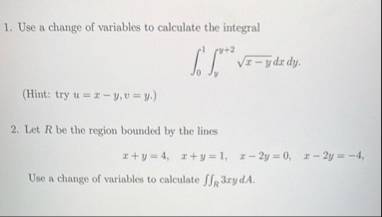 1. Use a change of variables to calculate the integral
fi
ff vise
(Hint try w= x= 0 =.) i
. Let R be tho region bounded by the ins 1
Thy=4 zey=l z-2=0 z-2ymd
change of arabes to calculate [fy dey dA. 4
This is AI generated Response.
Asked by: gvr
Created at: 2025-07-24 04:56:31
Asked by: gvr
Created at: 2025-07-24 04:56:31
Final Answer:
Rendered
Raw Text
Did you like this answer?
Let's solve **both problems step-by-step** as requested:
---
## **1. Change of Variables for the Integral**
\[
\int_0^1 \int_y^{y+2} \sqrt{x-y} \, dx \, dy
\]
Hint: Try \( u = x-y, \ v = y \).
### **Step 1: Change of Variables**
Let
- \( u = x-y \)
- \( v = y \)
Then,
- \( x = u + v \)
- \( y = v \)
The Jacobian determinant (\( J \)) for the transformation is:
\[
\frac{\partial(x, y)}{\partial(u, v)} =
\begin{vmatrix}
\frac{\partial x}{\partial u} & \frac{\partial x}{\partial v} \\
\frac{\partial y}{\partial u} & \frac{\partial y}{\partial v}
\end{vmatrix} =
\begin{vmatrix}
1 & 1 \\
0 & 1
\end{vmatrix}
= (1)(1) - (1)(0) = 1
\]
So, the Jacobian is 1.
---
### **Step 2: Change the Limits**
Original limits:
- \( y \) goes from \( 0 \) to \( 1 \)
- For each \( y \), \( x \) goes from \( y \) to \( y+2 \)
In \( (u,v) \) coordinates:
- \( v = y \) goes from \( 0 \) to \( 1 \)
- For each \( v \), \( u = x-y \) goes from \( 0 \) (when \( x = y \)) to \( 2 \) (when \( x = y+2 \))
---
### **Step 3: Substitute and Integrate**
The integrand \( \sqrt{x-y} = \sqrt{u} \).
So, the new integral is:
\[
\int_{v=0}^1 \int_{u=0}^2 \sqrt{u} \cdot 1 \ du \ dv
\]
---
### **Step 4: Compute the Integral**
First, integrate with respect to \( u \):
\[
\int_{u=0}^2 \sqrt{u} \ du = \int_0^2 u^{1/2} du = \left[ \frac{2}{3} u^{3/2} \right]_0^2 = \frac{2}{3} (2)^{3/2} - 0 = \frac{2}{3} \cdot 2 \sqrt{2} = \frac{4\sqrt{2}}{3}
\]
Now, integrate with respect to \( v \) from \( 0 \) to \( 1 \):
\[
\int_{v=0}^1 \frac{4\sqrt{2}}{3} dv = \frac{4\sqrt{2}}{3}[v]_0^1 = \frac{4\sqrt{2}}{3} (1-0) = \frac{4\sqrt{2}}{3}
\]
---
### **Final Answer (Problem 1):**
\[
\boxed{\frac{4\sqrt{2}}{3}}
\]
---
## **2. Region Bounded by Lines and Change of Variables**
The region \( R \) is bounded by:
- \( x + y = 4 \)
- \( x + y = 1 \)
- \( x - 2y = 0 \)
- \( x - 2y = -4 \)
We need to compute:
\[
\iint_R 3xy \ dA
\]
---
### **Step 1: Choose Substitutions**
Let:
- \( u = x + y \)
- \( v = x - 2y \)
Then,
- \( x = \frac{2u + v}{3} \)
- \( y = \frac{u - v}{3} \)
---
### **Step 2: Find the Jacobian**
\[
J = \begin{vmatrix}
\frac{\partial x}{\partial u} & \frac{\partial x}{\partial v} \\
\frac{\partial y}{\partial u} & \frac{\partial y}{\partial v}
\end{vmatrix}
=
\begin{vmatrix}
\frac{2}{3} & \frac{1}{3} \\
\frac{1}{3} & -\frac{1}{3}
\end{vmatrix}
= \left( \frac{2}{3} \cdot -\frac{1}{3} \right) - \left( \frac{1}{3} \cdot \frac{1}{3} \right)
= -\frac{2}{9} - \frac{1}{9} = -\frac{1}{3}
\]
So, \( |J| = \frac{1}{3} \).
---
### **Step 3: Express Integrand in Terms of \( u, v \)**
\[
xy = x y = \left(\frac{2u + v}{3}\right)\left(\frac{u - v}{3}\right)
= \frac{(2u + v)(u - v)}{9}
= \frac{2u(u-v) + v(u-v)}{9}
= \frac{2u^2 - 2uv + vu - v^2}{9}
= \frac{2u^2 - uv - v^2}{9}
\]
---
### **Step 4: Set Up the Bounds**
Given:
- \( x + y = u \), from 1 to 4
- \( x - 2y = v \), from -4 to 0
So \( u \) goes from 1 to 4, and \( v \) goes from -4 to 0.
---
### **Step 5: Set Up the Integral**
\[
\iint_R 3xy \ dA = \iint_{u=1}^{4} \int_{v=-4}^{0} 3 \left( \frac{2u^2 - uv - v^2}{9} \right) \cdot \left| -\frac{1}{3} \right| dv du
\]
\[
= \iint_{u=1}^{4} \int_{v=-4}^{0} \frac{3}{9}(2u^2 - uv - v^2) \cdot \frac{1}{3} dv du
\]
\[
= \iint_{u=1}^{4} \int_{v=-4}^{0} \frac{1}{9}(2u^2 - uv - v^2) dv du
\]
---
### **Step 6: Integrate with Respect to \( v \)**
\[
\int_{v=-4}^{0} (2u^2 - uv - v^2) dv =
\int_{v=-4}^{0} 2u^2 dv - \int_{v=-4}^{0} uv dv - \int_{v=-4}^{0} v^2 dv
\]
\[
= 2u^2 [v]_{-4}^0 - u [v^2/2]_{-4}^0 - [v^3/3]_{-4}^0
\]
\[
= 2u^2 (0 - (-4)) - u \left(0 - \frac{16}{2}\right) - \left(0 - \frac{(-64)}{3}\right)
\]
\[
= 2u^2 (4) - u (-8) + \frac{64}{3}
\]
\[
= 8u^2 + 8u + \frac{64}{3}
\]
---
### **Step 7: Integrate with Respect to \( u \)**
So the integral is:
\[
\int_{u=1}^{4} \frac{1}{9} \left(8u^2 + 8u + \frac{64}{3}\right) du
\]
\[
= \frac{1}{9} \left( \int_{u=1}^{4} 8u^2 du + \int_{u=1}^{4} 8u du + \int_{u=1}^{4} \frac{64}{3} du \right)
\]
Compute each:
1. \( \int_{1}^{4} 8u^2 du = 8 \left[ \frac{u^3}{3} \right]_{1}^{4} = 8 \left( \frac{64}{3} - \frac{1}{3} \right) = 8 \times \frac{63}{3} = 8 \times 21 = 168 \)
2. \( \int_{1}^{4} 8u du = 8 \left[ \frac{u^2}{2} \right]_{1}^{4} = 8 \times \left( \frac{16}{2} - \frac{1}{2} \right) = 8 \times \frac{15}{2} = 4 \times 15 = 60 \)
3. \( \int_{1}^{4} \frac{64}{3} du = \frac{64}{3} (4-1) = \frac{64}{3} \times 3 = 64 \)
Sum: \( 168 + 60 + 64 = 292 \)
---
### **Step 8: Multiply by \( \frac{1}{9} \)**
\[
\frac{1}{9} \times 292 = \frac{292}{9}
\]
---
### **Final Answer (Problem 2):**
\[
\boxed{\frac{292}{9}}
\]
---
## **Summary of Answers**
1. \(\boxed{\frac{4\sqrt{2}}{3}}\)
2. \(\boxed{\frac{292}{9}}\)
If you need any clarification, let me know!
📢 Instructions:
- Ask anything relatd to above question only.
- For new Question goto :