 VIPSolutions
Give step-by-step solution with explanation and final answer:1. Use the known Maclaurin Power Series expansion of cosx to find the power . ) 2 2 series expansion of x” cosx’ 1 2. Use the power series expansion of x”cosx” to find the integral [ x"cosx’dx as 0 a power series 3. Find the approximation of the above integral using the first three terms of the series. What is the estimate of the error. No need to simplify
Question:
Give step-by-step solution with explanation and final answer: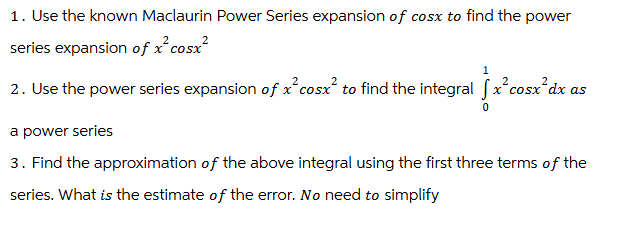 1. Use the known Maclaurin Power Series expansion of cosx to find the power
. ) 2 2
series expansion of x” cosx’
1
2. Use the power series expansion of x”cosx” to find the integral [ x"cosx’dx as
0
a power series
3. Find the approximation of the above integral using the first three terms of the
series. What is the estimate of the error. No need to simplify
This is AI generated Response.
Asked by: gvr
Created at: 2025-07-24 04:32:18
Asked by: gvr
Created at: 2025-07-24 04:32:18
Final Answer:
Rendered
Raw Text
Did you like this answer?
Let's solve each part step by step:
---
### 1. **Maclaurin Series for \(x^2 \cos x^2\)**
**Maclaurin Series for \( \cos x \):**
\[
\cos x = \sum_{n=0}^{\infty} \frac{(-1)^n x^{2n}}{(2n)!}
\]
**Substitute \( x^2 \) for \( x \):**
\[
\cos(x^2) = \sum_{n=0}^{\infty} \frac{(-1)^n (x^2)^{2n}}{(2n)!}
= \sum_{n=0}^{\infty} \frac{(-1)^n x^{4n}}{(2n)!}
\]
**Multiply by \( x^2 \):**
\[
x^2 \cos(x^2) = x^2 \sum_{n=0}^{\infty} \frac{(-1)^n x^{4n}}{(2n)!}
= \sum_{n=0}^{\infty} \frac{(-1)^n x^{4n+2}}{(2n)!}
\]
---
### 2. **Express the Integral as a Power Series**
We want to write:
\[
\int_{0}^{1} x^2 \cos(x^2) \, dx
\]
Using the series:
\[
\int_{0}^{1} x^2 \cos(x^2) \, dx = \int_{0}^{1} \sum_{n=0}^{\infty} \frac{(-1)^n x^{4n+2}}{(2n)!} dx
\]
We can integrate term by term:
\[
= \sum_{n=0}^{\infty} \frac{(-1)^n}{(2n)!} \int_{0}^{1} x^{4n+2} dx
\]
\[
= \sum_{n=0}^{\infty} \frac{(-1)^n}{(2n)!} \left[ \frac{x^{4n+3}}{4n+3} \right]_{0}^{1}
\]
\[
= \sum_{n=0}^{\infty} \frac{(-1)^n}{(2n)!(4n+3)}
\]
---
### 3. **Approximate with the First Three Terms and Estimate the Error**
#### **First Three Terms:**
For \( n = 0, 1, 2 \):
**n = 0:**
\[
\frac{(-1)^0}{(0)!(3)} = \frac{1}{3}
\]
**n = 1:**
\[
\frac{(-1)^1}{2!(7)} = -\frac{1}{2 \times 7} = -\frac{1}{14}
\]
**n = 2:**
\[
\frac{(-1)^2}{4!(11)} = \frac{1}{24 \times 11} = \frac{1}{264}
\]
**Sum:**
\[
\text{Approximation} = \frac{1}{3} - \frac{1}{14} + \frac{1}{264}
\]
#### **Error Estimate**
The error is the magnitude of the next term (\(n = 3\)):
\[
\text{Error} \leq \left| \frac{(-1)^3}{6!(15)} \right| = \frac{1}{720 \times 15} = \frac{1}{10800}
\]
---
## **Final Answers:**
### 1. **Power series for \( x^2 \cos(x^2) \):**
\[
x^2 \cos(x^2) = \sum_{n=0}^{\infty} \frac{(-1)^n x^{4n+2}}{(2n)!}
\]
### 2. **Integral as a power series:**
\[
\int_{0}^{1} x^2 \cos(x^2) dx = \sum_{n=0}^{\infty} \frac{(-1)^n}{(2n)!(4n+3)}
\]
### 3. **First three term approximation and error:**
\[
\text{Approximation} = \frac{1}{3} - \frac{1}{14} + \frac{1}{264}
\]
\[
\text{Error estimate:} \leq \frac{1}{10800}
\]
Question:
PLEASE CALCULATE ACCURATELY I NEED STEP BY STEP DETAILED CALCULATIONS OF EACH PART ALONG WITH THE FINAL ANSWER
This is AI generated Response.
Asked by: gvr
Created at: 2025-07-24 04:40:25
Asked by: gvr
Created at: 2025-07-24 04:40:25
Final Answer:
Rendered
Raw Text
Did you like this answer?
Let's carefully perform each step with detailed calculations.
---
### **Part 1: Find the power series expansion of \( x^2 \cos x^2 \) using Maclaurin series**
**Step 1:** Recall the Maclaurin series for \( \cos x \):
\[
\cos x = \sum_{n=0}^\infty \frac{(-1)^n x^{2n}}{(2n)!}
\]
**Step 2:** Substitute \( x^2 \) in place of \( x \):
\[
\cos x^2 = \sum_{n=0}^\infty \frac{(-1)^n (x^2)^{2n}}{(2n)!} = \sum_{n=0}^\infty \frac{(-1)^n x^{4n}}{(2n)!}
\]
**Step 3:** Multiply by \( x^2 \):
\[
x^2 \cos x^2 = x^2 \times \sum_{n=0}^\infty \frac{(-1)^n x^{4n}}{(2n)!} = \sum_{n=0}^\infty \frac{(-1)^n x^{4n + 2}}{(2n)!}
\]
**Result:**
\[
\boxed{
x^2 \cos x^2 = \sum_{n=0}^\infty \frac{(-1)^n x^{4n+2}}{(2n)!}
}
\]
---
### **Part 2: Find the power series expansion of the integral**
\[
I = \int_0^1 x^2 \cos x^2 \, dx
\]
**Step 1:** Substitute the series expansion:
\[
I = \int_0^1 \left( \sum_{n=0}^\infty \frac{(-1)^n x^{4n+2}}{(2n)!} \right) dx
\]
**Step 2:** Interchange the sum and the integral (justified since the series converges uniformly on [0,1]):
\[
I = \sum_{n=0}^\infty \frac{(-1)^n}{(2n)!} \int_0^1 x^{4n+2} dx
\]
**Step 3:** Compute the integral:
\[
\int_0^1 x^{4n+2} dx = \left[ \frac{x^{4n+3}}{4n+3} \right]_0^1 = \frac{1}{4n+3}
\]
**Step 4:** Write the series for the integral:
\[
I = \sum_{n=0}^\infty \frac{(-1)^n}{(2n)!} \times \frac{1}{4n+3}
\]
**Final Series:**
\[
\boxed{
I = \sum_{n=0}^\infty \frac{(-1)^n}{(2n)! \, (4n + 3)}
}
\]
---
### **Part 3: Approximate the integral using the first three terms and estimate the error**
**Step 1:** Calculate the first three terms (\( n=0,1,2 \)):
- **For \( n=0 \):**
\[
\frac{(-1)^0}{(0)! \times 3} = \frac{1}{1 \times 3} = \frac{1}{3}
\]
- **For \( n=1 \):**
\[
\frac{(-1)^1}{(2)! \times 7} = -\frac{1}{2 \times 7} = -\frac{1}{14}
\]
- **For \( n=2 \):**
\[
\frac{(-1)^2}{(4)! \times 11} = \frac{1}{24 \times 11} = \frac{1}{264}
\]
**Step 2:** Sum these three terms:
\[
\text{Approximate value} = \frac{1}{3} - \frac{1}{14} + \frac{1}{264}
\]
---
### **Numerical calculation:**
- Find common denominator for easier addition:
\[
\text{Denominator} = 3 \times 14 \times 264 = \text{(but easier to convert each to decimal)}
\]
Alternatively, convert each to decimal:
\[
\frac{1}{3} \approx 0.333333
\]
\[
\frac{1}{14} \approx 0.071429
\]
\[
\frac{1}{264} \approx 0.003788
\]
Now,
\[
I_{\text{approx}} \approx 0.333333 - 0.071429 + 0.003788 = 0.265692
\]
---
### **Error estimate:**
The next term corresponds to \( n=3 \):
\[
\frac{(-1)^3}{(6)! \times 15} = - \frac{1}{720 \times 15} = - \frac{1}{10800}
\]
The magnitude of the next term:
\[
|T_{4}| = \frac{1}{10800} \approx 0.00009259
\]
**Estimate of the error** (the remainder after 3 terms):
\[
\boxed{
\text{Error} \leq 0.0000926
}
\]
---
### **Final summarized answers:**
- **Power series for \( x^2 \cos x^2 \):**
\[
\boxed{
x^2 \cos x^2 = \sum_{n=0}^\infty \frac{(-1)^n x^{4n+2}}{(2n)!}
}
\]
- **Integral as a series:**
\[
\boxed{
\int_0^1 x^2 \cos x^2 dx = \sum_{n=0}^\infty \frac{(-1)^n}{(2n)! (4n+3)}
}
\]
- **Approximate value using first three terms:**
\[
\boxed{
I \approx 0.265692
}
\]
- **Error estimate:**
\[
\boxed{
\text{Error} \leq 0.0000926
}
\]
📢 Instructions:
- Ask anything relatd to above question only.
- For new Question goto :