 VIPSolutions
Give step-by-step solution with explanation and final answer:| | REL | | |
Question:
Give step-by-step solution with explanation and final answer: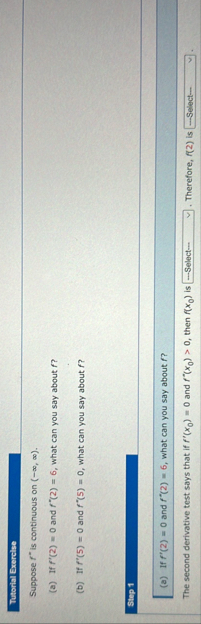 | |
REL |
| |
This is AI generated Response.
Asked by: gvr
Created at: 2025-07-24 03:25:30
Asked by: gvr
Created at: 2025-07-24 03:25:30
Final Answer:
Rendered
Raw Text
Did you like this answer?
Let's break down the given problem step by step.
---
### **Problem Statement**
Suppose \( f \) is continuous on \([a, b]\).
#### (a) If \( f(a) < 0 \) and \( f(b) > 0 \), what can you say about \( f \)?
#### (b) If \( f(a) > 0 \) and \( f(b) = 0 \), what can you say about \( f \)?
---
### **Step-by-step Solution**
#### **Step 1: Understanding the Theorem**
The **Intermediate Value Theorem** states:
> If a function \( f \) is continuous on a closed interval \([a, b]\) and \(N\) is any number between \(f(a)\) and \(f(b)\), then there exists a number \(c\) in \((a, b)\) such that \(f(c) = N\).
---
#### **Part (a): \( f(a) < 0 \) and \( f(b) > 0 \)**
- \(f(a)\) is negative and \(f(b)\) is positive.
- 0 is a number between \(f(a)\) and \(f(b)\).
**By the Intermediate Value Theorem:**
- There exists some \(c\) in \((a, b)\) such that \(f(c) = 0\).
**Explanation:**
Because \(f\) is continuous, the function must cross the x-axis somewhere between \(a\) and \(b\).
---
#### **Part (b): \( f(a) > 0 \) and \( f(b) = 0 \)**
- \(f(a)\) is positive and \(f(b)\) is zero.
- 0 is between \(f(a)\) and \(f(b)\) (since \(f(b) = 0\)).
**By the Intermediate Value Theorem:**
- There exists some \(c\) in \([a, b]\) such that \(f(c) = 0\).
**But since \(f(b) = 0\), we know that at \(b\), \(f(b) = 0\).**
So, **at least at \(b\)**, \(f\) is zero.
There may not be another zero in \((a, b)\) unless the function crosses zero before \(b\).
---
### **Final Answers**
**(a)**
If \( f(a) < 0 \) and \( f(b) > 0 \), then **there must be some \( c \) in \( (a, b) \) such that \( f(c) = 0 \)**.
**(b)**
If \( f(a) > 0 \) and \( f(b) = 0 \), then **\( f(b) = 0 \)**, so at least at \( b \), the function is zero; the Intermediate Value Theorem does not guarantee any zero in \( (a, b) \), only at \( b \).
---
#### **Summary Table**
| Condition | What can you say? |
|--------------------------------------------|-----------------------------------------------------|
| \( f(a) < 0 \), \( f(b) > 0 \) | There is \( c \in (a, b) \) with \( f(c) = 0 \) |
| \( f(a) > 0 \), \( f(b) = 0 \) | \( f(b) = 0 \), possibly only at \( b \) |
📢 Instructions:
- Ask anything relatd to above question only.
- For new Question goto :