 VIPSolutions
Give step-by-step solution with explanation and final answer:Co 2. For the given multivariable function f(x,y,2) = x? + 2y? + 22% + 22% + 2xy + 2yz (40 pts) a) Calculate the gradient vector and find the stationary point / points. (10 pts.) b) Compute the Hessian matrix/matrices for each stationary point and determine its/their sign definiteness. Identify the types of stationary points (local minimum, local maximum, inflection point or saddle point). (30 pts.)
Question:
Give step-by-step solution with explanation and final answer: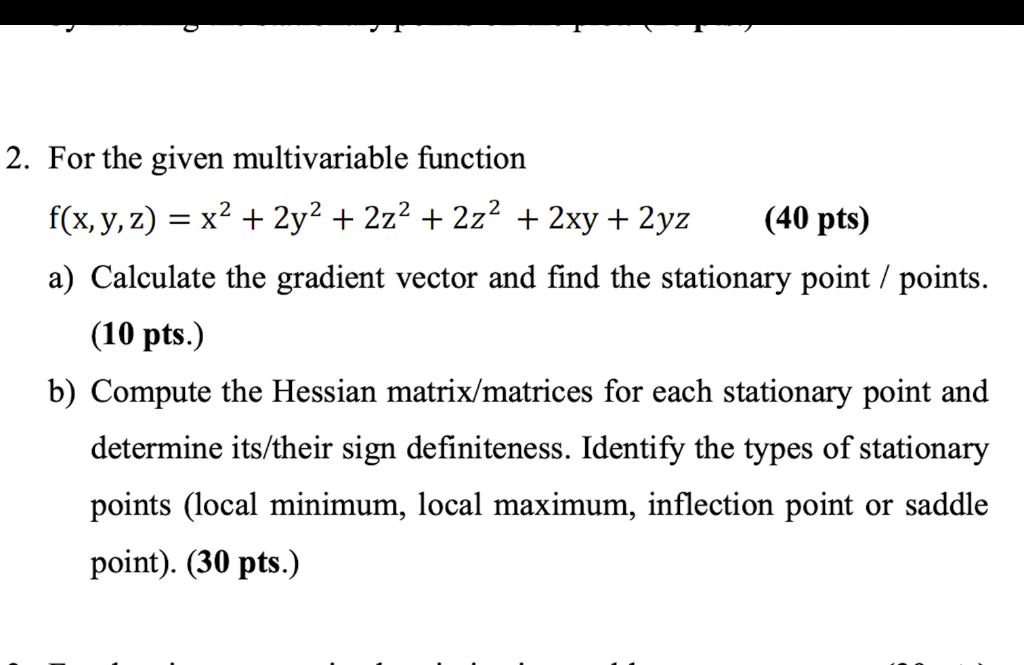 Co
2. For the given multivariable function
f(x,y,2) = x? + 2y? + 22% + 22% + 2xy + 2yz (40 pts)
a) Calculate the gradient vector and find the stationary point / points.
(10 pts.)
b) Compute the Hessian matrix/matrices for each stationary point and
determine its/their sign definiteness. Identify the types of stationary
points (local minimum, local maximum, inflection point or saddle
point). (30 pts.)
This is AI generated Response.
Asked by: gvr
Created at: 2025-07-23 23:24:03
Asked by: gvr
Created at: 2025-07-23 23:24:03
Final Answer:
Rendered
Raw Text
Did you like this answer?
Let's solve the problem step by step:
## Given Function
\[
f(x, y, z) = x^2 + 2y^2 + 2z^2 + 2z^2 + 2xy + 2yz
\]
Let's simplify:
\[
f(x, y, z) = x^2 + 2y^2 + 4z^2 + 2xy + 2yz
\]
---
### **a) Calculate the gradient vector and find the stationary point(s).**
The gradient vector is:
\[
\nabla f = \left( \frac{\partial f}{\partial x}, \frac{\partial f}{\partial y}, \frac{\partial f}{\partial z} \right)
\]
Calculate partial derivatives:
#### \( \frac{\partial f}{\partial x} \):
\[
\frac{\partial f}{\partial x} = 2x + 2y
\]
#### \( \frac{\partial f}{\partial y} \):
\[
\frac{\partial f}{\partial y} = 4y + 2x + 2z
\]
#### \( \frac{\partial f}{\partial z} \):
\[
\frac{\partial f}{\partial z} = 8z + 2y
\]
So,
\[
\nabla f = (2x + 2y,\, 4y + 2x + 2z,\, 8z + 2y)
\]
**Stationary points** occur when all components are zero:
\[
\begin{cases}
2x + 2y = 0 \\
4y + 2x + 2z = 0 \\
8z + 2y = 0 \\
\end{cases}
\]
Let's solve this system:
1. \(2x + 2y = 0 \implies x = -y\)
2. \(8z + 2y = 0 \implies 4z + y = 0 \implies y = -4z\)
3. Substitute \(x = -y\) and \(y = -4z\) into \(4y + 2x + 2z = 0\):
\[
4y + 2x + 2z = 0 \\
4(-4z) + 2(-(-4z)) + 2z = 0 \\
-16z + 8z + 2z = 0 \\
(-16z + 8z + 2z) = (-16+8+2)z = -6z = 0 \implies z = 0
\]
So, \(z = 0\), \(y = -4z = 0\), \(x = -y = 0\).
**Stationary point:** \(\boxed{(0, 0, 0)}\)
---
### **b) Compute the Hessian matrix at the stationary point and determine its sign definiteness.**
The Hessian matrix \(\mathbf{H}\) is the matrix of second derivatives:
#### Compute second derivatives:
- \(f_{xx} = \frac{\partial^2 f}{\partial x^2} = 2\)
- \(f_{yy} = \frac{\partial^2 f}{\partial y^2} = 4\)
- \(f_{zz} = \frac{\partial^2 f}{\partial z^2} = 8\)
- \(f_{xy} = \frac{\partial^2 f}{\partial x \partial y} = 2\)
- \(f_{xz} = \frac{\partial^2 f}{\partial x \partial z} = 0\)
- \(f_{yz} = \frac{\partial^2 f}{\partial y \partial z} = 2\)
The Hessian is:
\[
H = \begin{bmatrix}
2 & 2 & 0 \\
2 & 4 & 2 \\
0 & 2 & 8 \\
\end{bmatrix}
\]
#### **Sign definiteness (Sylvester's criterion):**
Calculate leading principal minors:
1. First minor: \(2 > 0\)
2. Second order minor:
\[
\begin{vmatrix}
2 & 2 \\
2 & 4
\end{vmatrix}
= (2)(4) - (2)(2) = 8 - 4 = 4 > 0
\]
3. Third order determinant:
\[
\begin{vmatrix}
2 & 2 & 0 \\
2 & 4 & 2 \\
0 & 2 & 8 \\
\end{vmatrix}
= 2 \begin{vmatrix} 4 & 2 \\ 2 & 8 \end{vmatrix} - 2 \begin{vmatrix} 2 & 2 \\ 0 & 8 \end{vmatrix} + 0 \cdot D
\]
Calculate:
- \(\begin{vmatrix} 4 & 2 \\ 2 & 8 \end{vmatrix} = 4 \cdot 8 - 2 \cdot 2 = 32 - 4 = 28\)
- \(\begin{vmatrix} 2 & 2 \\ 0 & 8 \end{vmatrix} = 2 \cdot 8 - 2 \cdot 0 = 16\)
So,
\[
= 2 \cdot 28 - 2 \cdot 16 = 56 - 32 = 24 > 0
\]
All leading principal minors are positive, so the Hessian is **positive definite** at \((0, 0, 0)\).
---
### **Conclusion**
- **Stationary point:** \(\boxed{(0, 0, 0)}\)
- **Type:** Since the Hessian is positive definite, this is a **local minimum**.
---
#### **Final Answers**
**a)** Gradient vector: \(\boxed{(2x + 2y,\, 4y + 2x + 2z,\, 8z + 2y)}\),
Stationary point: \(\boxed{(0, 0, 0)}\).
**b)** Hessian:
\[
\boxed{
\begin{bmatrix}
2 & 2 & 0 \\
2 & 4 & 2 \\
0 & 2 & 8 \\
\end{bmatrix}
}
\]
At \((0, 0, 0)\): **positive definite**, so the stationary point is a
\(\boxed{\text{local minimum}}\).
📢 Instructions:
- Ask anything relatd to above question only.
- For new Question goto :