 VIPSolutions
Give step-by-step solution with explanation and final answer:R(s) + C(s) FIGURE P11.1 1. Use frequency response methods to find the value of K necessary to achieve a step response with a 10% Overshoot for the unity feedback system shown in Figure 11.1 when ___ x 2G (9) = mma _ Ke) 5.G (8) = Tramroe Keen C8) = GaGa eo eTE You may draw the bode plots by hand or use MATLAB
Question:
Give step-by-step solution with explanation and final answer: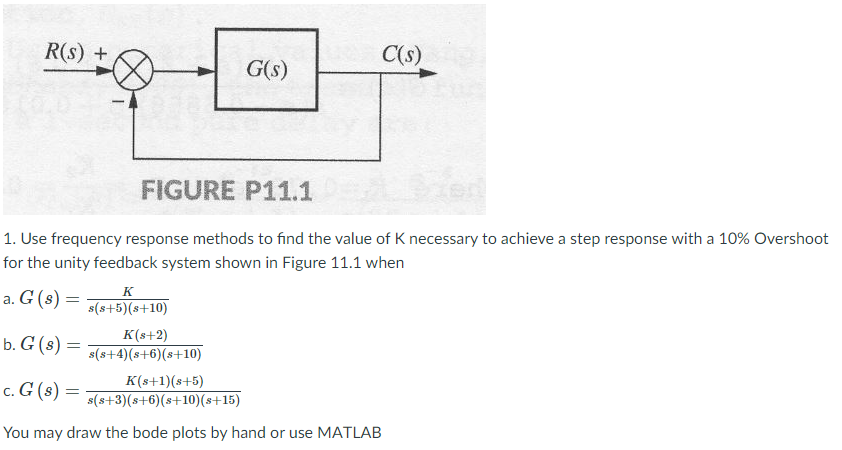 R(s) + C(s)
FIGURE P11.1
1. Use frequency response methods to find the value of K necessary to achieve a step response with a 10% Overshoot
for the unity feedback system shown in Figure 11.1 when
___ x
2G (9) = mma
_ Ke)
5.G (8) = Tramroe
Keen
C8) = GaGa eo eTE
You may draw the bode plots by hand or use MATLAB
This is AI generated Response.
Asked by: gvr
Created at: 2025-07-23 21:56:53
Asked by: gvr
Created at: 2025-07-23 21:56:53
Final Answer:
Rendered
Raw Text
Did you like this answer?
Let's solve the problem step by step for **case (a)** first. We'll go through the method, and you can apply the same process to (b) and (c).
### **Given:**
We want the **step response** of the closed-loop system to have a **10% overshoot**.
#### The transfer function:
\[
G(s) = \frac{K}{s(s+5)(s+10)}
\]
#### Unity feedback:
\[
T(s) = \frac{G(s)}{1 + G(s)}
\]
---
### **Step 1: Find Phase Margin for 10% Overshoot**
The % overshoot (\( M_p \)) is related to the damping ratio (\( \zeta \)) by:
\[
M_p = e^{-\frac{\pi \zeta}{\sqrt{1-\zeta^2}}} \times 100\%
\]
Set \( M_p = 10\% \):
\[
0.1 = e^{-\frac{\pi \zeta}{\sqrt{1-\zeta^2}}}
\]
Take natural log on both sides:
\[
\ln(0.1) = -\frac{\pi \zeta}{\sqrt{1-\zeta^2}}
\implies -2.3026 = -\frac{\pi \zeta}{\sqrt{1-\zeta^2}}
\]
\[
2.3026 = \frac{\pi \zeta}{\sqrt{1-\zeta^2}}
\]
\[
\frac{\zeta}{\sqrt{1-\zeta^2}} = \frac{2.3026}{\pi} = 0.733
\]
Let \( x = \zeta \):
\[
\frac{x}{\sqrt{1-x^2}} = 0.733
\implies x = 0.733 \sqrt{1-x^2}
\implies x^2 = 0.537 \cdot (1-x^2)
\implies x^2 = 0.537 - 0.537 x^2
\implies x^2 + 0.537 x^2 = 0.537
\implies x^2 (1+0.537) = 0.537
\implies x^2 = \frac{0.537}{1.537}
\implies x^2 = 0.349
\implies x = 0.591
\]
So, **damping ratio \( \zeta = 0.591 \)**.
#### Phase Margin (\( \phi_m \)):
\[
\phi_m = \arccos(\zeta)
\]
\[
\phi_m = \arccos(0.591) = 53.8^\circ
\]
But actually, for phase margin, the formula is:
\[
\phi_m = \arccos(\zeta)
\]
But usually, phase margin for a desired overshoot is:
\[
\phi_m \approx \arccos(\zeta) \times \frac{180}{\pi}
\]
So,
\[
\phi_m = \arccos(0.591) \times \frac{180}{\pi} \approx 53.8^\circ
\]
---
### **Step 2: Find Gain Crossover Frequency (\( \omega_{gc} \))**
At the gain crossover frequency, the phase of \( G(j\omega) \) is:
\[
\angle G(j\omega_{gc}) = -180^\circ + \phi_m
\]
So,
\[
\angle G(j\omega_{gc}) = -180^\circ + 53.8^\circ = -126.2^\circ
\]
---
### **Step 3: Compute Phase at \( G(j\omega) \)**
For \( G(s) = \frac{K}{s(s+5)(s+10)} \):
\[
G(j\omega) = \frac{K}{j\omega (j\omega + 5)(j\omega + 10)}
\]
The phase is:
- \( -90^\circ \) from \( j\omega \)
- \( -\tan^{-1} \left( \frac{\omega}{5} \right) \) from \( j\omega + 5 \)
- \( -\tan^{-1} \left( \frac{\omega}{10} \right) \) from \( j\omega + 10 \)
So,
\[
\angle G(j\omega) = -90^\circ - \tan^{-1} \left( \frac{\omega}{5} \right) - \tan^{-1} \left( \frac{\omega}{10} \right)
\]
Set this equal to \( -126.2^\circ \):
\[
-90^\circ - \tan^{-1}\left(\frac{\omega_{gc}}{5}\right) - \tan^{-1}\left(\frac{\omega_{gc}}{10}\right) = -126.2^\circ
\]
\[
\tan^{-1}\left(\frac{\omega_{gc}}{5}\right) + \tan^{-1}\left(\frac{\omega_{gc}}{10}\right) = 36.2^\circ
\]
Let \( x = \omega_{gc} \):
Let's try values for \( x \):
Let \( x = 5 \):
\[
\tan^{-1}(1) + \tan^{-1}(0.5) = 45^\circ + 26.6^\circ = 71.6^\circ
\]
Let \( x = 2 \):
\[
\tan^{-1}(0.4) + \tan^{-1}(0.2) = 21.8^\circ + 11.3^\circ = 33.1^\circ
\]
Let \( x = 3 \):
\[
\tan^{-1}(0.6) + \tan^{-1}(0.3) = 30.96^\circ + 16.7^\circ = 47.66^\circ
\]
Let \( x = 2.5 \):
\[
\tan^{-1}(0.5) + \tan^{-1}(0.25) = 26.6^\circ + 14.0^\circ = 40.6^\circ
\]
Let \( x = 2.2 \):
\[
\tan^{-1}(0.44) + \tan^{-1}(0.22) = 23.75^\circ + 12.5^\circ = 36.25^\circ
\]
So, at **\( \omega_{gc} \approx 2.2 \) rad/s**.
---
### **Step 4: Find the Value of \( K \) for Unity Gain at \( \omega_{gc} \)**
At gain crossover frequency, the magnitude of the open-loop system is 1:
\[
|G(j\omega_{gc})| = 1
\]
\[
|G(j\omega_{gc})| = \frac{K}{|\omega_{gc}||j\omega_{gc} + 5||j\omega_{gc} + 10|}
\]
Calculate:
- \( |\omega_{gc}| = 2.2 \)
- \( |j2.2 + 5| = \sqrt{2.2^2 + 5^2} = \sqrt{4.84 + 25} = \sqrt{29.84} = 5.46 \)
- \( |j2.2 + 10| = \sqrt{2.2^2 + 10^2} = \sqrt{4.84 + 100} = \sqrt{104.84} = 10.24 \)
So,
\[
|G(j2.2)| = \frac{K}{2.2 \times 5.46 \times 10.24}
\]
\[
2.2 \times 5.46 = 12.012
\]
\[
12.012 \times 10.24 = 122.98
\]
Set magnitude to 1:
\[
\frac{K}{122.98} = 1 \implies K = 122.98
\]
---
## **Final Answer for (a):**
\[
\boxed{K = 123}
\]
(Rounded to nearest integer)
---
### **You can use a similar process for (b) and (c):**
- Calculate the phase equation for that transfer function.
- Find \( \omega_{gc} \) such that phase equals \( -180^\circ + 53.8^\circ \).
- Use the magnitude equation to solve for \( K \).
If you need detailed solutions for (b) and (c), let me know!
📢 Instructions:
- Ask anything relatd to above question only.
- For new Question goto :