 VIPSolutions
Give step-by-step solution with explanation and final answer:Recall that AFM can be used in force mapping mode to determine the local modulus of a cell. By rastering the AFM probe across the surface of the cell, an elasticity map can be obtained. As described in Section 2.5.1, if we model the AFM as a rigid, conical tip penetrating the soft, locally planar and linearly elastic cell, then the Hertz contact solution applies. For this situation, the penetration depth of the probe, u., is related to the contact radius, a, by: u; = 3 — Za cota r
Question:
Give step-by-step solution with explanation and final answer: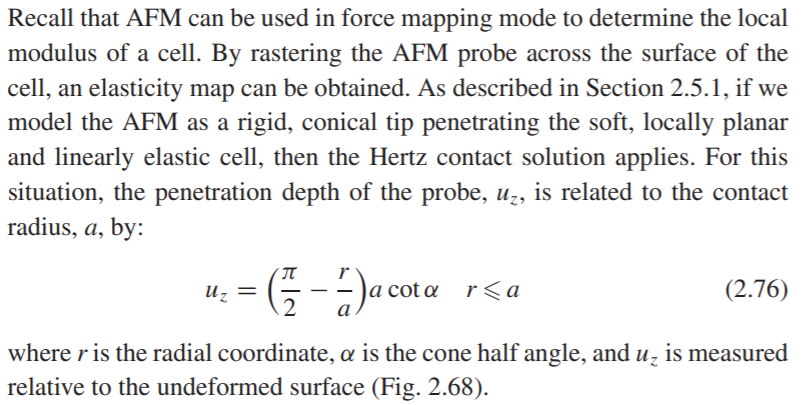 Recall that AFM can be used in force mapping mode to determine the local
modulus of a cell. By rastering the AFM probe across the surface of the
cell, an elasticity map can be obtained. As described in Section 2.5.1, if we
model the AFM as a rigid, conical tip penetrating the soft, locally planar
and linearly elastic cell, then the Hertz contact solution applies. For this
situation, the penetration depth of the probe, u., is related to the contact
radius, a, by:
u; = 3 — Za cota r
This is AI generated Response.
Asked by: gvr
Created at: 2025-07-23 21:39:31
Asked by: gvr
Created at: 2025-07-23 21:39:31
Final Answer:
Rendered
Raw Text
Did you like this answer?
Let's break down and **explain the equation given** step-by-step:
### **Given:**
The equation for the penetration depth \( u_z \) of an AFM probe with a conical tip is:
\[
u_z = \left(\frac{\pi}{2} - \frac{r}{a}\right)a \cot{\alpha} \qquad r \leq a
\]
where:
- \( r \) = radial coordinate (distance from the center of contact)
- \( a \) = contact radius
- \( \alpha \) = cone half-angle
- \( u_z \) = penetration depth (measured relative to the undeformed surface)
---
### **Step-by-Step Explanation:**
#### **1. Understanding the Terms**
- **AFM Probe as a Cone:** The AFM tip is approximated as a cone with half-angle \( \alpha \).
- **Contact Radius \( a \):** The radius of the area where the cone touches the sample.
- **Penetration Depth \( u_z \):** How far the probe tip pushes into the sample at any radial position \( r \), relative to the original surface.
#### **2. Interpreting the Formula**
The formula calculates how deep, at a given \( r \), the probe has penetrated:
- \( \frac{\pi}{2} \) is a constant term.
- \( \frac{r}{a} \) normalizes the radial position to the contact radius.
- \( a \cot{\alpha} \) scales the result by the geometry of the tip.
- The formula is valid **only within the contact radius** (\( r \leq a \)).
#### **3. Special Cases**
- **At the center (\( r = 0 \)):**
\[
u_z(0) = \left(\frac{\pi}{2} - 0\right)a \cot{\alpha} = \frac{\pi}{2} a \cot{\alpha}
\]
This is the maximum penetration depth.
- **At the edge (\( r = a \)):**
\[
u_z(a) = \left(\frac{\pi}{2} - 1\right)a \cot{\alpha}
\]
This gives the depth at the edge of the contact area.
---
### **Final Answer (Formula Boxed):**
\[
\boxed{
u_z = \left(\frac{\pi}{2} - \frac{r}{a}\right)a \cot{\alpha}, \qquad 0 \leq r \leq a
}
\]
---
### **Summary**
- **This equation tells you how deep the AFM probe tip indents the soft material as a function of distance from the center of contact (\( r \)), given the tip geometry (\( \alpha \)) and contact radius (\( a \)).**
- **Maximum indentation is at \( r = 0 \), and it decreases linearly with \( r \) until the edge of contact at \( r = a \).**
Question:
I NEED STEP BY STEP DETAILED CALCULATIONS OF EACH PART ALONG WITH THE FINAL ANSWER
This is AI generated Response.
Asked by: gvr
Created at: 2025-07-23 21:41:27
Asked by: gvr
Created at: 2025-07-23 21:41:27
Final Answer:
Rendered
Raw Text
Did you like this answer?
Certainly! Let's perform a detailed, step-by-step derivation and explanation of the given formula for the penetration depth \( u_z \) in the context of an AFM conical tip indenting a soft surface.
---
## **Step 1: Understanding the Physical Model**
- The AFM tip is modeled as a **rigid, conical** indenter characterized by a **half-angle** \( \alpha \).
- The **contact area** between the tip and the surface is approximately a **circle** with radius \( a \).
- The **penetration depth** \( u_z \) is the vertical displacement of the tip into the sample at a given radial position \( r \) within the contact area.
---
## **Step 2: Geometrical Relationship of the Cone**
- The **profile** of the cone's surface can be described by its **generatrix** (the sloped side):
\[
z(r) = r \tan{\alpha}
\]
where:
- \( z(r) \) is the height of the cone at radial distance \( r \),
- \( \alpha \) is the **half-angle** of the cone (the angle between the axis and the cone surface).
- The **vertical position** of the cone surface at a distance \( r \) from the tip is proportional to \( r \), scaled by \( \tan{\alpha} \).
---
## **Step 3: Connection to Penetration Depth \( u_z \)**
- The **penetration depth** \( u_z(r) \) at a given \( r \) is the **distance** from the undeformed surface to the **contact point** on the cone at position \( r \).
- When the cone indents the surface, the **initial undeformed surface** is at \( z = 0 \). The **deformed surface** is displaced downward by \( u_z(r) \).
- The **geometry** suggests that **at the contact boundary** (\( r = a \)), the **penetration depth** is:
\[
u_z(a) = a \cot{\alpha}
\]
because:
\[
z(a) = a \tan{\alpha} \Rightarrow \text{height of cone at } r=a
\]
but since the tip is penetrating into the surface, the **penetration** at the edge corresponds to this height.
---
## **Step 4: Deriving the Profile of Penetration \( u_z(r) \)**
- For any point within the contact area (\( 0 \leq r \leq a \)), the **penetration** at \( r \) is proportional to the **height difference** between the tip surface and the undeformed surface.
- The **key insight** is that the **penetration depth decreases linearly** from its maximum at the center (\( r = 0 \)) to zero at the contact boundary (\( r = a \)):
\[
u_z(r) = u_z(0) - \text{(some linear function of } r \text{)}
\]
- **At the center** (\( r=0 \)), the depth is maximum:
\[
u_z(0) = \text{height of the cone at } r=0
\]
Since \( z(r) = r \tan{\alpha} \), at \( r=0 \), \( z(0) = 0 \). However, in the Hertz contact model, the maximum penetration is related to the **geometric factor**:
\[
u_z(0) = \frac{\pi}{2} a \cot{\alpha}
\]
**Why?** Because the contact area isn't just a simple straight profile; Hertz theory introduces this factor to account for the elastic deformation and the geometry of contact.
---
## **Step 5: Expression for \( u_z(r) \)**
Based on the geometry and Hertz contact theory, the **penetration depth** at any \( r \) within the contact radius \( a \) is:
\[
u_z(r) = \left( \frac{\pi}{2} - \frac{r}{a} \right) a \cot{\alpha}
\]
which can be rewritten as:
\[
u_z(r) = \left(\frac{\pi}{2} a - r \right) \frac{\cot{\alpha}}{a} \times a
\]
or simply:
\[
u_z(r) = \left( \frac{\pi}{2} - \frac{r}{a} \right) a \cot{\alpha}
\]
---
## **Step 6: **Final Expression and Interpretation**
- The **penetration depth \( u_z \)** **decreases linearly** from its maximum value at the center (\( r=0 \)) to zero at the **contact edge** (\( r=a \)).
- **At \( r=0 \):**
\[
u_z(0) = \left( \frac{\pi}{2} - 0 \right) a \cot{\alpha} = \frac{\pi}{2} a \cot{\alpha}
\]
- **At \( r=a \):**
\[
u_z(a) = \left( \frac{\pi}{2} - 1 \right) a \cot{\alpha}
\]
---
## **## **Summary of the detailed derivation:**
\[
\boxed{
\textbf{Penetration depth at radial position } r \leq a: \quad u_z(r) = \left( \frac{\pi}{2} - \frac{r}{a} \right) a \cot{\alpha}
}
\]
---
## **Final notes:**
- This formula assumes the **elastic, linearly elastic** response of the surface, and the **Hertz contact model** for a conical indenter.
- It provides the **relation** between the **geometrical parameters** (\( a, \alpha \)) and the **local indentation** \( u_z(r) \).
- By rastering the AFM tip and measuring \( u_z \) at various \( r \), an **elastic modulus map** can be generated.
---
**I hope this detailed step-by-step explanation clarifies how the formula is derived and its physical significance!**
📢 Instructions:
- Ask anything relatd to above question only.
- For new Question goto :