 VIPSolutions
Give step-by-step solution with explanation and final answer:2) cosdrth sie 52h Te r———————— tonne the sm of he sri singh eof eft 0. Ql simat th or med in thissitin, ow mary tems eres oss hth um cst with 00007 155.4 [7,08 § 55 7 Feb rote he sof he srs
Question:
Give step-by-step solution with explanation and final answer: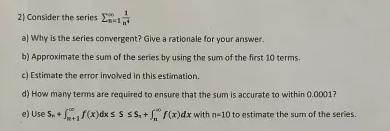 2) cosdrth sie 52h
Te r————————
tonne the sm of he sri singh eof eft 0.
Ql simat th or med in thissitin,
ow mary tems eres oss hth um cst with 00007
155.4 [7,08 § 55 7 Feb rote he sof he srs
This is AI generated Response.
Asked by: gvr
Created at: 2025-07-23 21:28:53
Asked by: gvr
Created at: 2025-07-23 21:28:53
Final Answer:
Rendered
Raw Text
Did you like this answer?
Let’s solve the problem step by step:
---
### Given Series
\[
\sum_{n=1}^\infty \frac{1}{n^2}
\]
---
### **a) Why is the series convergent? Give a rationale for your answer.**
This is a **p-series**: \(\sum_{n=1}^\infty \frac{1}{n^p}\).
- A p-series converges if \(p > 1\).
- Here, \(p = 2 > 1\).
- Therefore, the series converges **by the p-series test**.
**Rationale:**
For the p-series \(\sum_{n=1}^\infty \frac{1}{n^p}\), if \(p > 1\), the terms decrease fast enough for the series to converge.
---
### **b) Approximate the sum of the series by using the sum of the first 10 terms.**
Calculate:
\[
S_{10} = \sum_{n=1}^{10} \frac{1}{n^2}
\]
Let's compute each term:
- \(1/1^2 = 1\)
- \(1/2^2 = 0.25\)
- \(1/3^2 \approx 0.1111\)
- \(1/4^2 = 0.0625\)
- \(1/5^2 = 0.04\)
- \(1/6^2 \approx 0.0278\)
- \(1/7^2 \approx 0.0204\)
- \(1/8^2 = 0.015625\)
- \(1/9^2 \approx 0.0123457\)
- \(1/10^2 = 0.01\)
Sum:
\[
S_{10} \approx 1 + 0.25 + 0.1111 + 0.0625 + 0.04 + 0.0278 + 0.0204 + 0.015625 + 0.0123457 + 0.01 = 1.5497707
\]
So,
\[
\boxed{S_{10} \approx 1.5498}
\]
---
### **c) Estimate the error involved in this estimation.**
The error is the sum of the remaining terms:
\[
\text{Error} = \sum_{n=11}^\infty \frac{1}{n^2}
\]
A good estimate uses the **integral test remainder estimate**:
\[
\sum_{n=N+1}^\infty \frac{1}{n^2} < \int_{N}^{\infty} \frac{1}{x^2}dx = \left. -\frac{1}{x} \right|_{N}^{\infty} = \frac{1}{N}
\]
With \(N = 10\):
\[
\text{Error} < \frac{1}{10} = 0.1
\]
---
### **d) How many terms are required to ensure that the sum is accurate to within 0.0001?**
Set error \(< 0.0001\):
\[
\frac{1}{N} < 0.0001 \implies N > 10,000
\]
So, **at least 10,001 terms** are required.
---
### **e) Use \( S_n + \int_{n}^{\infty} f(x) dx \leq S \leq S_n + \int_{n+1}^{\infty} f(x) dx \) with \( n = 10 \) to estimate the sum.**
Here, \(f(x) = \frac{1}{x^2}\).
Calculate the integrals:
\[
\int_{10}^{\infty} \frac{1}{x^2} dx = \left. -\frac{1}{x} \right|_{10}^{\infty} = 0 - (-\frac{1}{10}) = 0.1
\]
\[
\int_{11}^{\infty} \frac{1}{x^2} dx = \frac{1}{11} \approx 0.09091
\]
So,
\[
S_{10} + 0.1 \leq S \leq S_{10} + 0.09091
\]
\[
1.5498 + 0.09091 \leq S \leq 1.5498 + 0.1
\]
\[
1.6407 \leq S \leq 1.6498
\]
---
## **Final Answers (Summary Table)**
| Part | Answer |
|------|--------|
| a) | The series converges by the p-series test since \(p = 2 > 1\). |
| b) | The sum of the first 10 terms: \(\boxed{1.5498}\) |
| c) | Error estimate using the integral: \(< 0.1\) |
| d) | At least \(10,001\) terms needed for accuracy within \(0.0001\) |
| e) | \(1.6407 \leq S \leq 1.6498\) |
**Note:** The exact sum of the series is \(\frac{\pi^2}{6} \approx 1.644934\).
📢 Instructions:
- Ask anything relatd to above question only.
- For new Question goto :