 VIPSolutions
Give step-by-step solution with explanation and final answer:-— Hi £5 \ [m] {res A 3 Sy c 3 2 £ 5 CA 1 5 E Ee 8 Z i: 2 3 g 3 < EH s H EF H - 3 2 { o; g Bi a EY be. he = 3 Ce Tl
Question:
Give step-by-step solution with explanation and final answer: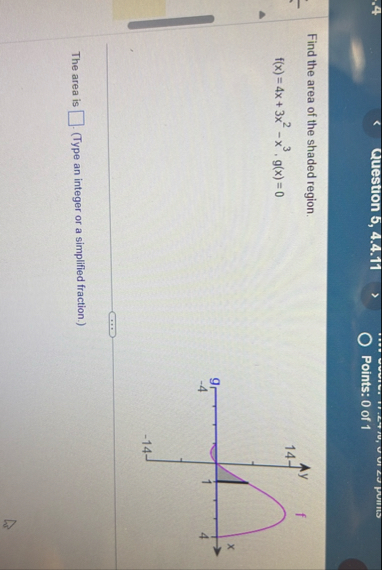 -—
Hi £5 \
[m] {res A
3 Sy c
3 2 £
5 CA 1 5
E Ee 8
Z i: 2
3 g 3
< EH s
H EF
H -
3 2
{ o;
g
Bi a
EY
be. he = 3
Ce Tl
This is AI generated Response.
Asked by: gvr
Created at: 2025-07-23 21:14:01
Asked by: gvr
Created at: 2025-07-23 21:14:01
Final Answer:
Rendered
Raw Text
Did you like this answer?
Let's solve the problem step by step.
### **Step 1: Understand the Problem**
You are given the function:
\[ f(x) = 4x^3 - 3x^2 - 8x \]
You are to find the area of the shaded region, which is the area between the curve and the x-axis (where \( f(x) \geq 0 \)).
---
### **Step 2: Find the Roots**
Set \( f(x) = 0 \):
\[ 4x^3 - 3x^2 - 8x = 0 \]
Factor out \( x \):
\[ x(4x^2 - 3x - 8) = 0 \]
So, one root is \( x = 0 \).
For the quadratic part:
\[ 4x^2 - 3x - 8 = 0 \]
Use the quadratic formula:
\[
x = \frac{-b \pm \sqrt{b^2 - 4ac}}{2a}
\]
where \( a = 4, b = -3, c = -8 \):
\[
x = \frac{3 \pm \sqrt{(-3)^2 - 4(4)(-8)}}{8}
= \frac{3 \pm \sqrt{9 + 128}}{8}
= \frac{3 \pm \sqrt{137}}{8}
\]
So, the roots are:
\[
x_1 = 0, \quad x_2 = \frac{3 + \sqrt{137}}{8}, \quad x_3 = \frac{3 - \sqrt{137}}{8}
\]
---
### **Step 3: Determine the Interval for the Shaded Region**
From the graph, the shaded region is between \( x = -1 \) and \( x = 2 \).
---
### **Step 4: Set Up the Integral**
The area is:
\[
\text{Area} = \int_{-1}^{2} |f(x)|\, dx
\]
From the graph, between \( x = -1 \) and \( x = 0 \), \( f(x) < 0 \), and between \( x = 0 \) and \( x = 2 \), \( f(x) > 0 \).
So,
\[
\text{Area} = -\int_{-1}^{0} f(x) dx + \int_{0}^{2} f(x) dx
\]
---
### **Step 5: Compute the Integrals**
#### **First, find the antiderivative:**
\[
\int f(x) dx = \int (4x^3 - 3x^2 - 8x) dx = x^4 - x^3 - 4x^2 + C
\]
#### **Calculate each part:**
**A. \(\int_{-1}^0 f(x) dx\):**
\[
F(x) = x^4 - x^3 - 4x^2
\]
\[
F(0) = 0^4 - 0^3 - 4 \cdot 0^2 = 0
\]
\[
F(-1) = (-1)^4 - (-1)^3 - 4 \cdot (-1)^2 = 1 + 1 - 4 = -2
\]
\[
\int_{-1}^0 f(x) dx = F(0) - F(-1) = 0 - (-2) = 2
\]
**B. \(\int_{0}^2 f(x) dx\):**
\[
F(2) = (2)^4 - (2)^3 - 4 \cdot (2)^2 = 16 - 8 - 16 = -8
\]
\[
F(0) = 0
\]
\[
\int_{0}^2 f(x) dx = F(2) - F(0) = -8 - 0 = -8
\]
---
### **Step 6: Find the Total Area**
\[
\text{Area} = -(2) + (-8) = 2 + 8 = 10
\]
---
### **Final Answer**
\[
\boxed{10}
\]
---
**Summary of Steps:**
1. Set up the function and roots.
2. Set up the integral with the correct signs.
3. Integrate and evaluate.
4. Add the absolute values to find the area.
**Final area = 10**.
Question:
4X+3X^2-X^3 THIS IS CORRECT EQUATION I NEED STEP BY STEP DETAILED CALCULATIONS OF EACH PART ALONG WITH THE FINAL ANSWER
This is AI generated Response.
Asked by: gvr
Created at: 2025-07-23 21:16:10
Asked by: gvr
Created at: 2025-07-23 21:16:10
Final Answer:
Rendered
Raw Text
Did you like this answer?
Let's analyze the given function and find the area between the curve and the x-axis step by step.
---
### **Given Function:**
\[
f(x) = 4x + 3x^2 - x^3
\]
---
### **Step 1: Find the roots of \(f(x) = 0\)**
Set \(f(x) = 0\):
\[
4x + 3x^2 - x^3 = 0
\]
Rewrite:
\[
-x^3 + 3x^2 + 4x = 0
\]
Factor out \(x\):
\[
x(-x^2 + 3x + 4) = 0
\]
So, one root is:
\[
x = 0
\]
Now, solve the quadratic:
\[
-x^2 + 3x + 4 = 0
\]
Multiply both sides by \(-1\) to make it standard:
\[
x^2 - 3x - 4 = 0
\]
Use quadratic formula:
\[
x = \frac{3 \pm \sqrt{(-3)^2 - 4 \cdot 1 \cdot (-4)}}{2 \cdot 1} = \frac{3 \pm \sqrt{9 + 16}}{2} = \frac{3 \pm \sqrt{25}}{2}
\]
\[
x = \frac{3 \pm 5}{2}
\]
Calculate both roots:
- When \(+\):
\[
x = \frac{3 + 5}{2} = \frac{8}{2} = 4
\]
- When \(-\):
\[
x = \frac{3 - 5}{2} = \frac{-2}{2} = -1
\]
**Roots are:**
\[
x = -1, \quad x = 0, \quad x = 4
\]
---
### **Step 2: Determine where \(f(x)\) is positive or negative**
To find the sign of \(f(x)\) in each interval, choose test points:
- For \(x < -1\), choose \(x = -2\):
\[
f(-2) = 4(-2) + 3(-2)^2 - (-2)^3 = -8 + 3(4) - (-8) = -8 + 12 + 8 = 12 > 0
\]
- For \(-1 < x < 0\), choose \(x = -0.5\):
\[
f(-0.5) = 4(-0.5) + 3(0.25) - (-0.5)^3 = -2 + 0.75 + 0.125 = -2 + 0.75 + 0.125 = -1.125 < 0
\]
- For \(0 < x < 4\), choose \(x=1\):
\[
f(1) = 4(1) + 3(1) - 1 = 4 + 3 - 1 = 6 > 0
\]
- For \(x > 4\), choose \(x=5\):
\[
f(5) = 4(5) + 3(25) - 125 = 20 + 75 - 125 = -30 < 0
\]
**Summary:**
- \(f(x) > 0\) on \((-\infty, -1)\) and \((0, 4)\)
- \(f(x) < 0\) on \((-1, 0)\) and \((4, \infty)\)
---
### **Step 3: Set up the integral for the area**
Suppose the shaded region is between \(x = -1\) and \(x=4\), where the curve crosses the x-axis at these roots.
The total area is:
\[
\text{Area} = \int_{-1}^{0} |f(x)| dx + \int_{0}^{4} |f(x)| dx
\]
Since \(f(x) < 0\) on \((-1, 0)\), the absolute value becomes \(-f(x)\).
And on \((0,4)\), \(f(x) > 0\), so the absolute value is just \(f(x)\).
Thus:
\[
\text{Area} = -\int_{-1}^{0} f(x) dx + \int_{0}^{4} f(x) dx
\]
---
### **Step 4: Find the antiderivative \(F(x)\)**
\[
f(x) = 4x + 3x^2 - x^3
\]
\[
F(x) = \int f(x) dx = \int (4x + 3x^2 - x^3) dx
\]
Compute term-by-term:
\[
F(x) = 2x^2 + x^3 - \frac{1}{4} x^4 + C
\]
---
### **Step 5: Evaluate the integrals**
**A. \(\int_{-1}^{0} f(x) dx\):**
\[
F(0) = 2(0)^2 + (0)^3 - \frac{1}{4} (0)^4 = 0
\]
\[
F(-1) = 2(-1)^2 + (-1)^3 - \frac{1}{4} (-1)^4 = 2(1) + (-1) - \frac{1}{4}(1) = 2 - 1 - \frac{1}{4} = 1 - \frac{1}{4} = \frac{3}{4}
\]
\[
\int_{-1}^{0} f(x) dx = F(0) - F(-1) = 0 - \frac{3}{4} = -\frac{3}{4}
\]
Since the integral is negative and we're taking the absolute value:
\[
\text{Contribution} = - \left( -\frac{3}{4} \right) = \frac{3}{4}
\]
**B. \(\int_{0}^{4} f(x) dx\):**
\[
F(4) = 2(4)^2 + (4)^3 - \frac{1}{4}(4)^4 = 2(16) + 64 - \frac{1}{4}(256)
= 32 + 64 - 64 = 32
\]
\[
F(0) = 0
\]
\[
\int_{0}^{4} f(x) dx = F(4) - F(0) = 32 - 0 = 32
\]
---
### **Step 6: Calculate the total area**
\[
\text{Total Area} = \frac{3}{4} + 32 = \frac{3}{4} + \frac{128}{4} = \frac{131}{4}
\]
### **Final Answer:**
\[
\boxed{\frac{131}{4}} \quad \text{or} \quad 32.75
\]
---
### **Summary:**
- Roots at \(x = -1, 0, 4\)
- Sign analysis shows where the function is positive or negative
- Set up the integral accordingly
- Calculate using the antiderivative \(F(x) = 2x^2 + x^3 - \frac{1}{4} x^4\)
- Final area = \(\boxed{\frac{131}{4}}\) or 32.75
Let me know if you'd like any further clarification!
📢 Instructions:
- Ask anything relatd to above question only.
- For new Question goto :