 VIPSolutions
Give step-by-step solution with explanation and final answer:The WKB equation for the tunneling probability T(E) through a potential U(x) is given by 22 P _ T(E) ~ exp [2 IA ee! w(@) = mii) - 8 ®) en where x5 are the turning points between which U(z) > E, kinetic energy is negative, and the decay constant (x) (i.e., imaginary part of wavevector k) is real. At the turning points, x = 0. (a) For a triangular barrier U(x) = Up (1 — /d) x ©(x), with ©(x) being the unit step function 1, z>0 oz) = 2) (=) { z
Question:
Give step-by-step solution with explanation and final answer: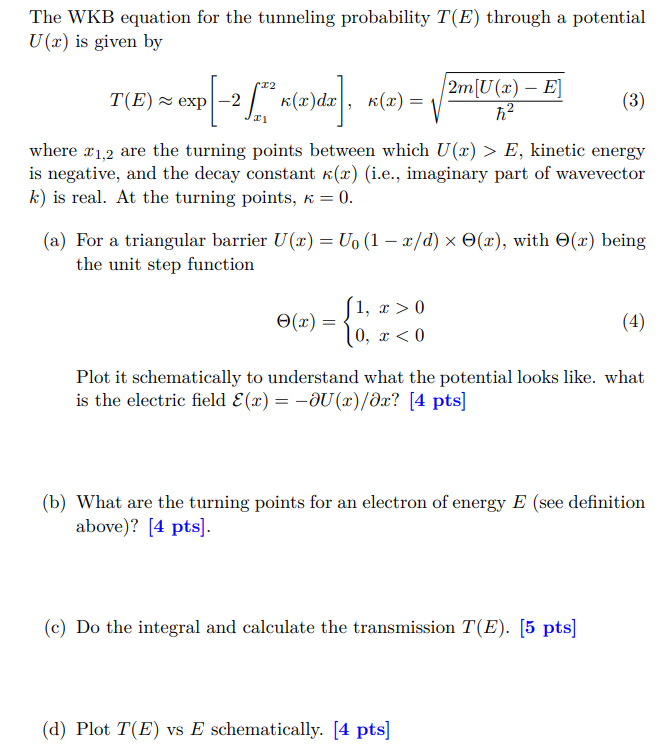
 The WKB equation for the tunneling probability T(E) through a potential
U(x) is given by
22 P _
T(E) ~ exp [2 IA ee! w(@) = mii) - 8 ®)
en
where x5 are the turning points between which U(z) > E, kinetic energy
is negative, and the decay constant (x) (i.e., imaginary part of wavevector
k) is real. At the turning points, x = 0.
(a) For a triangular barrier U(x) = Up (1 — /d) x ©(x), with ©(x) being
the unit step function
1, z>0
oz) = 2)
(=) { z
This is AI generated Response.
Asked by: gvr
Created at: 2025-07-23 18:35:15
Asked by: gvr
Created at: 2025-07-23 18:35:15
Final Answer:
Rendered
Raw Text
Did you like this answer?
Let's solve each part step by step:
---
### (a) **Triangular Barrier and Electric Field**
#### **Potential Plot and Expression**
Given:
\( U(x) = U_0 \left(1 - \frac{x}{d}\right)\Theta(x) \)
Where:
- \( U_0 \) = barrier height at \( x = 0 \)
- \( \Theta(x) \) = unit step function
\[
\Theta(x) =
\begin{cases}
1, & x > 0 \\
0, & x < 0
\end{cases}
\]
- For \( x < 0 \): \( U(x) = 0 \)
- For \( 0 \leq x \leq d \): \( U(x) = U_0 \left(1 - \frac{x}{d}\right) \) (linearly decreases)
- For \( x > d \): \( U(x) = 0 \)
**Schematic Plot:**
- At \( x=0 \), \( U = U_0 \).
- At \( x = d \), \( U = 0 \).
- For \( x < 0 \) or \( x > d \), \( U = 0 \).
- So, the potential is a triangle starting at \( U_0 \) at \( x=0 \) and going to zero at \( x=d \).
#### **Electric Field**
\[
\mathcal{E}(x) = -\frac{\partial U(x)}{\partial x}
\]
For \( 0 < x < d \):
\[
U(x) = U_0 \left(1 - \frac{x}{d}\right)
\implies \frac{\partial U}{\partial x} = -\frac{U_0}{d}
\]
So,
\[
\mathcal{E}(x) =
\begin{cases}
0, & x < 0 \text{ or } x > d \\
\frac{U_0}{d}, & 0 < x < d
\end{cases}
\]
---
### (b) **Turning Points**
Turning points: Where \( U(x) = E \).
\[
U(x) = U_0 \left(1 - \frac{x}{d}\right) = E
\]
Solve for \( x \):
\[
1 - \frac{x}{d} = \frac{E}{U_0} \implies \frac{x}{d} = 1 - \frac{E}{U_0} \implies x = d\left(1 - \frac{E}{U_0}\right)
\]
- For \( x < 0 \), \( U(x) = 0 < E \) (not a turning point for positive \( E \)).
- For \( x > d \), \( U(x) = 0 < E \).
- So, the only relevant turning point for \( E < U_0 \) is at \( x_1=0 \) and \( x_2 = d(1-E/U_0) \).
---
### (c) **Calculate \( T(E) \):**
\[
T(E) \approx \exp\left[-2 \int_{x_1}^{x_2} \kappa(x) dx \right]
\]
\[
\kappa(x) = \sqrt{\frac{2m[U(x) - E]}{\hbar^2}}
\]
For \( x_1 = 0 \), \( x_2 = d(1-E/U_0) \):
\[
U(x) - E = U_0 \left(1 - \frac{x}{d}\right) - E
= U_0 - U_0 \frac{x}{d} - E
= (U_0 - E) - U_0\frac{x}{d}
\]
So,
\[
\kappa(x) = \sqrt{\frac{2m}{\hbar^2} \left[(U_0 - E) - U_0 \frac{x}{d}\right]}
\]
Now, integrate:
Let \( a = U_0 - E \), \( b = U_0/d \)
\[
T(E) \approx \exp\left[-2 \int_0^{x_2} \sqrt{\frac{2m}{\hbar^2}(a - bx)} dx \right]
\]
Let \( y = a - bx \implies dx = -dy/b \).
When \( x = 0, y = a \), when \( x = x_2, y = E \).
\[
T(E) \approx \exp\left[-2 \int_{y=a}^{y=E} \sqrt{\frac{2m}{\hbar^2} y} \left(-\frac{1}{b}\right) dy \right]
\]
\[
= \exp\left[\frac{2}{b} \sqrt{\frac{2m}{\hbar^2}} \int_{E}^{a} \sqrt{y} dy \right]
\]
\[
= \exp\left[\frac{2}{b} \sqrt{\frac{2m}{\hbar^2}} \cdot \frac{2}{3} (a^{3/2} - E^{3/2}) \right]
\]
But \( a = U_0 - E \), \( b = U_0/d \):
\[
T(E) = \exp\left[ \frac{4d}{3U_0} \sqrt{\frac{2m}{\hbar^2}} \left((U_0 - E)^{3/2} - E^{3/2}\right) \right]
\]
But for \( E \ll U_0 \), ignore the \( E^{3/2} \) term:
\[
T(E) \approx \exp\left[ -\frac{4d}{3U_0} \sqrt{\frac{2m}{\hbar^2}} (U_0 - E)^{3/2} \right]
\]
---
### (d) **Plot \( T(E) \) vs \( E \) Schematic**
- \( T(E) \) is exponentially **small** for \( E \ll U_0 \).
- \( T(E) \) rises **rapidly** as \( E \to U_0 \).
- At \( E = U_0 \), \( T(E) \to 1 \).
- The plot is a sharply rising exponential curve.
---
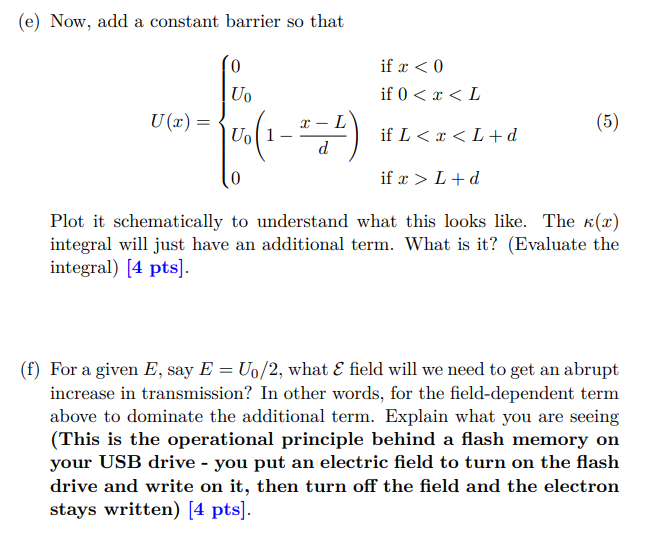
### (e) **Add Constant Barrier**
The potential is:
\[
U(x) =
\begin{cases}
0, & x < 0 \\
U_0, & 0 < x < L \\
U_0\left(1 - \frac{x-L}{d}\right), & L < x < L+d \\
0, & x > L+d
\end{cases}
\]
So, you have a flat barrier from \( 0 \) to \( L \), then a triangular barrier from \( L \) to \( L + d \).
**Schematic Plot**:
- \( 0 \leq x < L \): Flat at \( U_0 \).
- \( L \leq x \leq L + d \): Decreases linearly from \( U_0 \) to \( 0 \).
- Elsewhere: \( U = 0 \).
**\(\kappa(x)\) Integral**:
\[
\int_{x_1}^{x_2} \kappa(x) dx = \int_{0}^{L} \sqrt{\frac{2m}{\hbar^2}(U_0 - E)} dx + \int_{L}^{L+d} \sqrt{\frac{2m}{\hbar^2}(U_0(1-\frac{x-L}{d}) - E)} dx
\]
First term:
\[
\sqrt{\frac{2m}{\hbar^2}(U_0 - E)} \times L
\]
Second term: As before, but over \( x = L \) to \( L + d \):
Let \( y = x - L \):
\[
\int_{0}^{d} \sqrt{\frac{2m}{\hbar^2}(U_0(1 - \frac{y}{d}) - E)} dy
\]
Proceed as before.
---
### (f) **Critical Electric Field for Abrupt Transmission Change**
Set \( E = U_0 / 2 \).
We want the electric field \( \mathcal{E} \) such that the barrier is suppressed, i.e., the field term dominates the "flat" barrier (from part e).
The triangular part becomes "thin" enough that transmission jumps.
If \( \mathcal{E} = U_0/d \), the entire barrier can be suppressed for electrons with \( E = U_0/2 \).
This is the operational principle in flash memories:
- **Apply field:** Barrier lowers, electrons can tunnel (write).
- **Remove field:** Barrier increases, electrons are stuck (data stored).
---
## **Summary of Answers**
**(a)**
- **Plot:** Triangle from \( U_0 \) at \( x=0 \) to 0 at \( x=d \).
- **Field:** \( \mathcal{E}(x) = U_0/d \) for \( 0 < x < d \), zero elsewhere.
**(b)**
- **Turning points:** \( x_1 = 0 \), \( x_2 = d(1 - E/U_0) \).
**(c)**
\[
T(E) \approx \exp\left[ -\frac{4d}{3U_0} \sqrt{\frac{2m}{\hbar^2}} (U_0 - E)^{3/2} \right]
\]
**(d)**
- **Plot:** Exponentially small for \( E \ll U_0 \), rises sharply as \( E \to U_0 \).
**(e)**
- **Plot:** Flat barrier (\( U_0 \)), then triangle.
- **Integral:** Add \( L \sqrt{\frac{2m}{\hbar^2}(U_0 - E)} \) to earlier result.
**(f)**
- For \( E = U_0/2 \), need \( \mathcal{E} \approx U_0/d \) for abrupt transmission increase. This is the operational principle for flash memory.
---
**If you need specific plots or more details on one step, let me know!**
📢 Instructions:
- Ask anything relatd to above question only.
- For new Question goto :