 VIPSolutions
Give step-by-step solution with explanation and final answer:Find / Fd, where F = 3yi — 22] + (8y — 2z)k and C' is a fel circle of radius 7 in the plane z + y + z = 4, centered at (1,1,2) and oriented clockwise when viewed from the origin. NOTE: Enter exact answers, or round to three decimal places. / F. di = c
Question:
Give step-by-step solution with explanation and final answer: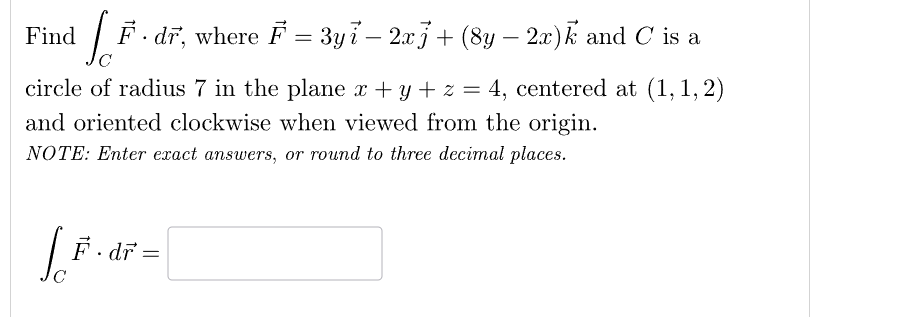 Find / Fd, where F = 3yi — 22] + (8y — 2z)k and C' is a
fel
circle of radius 7 in the plane z + y + z = 4, centered at (1,1,2)
and oriented clockwise when viewed from the origin.
NOTE: Enter exact answers, or round to three decimal places.
/ F. di =
c
This is AI generated Response.
Asked by: gvr
Created at: 2025-07-23 13:12:41
Asked by: gvr
Created at: 2025-07-23 13:12:41
Final Answer:
Rendered
Raw Text
Did you like this answer?
Let's solve the line integral step by step using **Stokes' Theorem**.
### 1. **Stokes' Theorem Statement**
\[
\int_C \vec{F} \cdot d\vec{r} = \iint_S (\nabla \times \vec{F}) \cdot d\vec{S}
\]
where \( S \) is any surface bounded by \( C \).
---
### 2. **Find \( \nabla \times \vec{F} \) ("the curl")**
Given:
\[
\vec{F} = 3y\vec{i} - 2x\vec{j} + (8y - 2x)\vec{k}
\]
Compute the curl:
\[
\nabla \times \vec{F} =
\begin{vmatrix}
\vec{i} & \vec{j} & \vec{k} \\
\partial_x & \partial_y & \partial_z \\
3y & -2x & 8y-2x
\end{vmatrix}
\]
Compute each component:
- **i-component**:
\[
\frac{\partial (8y-2x)}{\partial y} - \frac{\partial (-2x)}{\partial z} = 8 - 0 = 8
\]
- **j-component**:
\[
-\left( \frac{\partial (8y-2x)}{\partial x} - \frac{\partial (3y)}{\partial z} \right) = -(-2 - 0) = 2
\]
- **k-component**:
\[
\frac{\partial (-2x)}{\partial x} - \frac{\partial (3y)}{\partial y} = -2 - 3 = -5
\]
So,
\[
\nabla \times \vec{F} = 8\vec{i} + 2\vec{j} - 5\vec{k}
\]
---
### 3. **Find the Surface's Normal Vector and Area**
The plane is \( x + y + z = 4 \), so the normal vector is \( \vec{n}_0 = (1,1,1) \).
The magnitude of \( \vec{n}_0 \) is \( |\vec{n}_0| = \sqrt{1^2 + 1^2 + 1^2} = \sqrt{3} \).
The area of the circle in the plane is the projection onto the plane:
\[
A_{\text{plane}} = \pi r^2 = \pi \times 7^2 = 49\pi
\]
The "actual" surface area in the plane is \( \frac{A_{\text{plane}}}{|\vec{n}_0|} \), but since we're integrating a constant curl over the *flat* surface, we can use the projected area and dot with the unit normal.
---
### 4. **Set Up the Surface Integral**
The **unit normal** to the plane (pointing in the direction of increasing \( x + y + z \)) is:
\[
\vec{n} = \frac{1}{\sqrt{3}}(1,1,1)
\]
The surface integral becomes:
\[
\iint_S (\nabla \times \vec{F}) \cdot d\vec{S} = (\nabla \times \vec{F}) \cdot \vec{n} \cdot \text{Area}
\]
---
### 5. **Dot Product**
\[
(\nabla \times \vec{F}) \cdot \vec{n} = (8,2,-5) \cdot \frac{1}{\sqrt{3}}(1,1,1) = \frac{1}{\sqrt{3}}(8 + 2 - 5) = \frac{1}{\sqrt{3}}(5)
\]
---
### 6. **Check the Orientation**
The curve is oriented **clockwise as seen from the origin**. The Stokes' theorem uses the right-hand rule, which means that if the surface normal points away from the origin, the orientation is positive. Since the plane \( x+y+z=4 \) with center at \( (1,1,2) \) and the normal vector \( (1,1,1) \) (which points away from the origin), the orientation matches. But the problem says "clockwise as seen from the origin," so we need to **reverse the sign** of the integral.
---
### 7. **Final Calculation**
So, the integral is:
\[
\int_C \vec{F} \cdot d\vec{r} = -\left[ (\nabla \times \vec{F}) \cdot \vec{n} \right] \cdot (\text{Area})
\]
\[
= -\left( \frac{5}{\sqrt{3}} \right) \cdot (49\pi)
\]
\[
= -\frac{245\pi}{\sqrt{3}}
\]
---
### 8. **Numerical Value**
\[
\frac{245\pi}{\sqrt{3}} \approx \frac{245 \times 3.14159}{1.73205} \approx \frac{769.690}{1.73205} \approx 444.221
\]
So,
\[
\boxed{-444.221}
\]
---
### **Final Answer**
\[
\boxed{
\int_C \vec{F} \cdot d\vec{r} = -\frac{245\pi}{\sqrt{3}} \approx -444.221
}
\]
📢 Instructions:
- Ask anything relatd to above question only.
- For new Question goto :