 VIPSolutions
Give step-by-step solution with explanation and final answer:Cov seg [ih | hb TERN VAR ama we fierce eA me i eb he pn | 28 mmm Tops HHA \ iii AA NN 7 il he mig ica. Be, pe rs ASSES mm To fe ea SSE JP Te
Question:
Give step-by-step solution with explanation and final answer: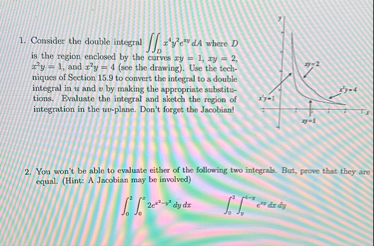 Cov seg [ih |
hb TERN
VAR ama we
fierce eA me
i eb he pn | 28
mmm Tops
HHA \
iii AA NN
7 il he mig ica. Be, pe
rs ASSES
mm To fe ea
SSE
JP Te
This is AI generated Response.
Asked by: gvr
Created at: 2025-07-23 10:18:46
Asked by: gvr
Created at: 2025-07-23 10:18:46
Final Answer:
Rendered
Raw Text
Did you like this answer?
Let's solve **Problem 1** step by step:
### **Step 1: Understanding the Region \( D \)**
Given curves:
- \( xy = 1 \)
- \( xy = 2 \)
- \( x^2y = 1 \)
- \( x^2y = 4 \)
These curves bound the region \( D \).
### **Step 2: Substitution**
Let’s define:
- \( u = xy \) (so \( u \) goes from 1 to 2)
- \( v = x^2y \) (so \( v \) goes from 1 to 4)
Now, solve for \( x \) and \( y \) in terms of \( u \) and \( v \):
From \( v = x^2y \) and \( u = xy \):
- \( v = x \cdot (xy) = x \cdot u \implies x = v/u \)
- \( y = u/x = u/(v/u) = u^2/v \)
So,
- \( x = v/u \)
- \( y = u^2/v \)
### **Step 3: Find the Jacobian**
The Jacobian determinant is:
\[
J = \left| \frac{\partial(x, y)}{\partial(u, v)} \right|
\]
Let's compute:
- \( x = v/u \)
- \( y = u^2/v \)
So,
\[
\frac{\partial x}{\partial u} = -\frac{v}{u^2}, \quad \frac{\partial x}{\partial v} = \frac{1}{u}
\]
\[
\frac{\partial y}{\partial u} = \frac{2u}{v}, \quad \frac{\partial y}{\partial v} = -\frac{u^2}{v^2}
\]
So the Jacobian is:
\[
J =
\begin{vmatrix}
-\frac{v}{u^2} & \frac{1}{u} \\
\frac{2u}{v} & -\frac{u^2}{v^2} \\
\end{vmatrix}
= \left(-\frac{v}{u^2}\right)\left(-\frac{u^2}{v^2}\right) - \left(\frac{1}{u}\right)\left(\frac{2u}{v}\right)
\]
\[
= \frac{v}{u^2} \cdot \frac{u^2}{v^2} - \frac{2u}{uv}
= \frac{1}{v} - \frac{2}{v}
= -\frac{1}{v}
\]
Take the absolute value (since areas are positive):
\[
|J| = \frac{1}{v}
\]
### **Step 4: Change the Integral**
Original integral:
\[
\iint_D x^2 y^2 \, dA
\]
Express \( x^2 y^2 \) in terms of \( u \) and \( v \):
- \( x^2 y^2 = (xy)^2 = u^2 \)
So the integral becomes:
\[
\int_{u=1}^{2} \int_{v=1}^{4} u^2 \cdot \frac{1}{v} \, dv \, du
\]
### **Step 5: Evaluate the Integral**
First, integrate with respect to \( v \):
\[
\int_{v=1}^{4} \frac{1}{v} dv = \ln v \Big|_{1}^{4} = \ln 4 - \ln 1 = \ln 4
\]
Now, integrate with respect to \( u \):
\[
\int_{u=1}^{2} u^2 \, du = \left[ \frac{u^3}{3} \right]_{1}^{2} = \frac{8}{3} - \frac{1}{3} = \frac{7}{3}
\]
So, the total integral is:
\[
\left(\frac{7}{3}\right) \ln 4
\]
### **Step 6: Final Answer**
\[
\boxed{
\iint_D x^2 y^2 \, dA = \frac{7}{3} \ln 4
}
\]
---
#### **Region in the \( u, v \)-plane:**
- \( 1 \leq u \leq 2 \)
- \( 1 \leq v \leq 4 \)
---
If you need the region sketch or help with Problem 2, let me know!
📢 Instructions:
- Ask anything relatd to above question only.
- For new Question goto :